
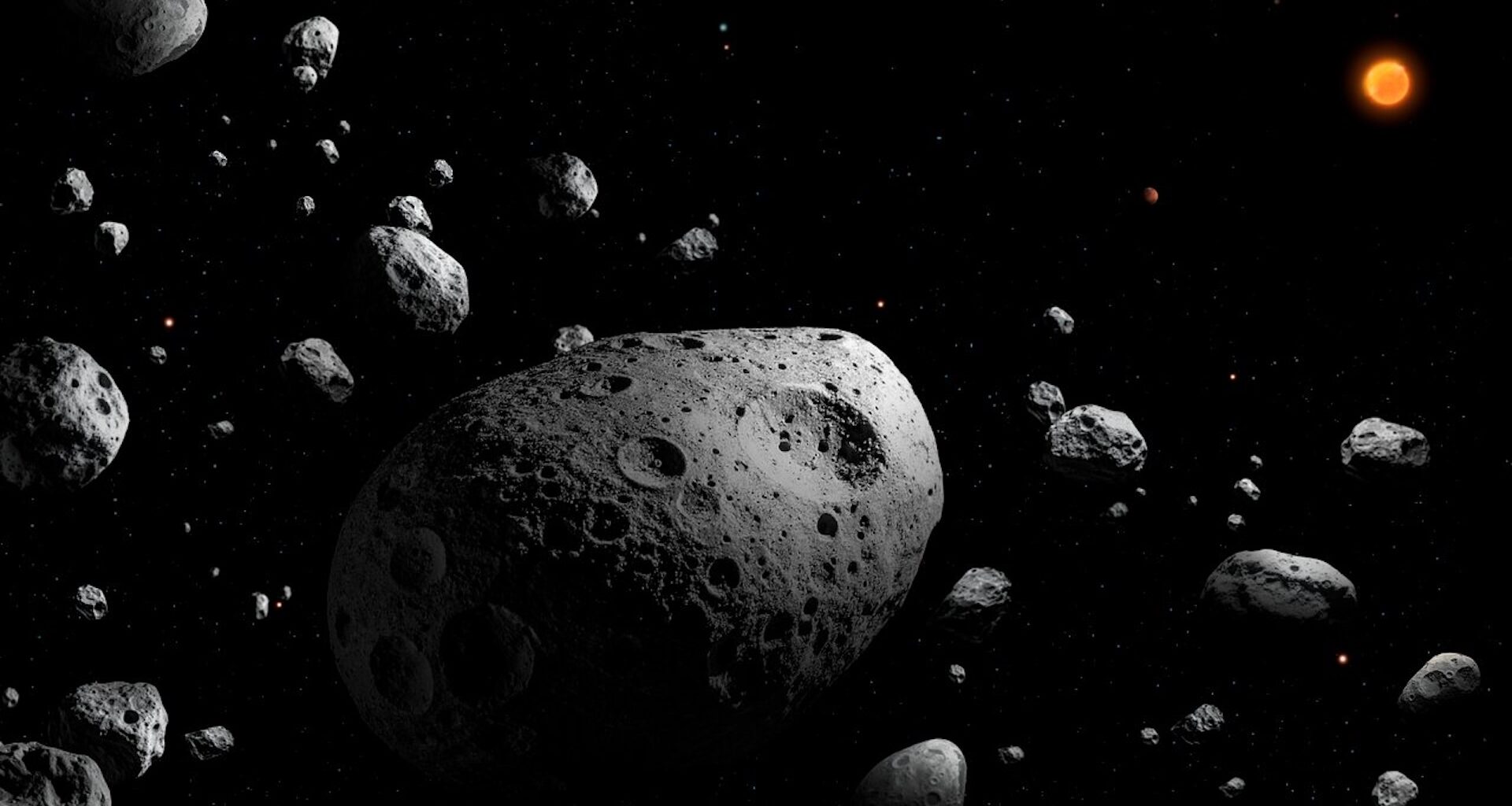
The Vera C. Rubin Observatory has observed a record-breaking ultra-fast-rotating asteroid. The space rock is the fastest-spinning asteroid larger than 500 meters (0.3 miles) to have ever been observed.
The asteroid, designated 2025 MN45, completes a full rotation every 1.88 minutes. Announced at the NSF–DOE Vera C. Rubin Observatory First Look event in June 2025, it was one of 1,900 new asteroids recently discovered by the observatory, 19 of which were super- and ultra-fast-rotating space rocks.
2025 MN45: An ‘exceptionally fast-rotating asteroid’
A study on the new asteroids was led by Sarah Greenstreet, NSF NOIRLab assistant astronomer and lead of Rubin Observatory’s Solar System Science Collaboration’s Near-Earth Objects and Interstellar Objects working group. The team presented their results in a new paper in The Astrophysical Journal Letters.
For the study, the team collected data over the course of roughly 10 hours across seven nights in April and May of last year. This was during the Rubin Observatory’s early commissioning phase. According to a press statement, the paper is the first peer-reviewed scientific paper to use data from the largest digital camera in the world—the Rubin Observatory’s LSST Camera.
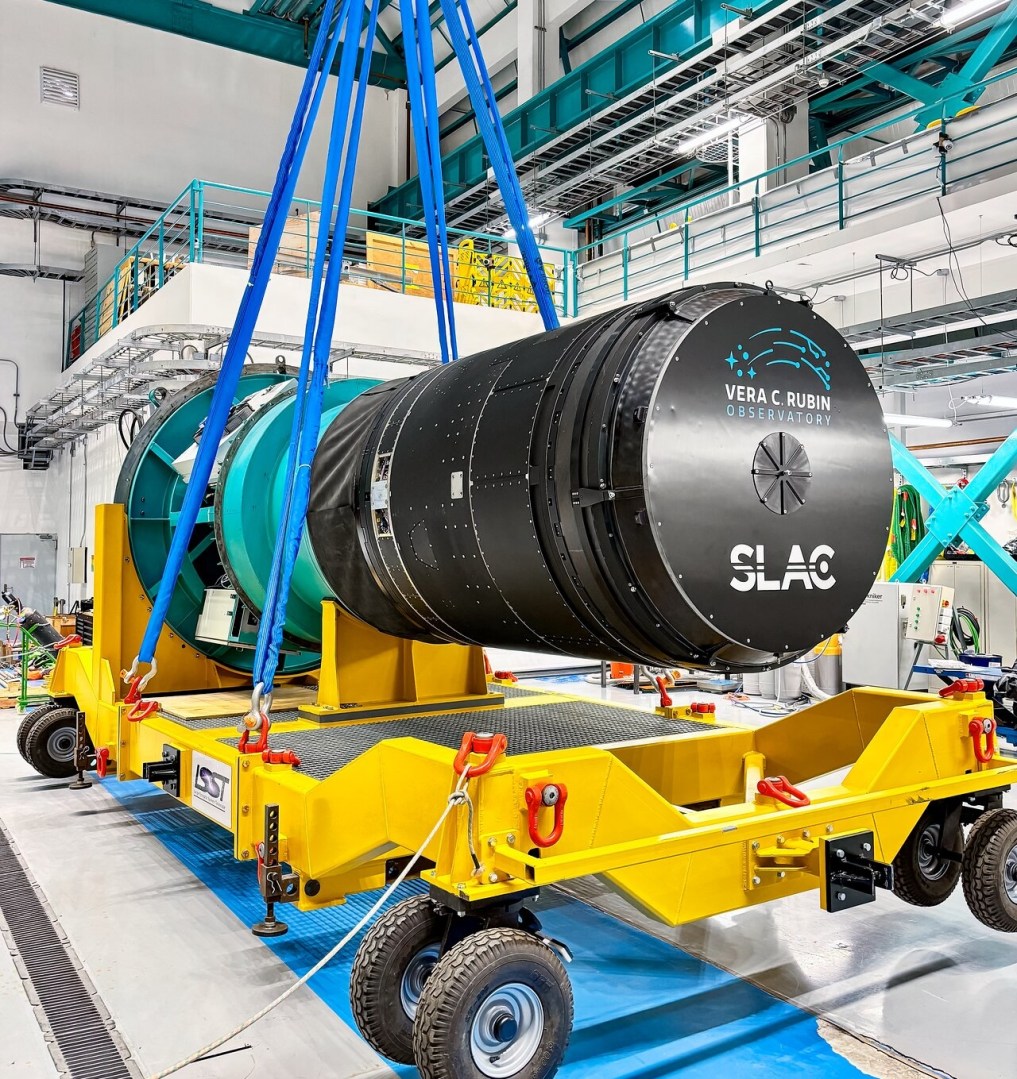 The LSST camera during installation in March, 2025. Source: Rubin Observatory / NOIRLab / SLAC
LSST is a car-sized, 3,200-megapixel digital camera that was mounted onto the observatory in March, 2025. It features an 8.4-meter primary/tertiary mirror and a 3.5-meter secondary mirror, and weighs over 3,000 kg.
“The Department of Energy’s investment in Rubin Observatory’s cutting-edge technology, particularly the LSST Camera, is proving invaluable,” said Regina Rameika, the DOE Associate Director for High Energy Physics. “Discoveries like this exceptionally fast-rotating asteroid are a direct result of the observatory’s unique capability to provide high-resolution, time-domain astronomical data, pushing the boundaries of what was previously observable.”
What spinning space rocks can tell us
Spinning space rocks can provide insight into the early formation of our solar system. An asteroid may be spinning quickly due to a collision with another space rock. It could be a hint that it was once part of a larger object that fragmented into smaller pieces.
Scientists can also glean information about the formation and composition of asteroids from their spin rate. If an asteroid is spinning at an incredibly fast rate, it must be made from a strong material for it not to break into pieces.
The asteroid 2025 MN45 is 710 meters (0.4 miles) in diameter. The main-belt asteroid rotates once every 1.88 minutes, making it the fastest-spinning asteroid with a diameter over 500 meters ever observed.
“Clearly, this asteroid must be made of material that has very high strength in order to keep it in one piece as it spins so rapidly,” Greenstreet explained. “We calculate that it would need a cohesive strength similar to that of solid rock. This is somewhat surprising since most asteroids are believed to be what we call ‘rubble pile’ asteroids, which means they are made of many, many small pieces of rock and debris that coalesced under gravity during Solar System formation or subsequent collisions.”
What the future holds for the Rubin Observatory
The new asteroid observations give a taste of what is to come in the near future. The Vera C. Rubin Observatory’s Legacy Survey of Space and Time (LSST) mission is set to start in the coming months. It will repeatedly scan the Southern Hemisphere night sky over the course of 10 years. In doing so, it will create an ultra-wide, ultra-high-definition time-lapse record of the Universe.
“NSF–DOE Rubin Observatory will find things that no one even knew to look for,” Luca Rizzi, an NSF program director for research infrastructure, explained in the press statement. “When Rubin’s Legacy Survey of Space and Time begins, this huge spinning asteroid will be joined by an avalanche of new information about our Universe, captured nightly.”
“The ability to find thousands of new asteroids in such a short period of time, and learn so much about them, is a window into what will be uncovered during the 10-year survey,” added Aaron Roodman, Deputy Head of LSST and professor of Particle Physics and Astrophysics at SLAC.
Chris Young is a journalist, copywriter, blogger and tech geek at heart who’s reported on the likes of the Mobile World Congress, written for Lifehack, The Culture Trip, Flydoscope and some of the world’s biggest tech companies, including NEC and Thales, about robots, satellites and other world-changing innovations.