
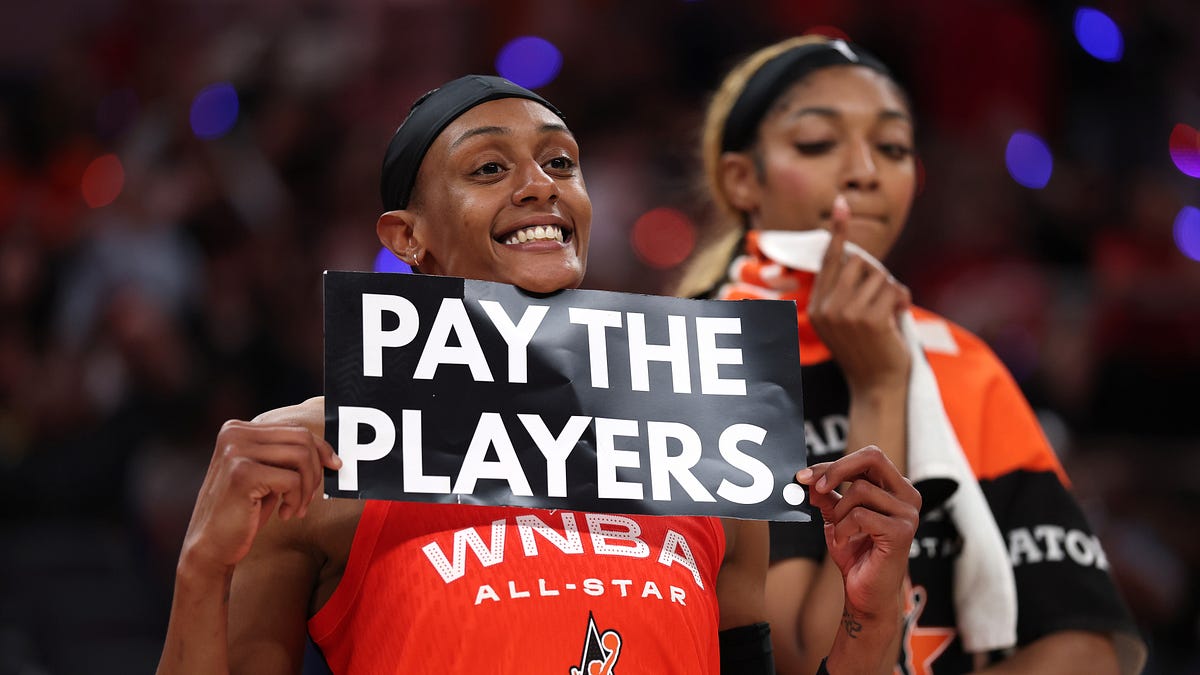
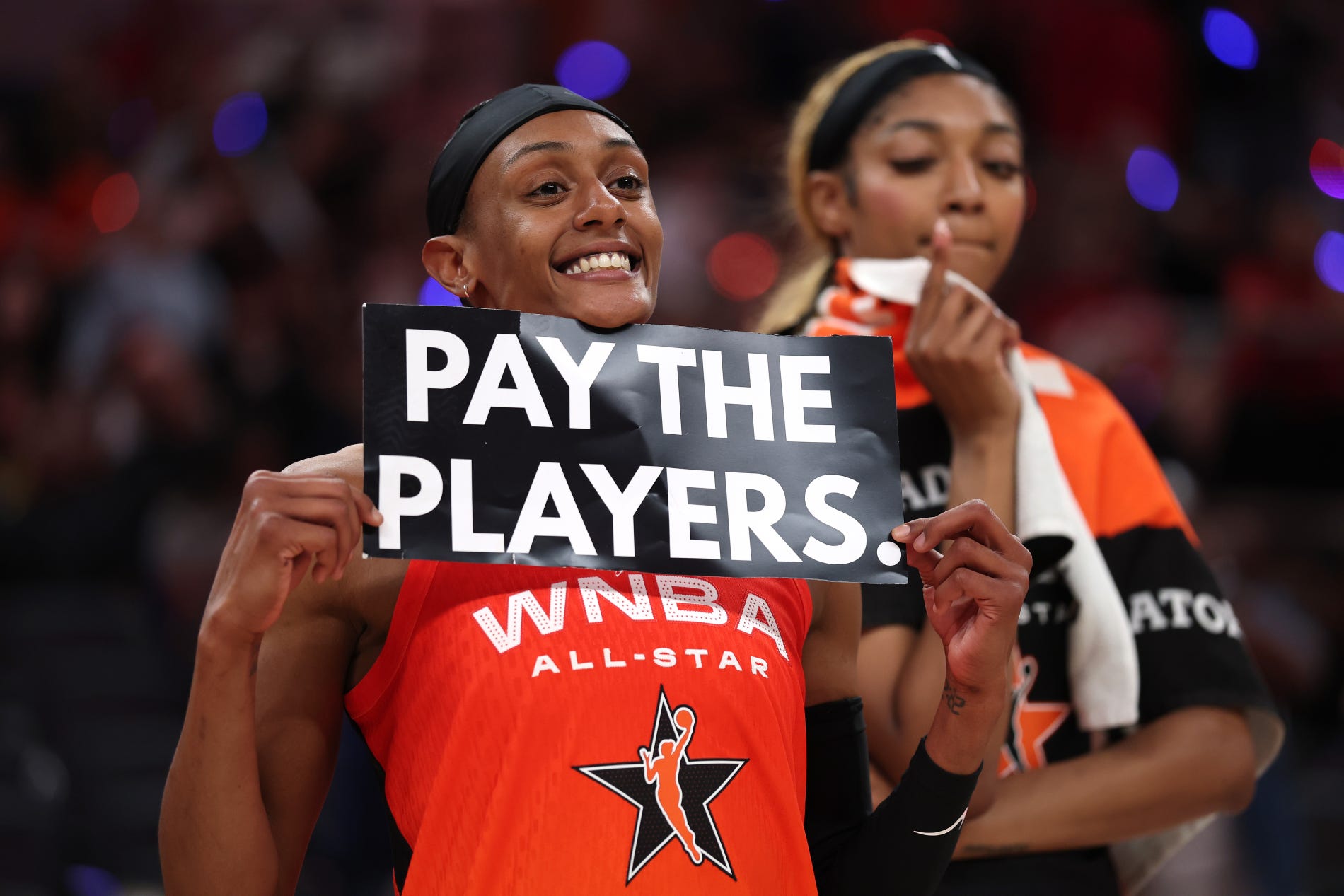
 Brittney Sykes of the Washington Mystics holds a “Pay the Players” sign following the 2025 AT&T WNBA All-Star Game at Gainbridge Fieldhouse on July 19, 2025. (Steph Chambers/Getty Images)
(Note: I’d love your feedback! Fill out this short survey to help shape the future of the Substack.)

Coming out of an All-Star weekend in which the WNBA’s biggest stars wore “Pay Us What You Owe Us” shirts in warm-ups, the league’s collective bargaining agreement negotiations seem to be on everyone’s minds.
The players themselves are talking about it — “We look forward to negotiating our fair share and our value,” WNBPA president Nneka Ogwumike said. The media is talking about it — drawing comparisons to the U.S. Women’s Soccer Team’s successful fight for equal pay earlier in the decade. Even Barstool founder Dave Portnoy, nobody’s idea of a social-justice warrior, says that anyone who doesn’t think WNBA players deserve more money is a “moron”. (I agree!)
One of the most fascinating aspects of this CBA negotiation between league owners (as represented by commissioner Cathy Engelbert) and the players’ association revolves around not just revenue splitting — which is obviously a contentious issue, to be clear — but also around who gets a piece of the growing pie in terms of how the WNBA’s future value as an asset is perceived.
The league’s revenue has certainly grown by leaps and bounds in recent seasons. According to Bloomberg, total WNBA revenue increased from $102 million in 2019 to roughly $190 million in 2023 — an average annual growth rate of 17 percent — and worldwide women’s pro hoops revenue was projected to leap again by a whopping 45 percent from 2024 to 2025. Relatedly, league media rights fees are set to rise from $57 million this season to at least $200 million — a 251 percent increase! — next season, as part of a new broadcast deal signed in conjunction with the NBA. And per-game attendance is the highest it’s ever been, according to Across The Timeline:
So negotiating a greater share of that increasing revenue is important. But the even greater area of growth for WNBA teams has been in their valuations, which exploded by 180 percent just since last year and possibly as much as 82 percent annually each year since 2021. Likewise, the league’s $250 million expansion fee for the new crop of teams joining the WNBA in Cleveland, Detroit, and Philadelphia is a 124 percent annualized increase over what the Golden State Valkyries paid ($50 million) in 2023. These increases in valuation, implied or estimated, are even greater than increases in short-term league revenue projections, which is why the players are even more miffed about the frictions in their negotiations — and why they talk about wanting a piece of the league’s asset growth, not just its revenue growth (as the traditional sports-league model has long held).
“It’s interesting that there’s a $250 million expansion fee, and there’s no openness to have that be reflected in revenue share that goes to the players, especially as we’re experiencing growth,” Ogwumike said to the Associated Press before the All-Star festivities in Indianapolis. “It doesn’t make a lot of sense to me, but we’re hoping we can get some clarity on that in Indiana.”
It’s no secret that tying your economic future to rising asset prices rather than actual production or revenues is a smart idea in modern America. Using data from the St. Louis Fed, here’s a plot of yearly nominal values for the S&P 500 (as a stand-in for broad asset-price appreciation), U.S. gross domestic product, median home prices and median household incomes, indexed such that all rated as 100 in 1984:
We can see that asset values — particularly in capital markets like the S&P — have dramatically outpaced both wages and even economic output itself over the past four decades. In other words, working for a living doesn’t build wealth — owning assets does. That trend is also true in sports franchise ownership, where Sportico’s Eben Novy-Williams reported a 7.3x average value-to-revenue multiple for WNBA teams, which is higher than men’s leagues in MLB (6.7x) and the NHL (6.2x), though lower than the NBA (11x!) or NFL (9.3x):

It’s not that these leagues aren’t making money — they’re making a lot of it. But their revenue growth still lags the amount people are willing to spend to buy the teams as an asset (whether to invest for a future sale, or simply to appreciate like art).
This might reflect irrational exuberance on the part of rich folks who are anxious to join an exclusive and prestigious club, or it might actually represent accurate revenue expectations for the league in the future. But from the current players’ perspective, there’s no real distinction to be made there.
Either a future generation of WNBA players will get a cut of the higher revenue the league is laying the groundwork for now — which is nice for them, but does nothing for current stars — or the players are putting in the labor to drive up the value of somebody else’s asset, beyond even the revenue they generate.
That’s why the players seem to increasingly be rethinking the entire economic model of major sports leagues. As Sportico’s Kurt Badenhausen points out here, players being able to get in on rising expansion fees (to say nothing of franchise valuations) would be exceedingly rare in modern pro sports. And some of that is due to the complicated nature of WNBA stakeholder structures, with money getting split between a web of investors that includes the NBA itself.
(This is part of why Friend of the Substack Ethan Strauss says nobody knows how much to pay WNBA players — because nobody really knows where the NBA ends and the WNBA begins.)
But it’s also rare because things are written into the various CBAs that way for a reason. And as much as revenues have risen in the television era of major sports, with absurd rights fees spiraling ever upward even in the face of widespread doubts, franchise valuations have risen even more. Ted Leonsis bought the Washington Mystics for $10 million in 2005, an investment that has increased in value more than twenty fold in the years since — or 4.2 times as much as if Leonsis had dropped that money in the S&P instead. Owners have been much more willing to dangle the promise of immediate, revenue-based payouts in front of players, as long as they don’t ask for real equity in the leagues they’re helping to grow.
Will the WNBA change that? It’s tough to say, but this league has a particularly stark split between current revenue — and perhaps especially profit — and the lofty expectations of future growth and returns implied by those rapidly rising franchise valuations and expansion fees. This, in turn, might make the W a perfect proving ground for new ideas around how players should get paid, and whether increasing the perceived asset value of a league for owners tomorrow ought to be rewarded with increased salaries today.
Because if the WNBA is growing like a unicorn startup with a high P/E ratio, it makes sense that its players want to stop being paid like they work for a tiny nonprofit.
Filed under: WNBA