
Sign up for the Slatest to get the most insightful analysis, criticism, and advice out there, delivered to your inbox daily.
A decade ago, when we imagined the horrors of living in a world fractured into different realities, we pictured something technologically dystopian. Experts warned that the time would come when we, as a public, would no longer be able to tell what’s real and what’s not. We would be fed snippets meant to inflame our anger and disgust. There would be candidate sex tapes and footage of crimes committed by racial minorities and leaked audio files with politicians saying horrible things—all fabrications. We would live in a swirl of anguished mass confusion.
But now that that technology is here, it’s finally time to admit it wasn’t ever necessary. At least not to destroy our own shared reality. For that, we just need partisan loyalties.
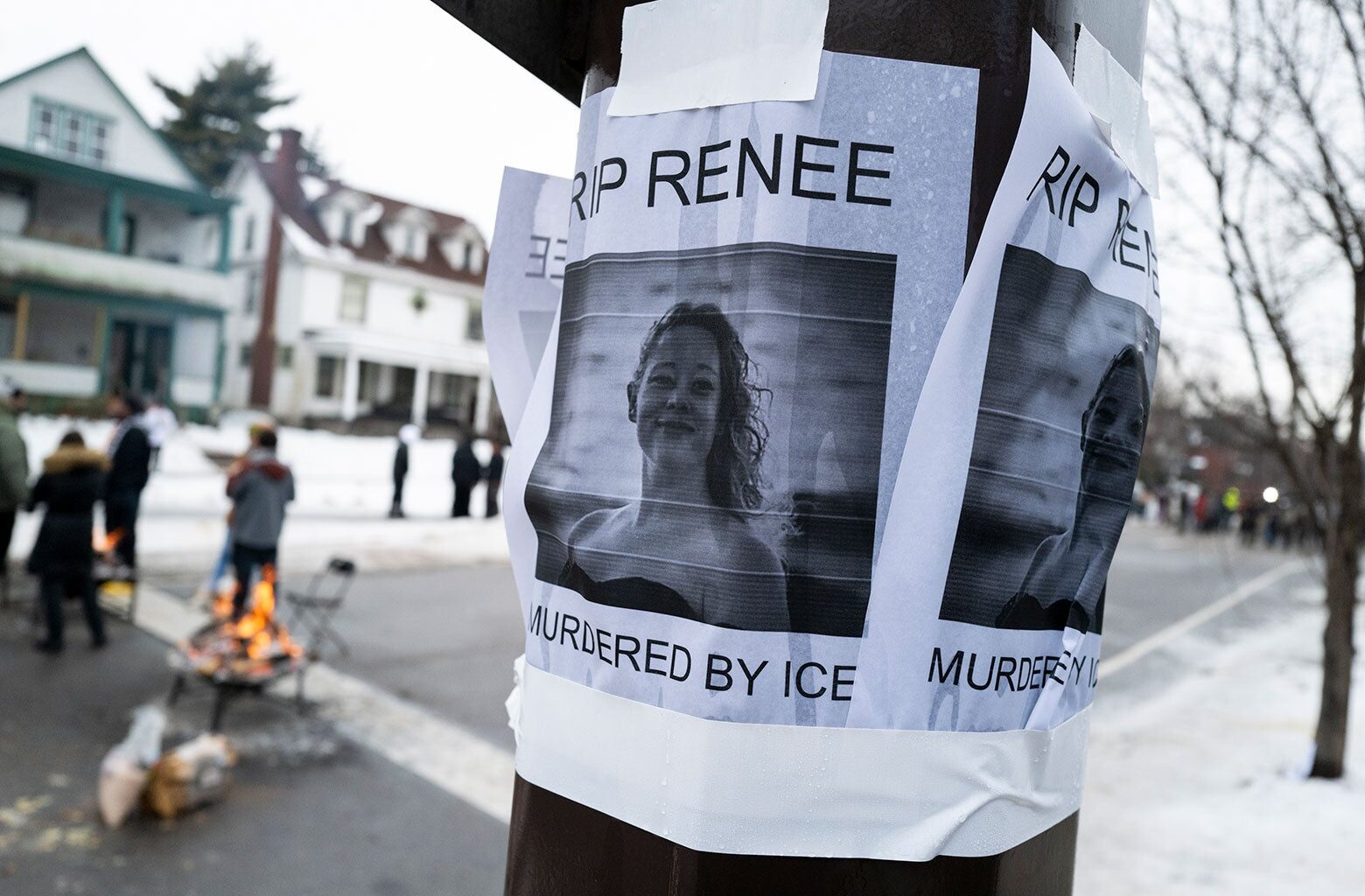
On Wednesday, when an Immigration and Customs Enforcement agent shot and killed a woman in her car in Minneapolis, the casual and disproportionate violence seemed indisputable: no angle showed Renee Good, the driver, gunning for the ICE agent. The most charitable defense of the agent was that he was jumpy and reacted out of fear when the car started moving near his foot; it was harder to defend him shooting at the window after Good had already cleared him. But immediately, people with partisan and commercial interests in defending ICE declared that the video showed Good was trying to kill the ICE agent. Department of Homeland Security Secretary Kristi Noem called it “domestic terrorism.” Official government statements cited a “ramming” event. President Trump wrote on social media that the car’s driver “violently, willfully, and viciously ran over the ICE Officer, who seems to have shot her in self defense. Based on the attached clip, it is hard to believe he is alive, but is now recovering in the hospital.” If you watch the videos, the ICE agent not only appears to have escaped unscathed, he also calmly holsters his gun and walks toward the car after the shooting.
And if social media is any indication—and it must be, as it remains one of the key places where large parts of the population take their cues on how to digest political news—the right has agreed to this interpretation. It needed no fake evidence; it only needed an assertion from authorities in the movement that there was a way to process what they were seeing without challenging their narratives. A simple answer that showed how, if you just thought about things the right way, you could ignore your lying eyes.
Yes, when the videos first emerged, there was some small amount of accompanying A.I.-driven disinformation. Some internet users shared A.I.-produced efforts to “unmask” the ICE agent who killed her, and others shared A.I.-generated photos of Good in conversation with the ICE agent. (Ultimately, A.I.’s biggest influence on this story was for provocation: An anonymous internet user asked an A.I. chatbot to reimagine her corpse in a bikini.)
But for the most part, the discussions surrounding the incident started from the authentic bystander videos, all of which clearly showed Good being shot as she was driving away from the officers. Trump and his allies didn’t need fraudulent evidence; they only needed to lie to themselves about what the video showed. The real video was enough for that.
As a result of all this, instead of mourning a tragedy, we’re stuck in a debate between two entirely different translations of the same material. This matters not just because it warps truth and dishonors Good’s memory but because it makes improving the world impossible. The first step to coming together to address a problem—a failure in training or protocol; a too-casual use of deadly force; a culture of hostility toward the public; or the charged situation itself, the result of a city under siege—is agreeing there is a problem. Right now, the mechanism for agreeing on that starting point is broken.
In the Horrifying New Video Filmed by Renee Good’s Killer, Her Real “Crime” Is Clear
This Content is Available for Slate Plus members only
ICE’s Killing of Renee Good Is Part of a Bigger Project
And when everything is subjective, nobody ever has to be accountable. That’s particularly true in the killing of Renee Good. But it’s also true with another event that unfolded this week: the ongoing rewriting of the events of Jan. 6, 2021, and the state-funded efforts to recast it as a patriotic response to a stolen election. The insurrectionists have received pardons and are asking for reparations; they no longer have to worry about accountability.
It has become clear that the insistence on polarized realities poses deeply existential threats. Threats to democracy, as with the notion that you can simply declare your election won. Threats to public safety, as with the refusal to acknowledge millions dead from a global pandemic. Threats to the planet, as with the refusal to recognize climate science. On a more intimate scale, it’s also just exhausting. It’s exhausting to be told you didn’t see what you saw; that you are lying; that you are acting on corrupt motivation, rather than pain in witnessing a human life snuffed out so casually. It’s exhausting to try to extend compassion and to be told that doing so is an inherently partisan activity.

Susan Matthews
Yes, You Should Watch the Video of the ICE Shooting in Minneapolis
Read More
The left is not immune to this. Liberals watched as a flailing President Biden crowed that we “finally beat Medicare” in a debate, and many still insisted he was fit for office. There had been appearances that showed his mental deterioration before that, and there would be others afterward. And yet they shook off what they could plainly see.
Still, Trump is in power, he has torn down all political norms, and his party bears far more responsibility for where we are today. But as long as everyone is willing to do this, to ignore what is right in front of us in order to arm ourselves for conversations to be won or lost, the dynamics will never change: Nothing is ever real, or not real. It’s always gray, always partisan.
Artificial intelligence will undoubtedly make all of this worse. But we won’t have to wait for that dark moment when it subsumes our reality; we’re already all too willing to alter reality in our own minds.

Sign up for Slate’s evening newsletter.