
By Scott Dochterman, David Ubben and Grace Raynor
The Indiana Hoosiers are one win from turning an impossible dream into an indestructible reality.
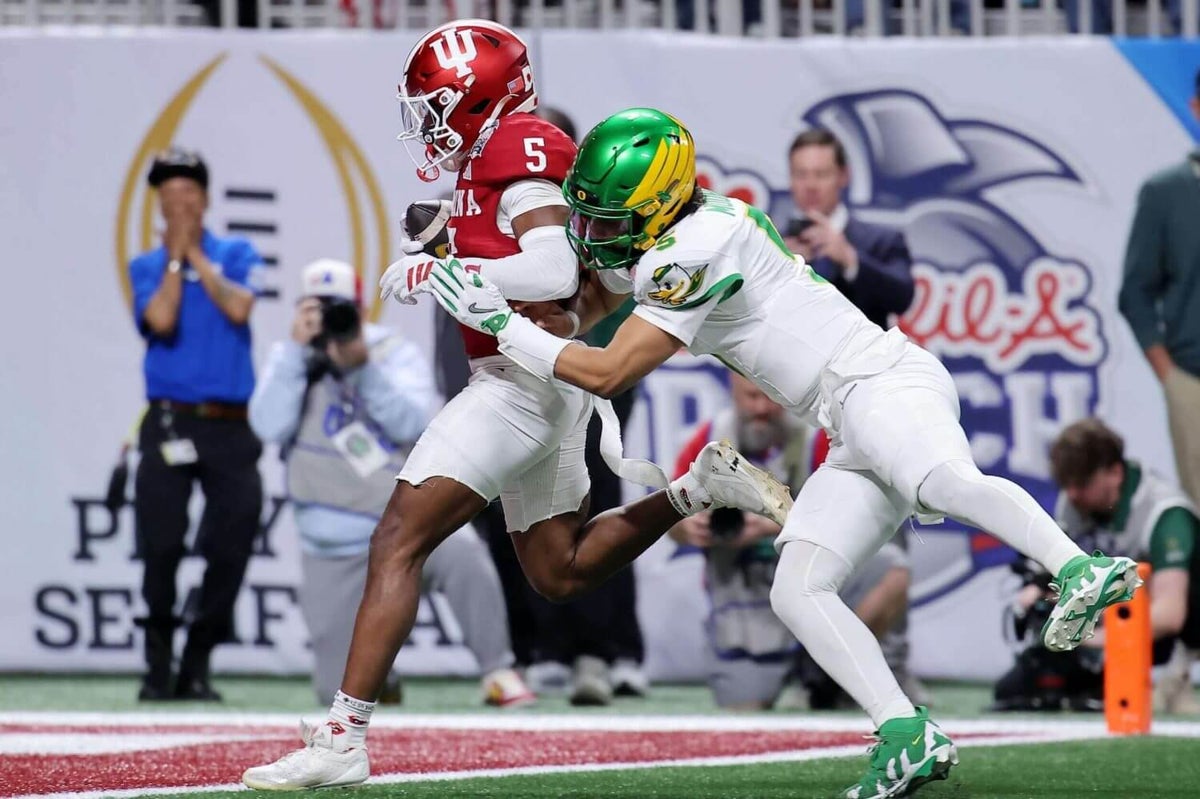
The College Football Playoff’s top seed overwhelmed and steamrolled Big Ten foe Oregon 56-22 to win the Peach Bowl semifinal and reach their first national championship game in school history. No. 1 Indiana (15-0) will play No. 10 Miami (13-2) on Jan. 19 at Hard Rock Stadium in Miami Gardens, Fla., for the title.
Indiana was once considered college football’s ultimate laughingstock, making headlines as the first school to lose 700 games. Since Curt Cignetti took over as head coach two years ago, the Hoosiers have become a juggernaut, and for the second time this postseason, they flexed on a team with more talent and tradition.
Last week at the Rose Bowl, Indiana handed Alabama a 38-3 beatdown, the Tide’s worst loss in their vast postseason history. The Hoosiers blasted the Ducks in even more dominant fashion in front of a Mercedes-Benz Stadium crowd overflowing with crimson. And it started from the game’s first snap.
Indiana cornerback D’Angelo Ponds picked off a pass on the first play and returned it 21 yards for a touchdown to immediately give the Hoosiers a 7-0 lead. After the Ducks responded with a 75-yard scoring drive, Indiana took complete control, scoring touchdowns on five of its first six offensive possessions. Two of those series took place inside Oregon territory after Ducks’ fumbles.
Heisman Trophy-winning quarterback Fernando Mendoza put up another dazzling performance, completing 17 of 20 passes for 177 yards and five touchdowns. So far in the College Football Playoff, Mendoza has eight touchdown passes, no interceptions and only five incompletions. Four of his touchdown strikes went to different receivers, including two to Elijah Sarratt. Omar Cooper Jr., E.J. Williams and Charlie Becker also caught touchdown passes.
The Hoosiers’ ground game was just as dominant, running for 186 yards on 39 carries. Three different running backs picked up at least 40 yards.
Indiana had lost two defensive ends to season-ending injuries, including Stephen Daley, the Big Ten leader in tackles for loss. Daniel Ndukwe stepped in and totaled two sacks, forced a fumble and blocked a punt. The Hoosiers forced 10 tackles for loss and sacked Oregon quarterback Dante Moore three times.
“There was a lot of skepticism after last year that we were a fluke,” Cignetti said. “I think a lot of that negative stuff in the media fueled the guys returning from this team, and we added some real key pieces, the main ones sitting right here on my left, but other ones as well. Great leaders, great players. And we’ve just built off our successes, and we’ve won some big games on the road, and it helps when you have a quarterback play his best football when the game is on the line in the fourth quarter. So here we are.”
Is Indiana the most dominant team in CFP history?
Since the College Football Playoff began in 2014, no team has won two Playoff games by a wider combined margin than Indiana.
The Hoosiers beat Alabama by 35 and Oregon by 34; the previous CFP era record for total margin of victory over a two-game stretch was 55, set by Clemson in 2018-19, which beat Notre Dame 30-3 and Alabama 44-16. The four-team Playoff era wouldn’t have included teams ranked as low as Indiana’s first two opponents — let alone its national title opponent Miami — but the top seed’s dominance thus far has been astounding.
Blowouts like Friday’s are nothing new for the Hoosiers under Cignetti. In 2024, Indiana had wins of 74, 38, 37, 49 and 66 points. This year, it won regular-season games by 47, 73, 53, 50, 45 and 53 points, including a 53-point win over an Illinois team that was ranked in the top 10 at kickoff and finished 9-4. — David Ubben
Dan Lanning’s latest CFP crash-out
Oregon’s Dan Lanning has started his head-coaching career with four straight double-digit-win seasons, including at least 12 wins in each of the last three. However, blowout CFP losses in consecutive years could have a way of sticking to his legacy.
Last year, the Ducks won the Big Ten title in their inaugural season as a league member and entered the College Football Playoff unbeaten and ranked No. 1. After a first-round bye, they earned a trip to the Rose Bowl and faced No. 8 seed Ohio State, a rematch of a game they won 32-31 in the regular season. The Buckeyes rolled up a 34-0 second-quarter lead and blew out Oregon 41-21.
This year, Oregon lost to Indiana 30-20 in October, and the Hoosiers have since dominated by winning their first two CFP games. Then they showed up in Atlanta and fell behind 42-7 early in the third quarter. The Ducks and Lanning are in for more barbs about how they perform in big games. And it’s not just a CFP issue.
In Lanning’s second season in 2023, the Ducks lost twice to archrival Washington. Their second matchup was a top-five collision for the Pac-12 championship, with the winner earning a berth in the four-team CFP. Lanning lost to eventual national champion Georgia 49-3 in his head-coaching debut to open the 2022 season, but more devastatingly, the Ducks dropped late-season games to Washington and Oregon State while ranked in the top 10. The Oregon State loss cost Oregon a Pac-12 title shot.
With a 48-8 record in four seasons, Lanning has proven himself as one of college football’s best coaches. Yet his team’s showings in big games raise questions that will last all offseason — or at least until his next high-profile test. — Scott Dochterman
Magnificent Mendoza
Within the last month, Fernando Mendoza has added his Heisman Trophy to his now-infamous LinkedIn page. Still, his play on the field has only gotten better since he won college football’s most storied individual award.
On Friday night, he put on a show while guiding Indiana into the national championship game for the first time in school history.
He completed 10 of 11 passes in the first half for 110 yards and three scores, and he slipped out of the backfield on a blitz to convert a third down with a 21-yard scramble. On his worst play of the half, he managed to recover his own fumble after a strip sack and nearly found a receiver downfield for a completion before being sacked for a second time on the play. It was the only blip in an otherwise outstanding performance among many this season.
“My job is to be effective with making really accurate balls and really great decisions, and that’s what I pride myself on every single play, and so I’m glad those results came,” Mendoza said. — Ubben
Oregon’s self-inflicted wounds
For as much as the Ducks talked about putting themselves in position for things to go differently, Oregon somehow looked like a significantly worse team than when these two met in the regular season — a testament to Indiana’s defense and Oregon’s own slew of preventable mistakes.
It started from the opening moments, when Moore threw a pick six on the first play from scrimmage that had Mercedes-Benz Stadium nearly bursting at the seams. Moore settled in on the second series of the night and led the Ducks on a touchdown drive, but the wheels fell off entirely in the second quarter. By halftime alone, Moore had lost two fumbles — lowlighted by a collision with running back Dierre Hill Jr. during his windup to throw that jarred the ball loose inside his own 5 — and the Hoosiers had scored 21 of their 35 first-half points on Oregon turnovers.
“First thing is first, the quarterback has to protect the football,” Moore said. “They have a great defense, great disguise and different looks, but you can’t win football games if you’re causing turnovers. Something of course I need to work at.”
Moore, who said after the game he had not yet decided whether he would leave school to enter the NFL Draft, finished the night 24 of 39 passing for 285 yards, two touchdowns and the opening interception. Take away the three first-half turnovers, and the final score may have looked a little more competitive for the Ducks. Instead, the game — and Oregon’s season — was over by halftime. — Grace Raynor
Hoosiers fans take over the Peach Bowl
Indiana fans flooded downtown Atlanta in the lead-up to the game, and it showed inside Mercedes-Benz Stadium. Outside of a small section next to the Oregon band and some patches in the lower deck, the crowd was overwhelmingly wearing crimson and rooting for the Hoosiers. Several in the press box had it as a roughly 90-10 split in favor of the Big Ten champs. The Ducks were soundly booed during their entrance.
It was the biggest Indiana football game to date, facing an Oregon program that’s already played two Playoff games: a home game and another cross-country trip to Miami for the Orange Bowl.
Indiana didn’t get to host a Playoff game because, as the top seed in the College Football Playoff, it earned a first-round bye and a trip to the Rose Bowl. But Friday’s game in Atlanta was practically a Hoosiers home game anyway, in a packed stadium. And it sounded like it when Ponds ran in his pick six on the first play to set off the rout. By the end of the third quarter, the Hoosiers faithful were dancing along to the Isley Brothers’ “Shout” as much as the few remaining fans in green were. — Ubben
Another Big Ten 3-peat?
The Big Ten has a chance to win its third straight national title for the first time in more than 80 years.
The top-seeded Hoosiers (15-0) face No. 10 seed Miami (13-2) for the national championship on Jan. 19 in Miami Gardens, Fla. Should Indiana win, it will join Michigan and Ohio State in carrying the league banner. The Big Ten last won three straight titles from 1940 to 1942.
In 1940 and 1941, Minnesota extended one of the sport’s greatest dynasties, collecting its fourth and fifth national titles in eight years. The Gophers won top-three showdowns against Michigan in the pair of years, in renditions of what was the Big Ten’s preeminent rivalry over the conference’s first 50 years.
The Gophers’ 1941 squad was one of the most dominant in college football history, crushing its eight opponents by a combined score of 186-38. That year was also the final championship for legendary coach Bernie Bierman, who went into military service following the attack on Pearl Harbor on Dec. 7, 1941.
Ohio State claimed its first national title in 1942 with a 9-1 record. The Buckeyes lost a Halloween showdown with Wisconsin that put the Badgers in position to earn their first title. However, No. 2 Wisconsin stumbled with a late-season loss to Iowa, while Ohio State won its last four games by an average of 27 points to secure the Associated Press crown. Wisconsin finished third that season.
Michigan claimed the CFP title two years ago by stopping current Big Ten foe Washington, in the Huskies’ final season representing the Pac-12. Last year, Ohio State won four straight games in the inaugural 12-team CFP to win its championship. The Hoosiers have never won a national title. — Dochterman