
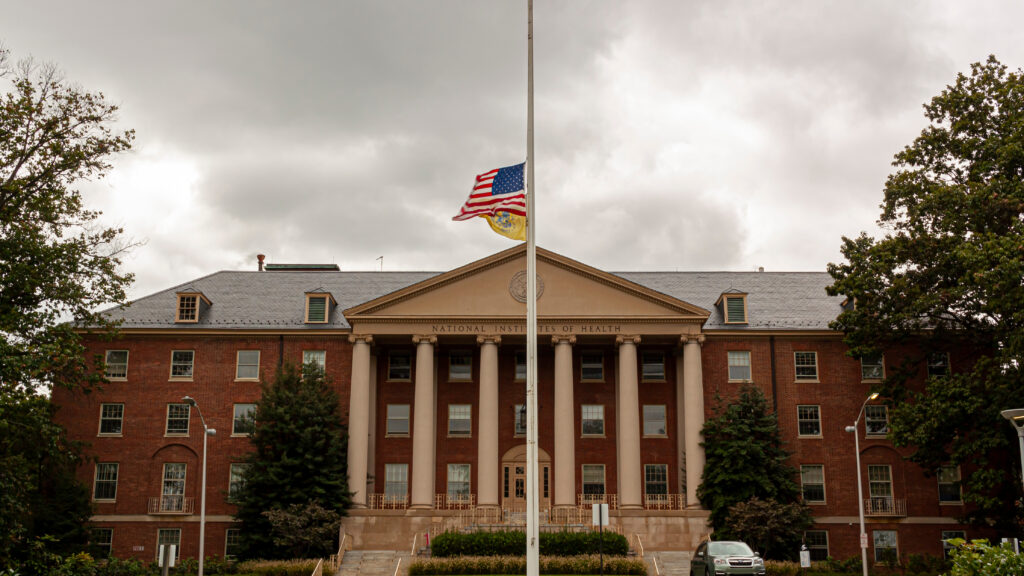
We are National Institutes of Health scientists and administrators with more than 50 years of collective civil service.
Or, more accurately, we were NIH scientists and administrators.
At the beginning of 2025, we anticipated changes with the new administration, but expected that rigorous scientific inquiry would continue to be valued. After all, the country’s health research infrastructure, considered the most prestigious in the world, had always garnered broad bipartisan support.
Over the course of the year, as we witnessed the Trump administration’s reckless policies, we tried to protect the science we had always championed. We spoke up when we could, and in June we joined hundreds of our colleagues in signing the Bethesda Declaration, an open letter to the NIH director detailing how several new policies were undermining scientific integrity and the institute’s mission.
But we can no longer lend our credibility to an organization that has lost its integrity. In recent months, each of us independently reached the decision to resign in protest of the actions of an administration that treats science not as a process for building knowledge, but as a means to advance its political agenda. One of us resigned just Friday.
We have resigned because:
We protest the hypocrisy of an NIH leadership that claims to protect academic freedom while censoring grants and staff communication. Instead of applying our skills and knowledge to science, we have been instructed to tell scientists competing for NIH funding to remove words like “equity,” “diversity,” “minority,” and “underserved,” regardless of the scientific appropriateness of these terms or the significance of the projects. To this day, grants continue to be “realigned” with administration priorities, a clear form of ideological coercion. The damage to research and destabilizing effects on the scientific workforce will be long lasting.

STAT Plus: NIH specifies how grant reviewers should ensure alignment with Trump priorities
We protest an NIH leadership that claims to champion early-career scientists and prioritize “solutions-oriented” health disparities research while selectively terminating and censoring these awards. We witnessed unilateral withdrawals of applications and terminations of active awards to early-career scientists simply because they had applied to funding announcements designed to broaden participation in the scientific workforce. The progress or promise of this science was never considered.
Similarly, funding announcements that solicited research to address health disparities were disappeared from the public record because they were deemed “DEI.” Associated applications were withdrawn without review and awards were terminated. Some of these applications and awards were in our portfolios and we urged reconsideration of these actions, providing justifications based on the awards’ merit and even its actual alignment with publicly stated priorities. Our requests went unanswered and the grantees’ appeals were ignored. These decisions will hurt American communities and stifle scientific advancements for decades to come.
We protest an NIH leadership that creates a culture of fear within the agency’s dedicated staff. Colleagues who question illegal and politically motivated orders have been silenced, with some placed on leave or forced out. Each of us has been told not to push back because “people would lose their jobs.” Refrains heard in the hallways include: “What I’m being asked to do feels wrong, but I need my health insurance” and “we have to keep our heads down and avoid putting a target on our backs.” These should not be concerns articulated in a world-class scientific institution.
Upholding our oath of office — “to protect and defend the Constitution from enemies foreign and domestic” — and living up to our values requires us to leave the jobs we previously cherished.
We are by no means the only ones leaving. Many of our colleagues have resigned, have retired earlier than planned, or are actively taking steps to leave the NIH, sometimes at great personal sacrifice. Other colleagues are wrestling with whether the costs of staying outweighs the costs of leaving.
In sharing our personal reasons for leaving, we hope to let our colleagues know they are not alone in recognizing the harms that are undermining the agency they loved.
A stable research funding infrastructure is essential to solve the country’s health challenges and to support a functional democracy where policy is based on evidence. Despite leaving the NIH, we refuse to lose hope. We remain committed to the work of advancing science and improving public health.
To researchers whose work lifts up vulnerable communities and who have devoted their work to currently “sensitive” topics — vaccines, health equity, the health of sexual and gender minorities, climate change, misinformation: We need to continue to speak up and speak out. We also need to work together to build new opportunities for this critical work until the NIH returns to its mission.
To our colleagues who plan to remain at the NIH and those who continue to seek funding from the NIH: The options in front of us are not good: continue in a compromised process or refuse to participate and risk professional stability. We wish all of you well as you continue to weigh the impact of your choices on the scientific enterprise and on the communities across the nation. We know you seek to do your best to navigate the ethical and practical challenges and uphold the moral and scientific integrity. We are already moving down the slippery slope. Please decide where your red line is so you can choose to act before the line is already behind you.
Not only is our health at stake, but this attack on science is an attack on freedom of speech and thought. What we have seen at NIH is a threat to the fundamental freedoms that all of us cherish.
But we can fight back. The biggest lesson the four of us have learned over this past year is that what feels impossible and overwhelming when you’re sitting by yourself can begin to feel achievable and urgent when you are working with others that share your values. Working together, we can preserve our moral and scientific integrity. We can rebuild a robust biomedical research ecosystem free from heedless political interference. Acting boldly now will help to protect democracy and ensure better health for all.
Sylvia Chou, Ph.D., MPH, resigned Friday from the position of program director at the National Cancer Institute. Paul Grothaus, Ph.D., retired on Dec. 31, 2025, earlier than planned, from the position of program officer at the National Institute of Aging. Alexa Romberg, Ph.D., resigned Dec. 8, 2025, from the position of deputy chief of the Prevention Research Branch at the National Institute on Drug Abuse. Vani Pariyadath, Ph.D., resigned June 14, 2025, from the position of chief of the Behavioral and Cognitive Neuroscience Branch at the National Institute on Drug Abuse. All authors are writing in their personal capacities.