
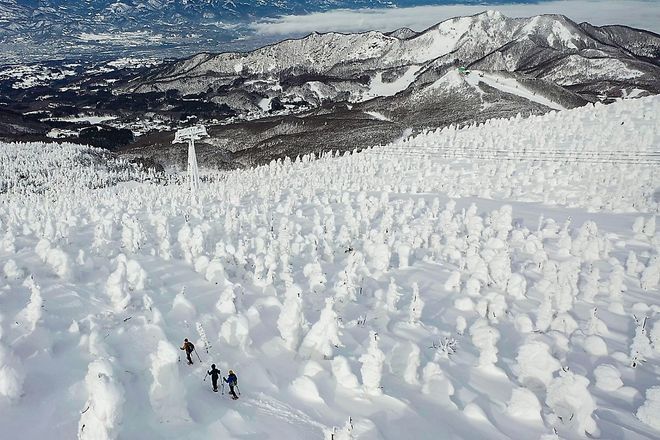
YAMAGATA–Winter in Japan’s northern Tohoku region is often cast as a surreal spectacle concerning the Zao mountain range where countless “snow monsters” appear.
But a new explanation for this frozen theater of eerily biomorphic “juhyo” conifers bizarrely cocooned in ice suggests it owes less to the trees themselves, or even to the storms that lash them.
Fumitaka Yanagisawa, a professor emeritus of environmental science at Yamagata University, instead said the phenomenon is the result of a violent remaking of the mountain tens of thousands of years ago.
Yanagisawa explained a key factor behind the icy trees was a sector collapse 40,000 to 80,000 years ago while presenting the new findings at a regular presidential news conference on Dec. 4.
It began with a steam-driven phreatic eruption on Mount Ryuzan located near the northwestern part of the Zao volcanic range whose entirety straddles Yamagata and Miyagi prefectures.
The eruption triggered a collapse of the mountain’s flank and dropped the peak down by an estimated 600 meters from a height of at least 1,500 meters. This resulting depression would become Zao Onsen, a historic hot spring village and major mountain resort partway up the range.
With the mountain barrier gone, winter’s frigid northwesterly winds from Siberia now had a pathway straight into the radically transformed range.
These north-westerlies continue to slam directly against Mount Jizo (1,736 meters) and Mount Kumano (1,841 meters), two of Zao’s most prominent peaks, setting in motion the atmospheric conditions that help create the fantastical snow monsters each year.
As the moisture-laden air collides with the mountains, it is forced upward and cools rapidly, producing masses of supercooled water droplets. The result is an area locked in near-constant blizzard conditions through the winter season.
Previous research indicates that Maries’ fir (Abies mariesii), known in Japanese as “Aomori-todomatsu,” has grown in the Zao range for roughly 1,000 years. When seasonal winds carrying supercooled droplets strike these conifers, ice and snow accrete layer by layer to mold them anew.
“I feel a sense of wonder knowing that the tree ice of Zao is created by such a delicate balance of the natural world,” Yanagisawa said.