
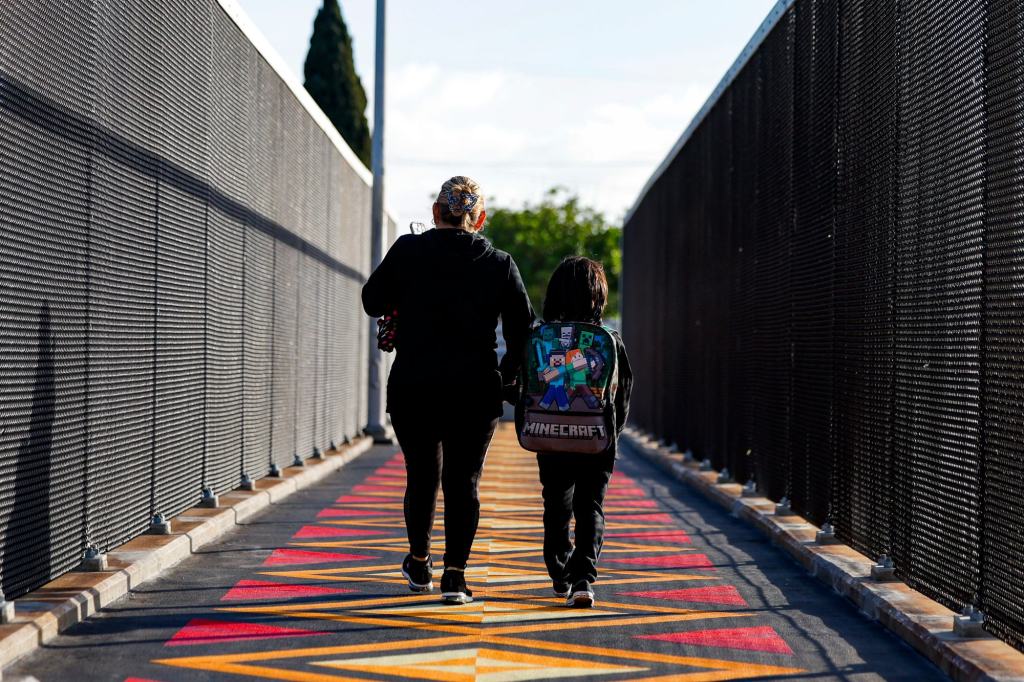
A new art installation on a pedestrian bridge in southeastern San Diego is rooted in the history and culture of two neighborhoods that have long been bisected by freeways and development.
The artwork, designed by San Diego artist Brisk One, runs the entire length of the 30th Street bridge, which crosses Interstate 5 near Boston Avenue to connect Barrio Logan and Logan Heights. It features a feathered serpent known as the god Quetzalcōātl in Aztec culture.
The work is part of a series of projects from the Caltrans to improve bridge infrastructure in San Diego County. Five bridges are getting updates through the nearly $9 million project, but this is the only one with an artistic component.
“The art design reflects the community,” said Marisa Aguayo, executive director of All for Logan, a community group that promotes public art and businesses in Barrio Logan and partnered with Caltrans on the project. “That’s our culture and our ancestors.”
The design aims to promote a sense of belonging in the Latino community, Aguayo added, especially as President Donald Trump has targeted immigrants and ramped up enforcement.
“When you’re seeing that your people are being attacked, to be able to walk out and feel connected to your own community, to have something that represents you, I think that’s beautiful,” she said.
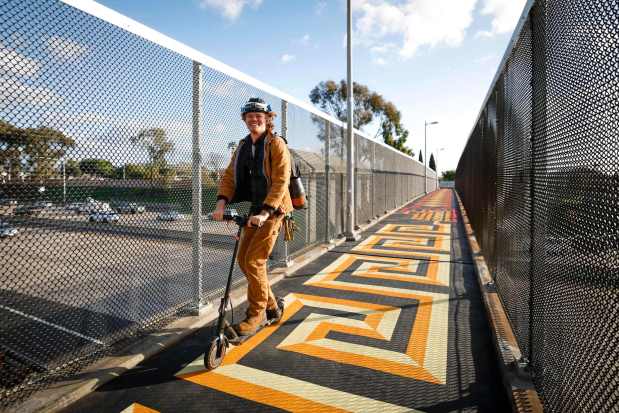 People cross the 30th Street Pedestrian Bridge on Thursday, Jan. 8, 2026, in San Diego. (Meg McLaughlin / The San Diego Union-Tribune)
The bridge improvements were funded through Caltrans’ State Highway Operation and Protection Program. They included replacing the bridge’s fencing and pavement preservation — a process that let crews incorporate color into the deck treatment. What looks like paint is actually a preservation product that protects the surface from weathering.
About a year ago, All for Logan solicited designs for the deck’s art installation, and community members voted on the final design.
“It’s way better,” said nearby resident Kevin Cabral on Friday afternoon. Cabral commutes across the bridge each day, riding his scooter from Logan Heights to work at a shipyard in Barrio Logan.
He said the bridge’s fencing was falling apart before, but now “it looks pristine.”
Barrio Logan and Logan Heights were once a single neighborhood with a vibrant Mexican American community. But construction of Interstate 5 in 1963 and of the San Diego-Coronado Bridge four years later effectively cut the neighborhood in half.
The building of the highways, along with years of gentrification and discriminatory housing policies, displaced thousands of people. And the effects of development — including polluting industry, junkyards and sewage — left the area with some of the worst air in California, deepening concerns about access to safe modes of transportation.
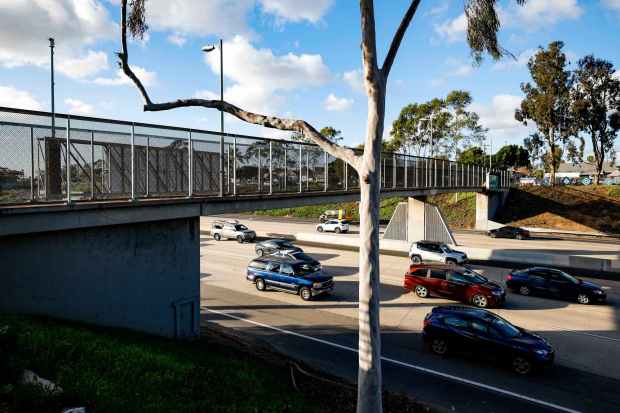 Cars travel under the 30th Street Pedestrian Bridge on Thursday, Jan. 8, 2026 in San Diego. (Meg McLaughlin / The San Diego Union-Tribune)
Local community groups have been working to improve things.
Caltrans, through its Clean California project in the Barrio Logan neighborhood, has installed better lighting and improved access for people with disabilities, including by converting the 30th Street bridge’s former stairs to a ramp.
There are also plans for a Boston Avenue linear park, an initiative by the San Diego Foundation and Environmental Health Coalition to help fund climate-resilient projects in San Diego’s historically underfunded barrios.
“To give folks the dignity and safe access to green spaces, and even just more walkability, it’s really amazing to see that,” said Amy Castañeda, policy director at the Environmental Health Coalition, which also worked with Caltrans on the bridge project.
The artwork on the bridge is colorful, with shades of red and orange, and its square and triangles shapes feature sharp angles.
Brisk One said it’s one of the largest pieces he’s worked on. It was a unique experience for him to create a design people would walk on rather than a typical mural — but for him, that made the project more significant.
“A serpent represents the earth, and it slides on its stomach,” said Brisk One. “So people will be walking on it with that same feel.”
And he hopes it’ll make for a more engaging walk for the families who pass by — “instead of just having a regular bridge to cross, having something that’s more fun and playful and gives color to that area that wasn’t there before.”