
I stepped into a real live, working — smells and all — black and white darkroom this week, for the first time in decades.
I watched Charlotte Astor, a junior at Cherry Hill High School East, develop her B&W photographs in the school’s darkroom.
For a few years after The Inquirer went digital I kept the small enlarger and other personal equipment that I’d used in my crude basement darkroom from when I was starting out. I had little use for it after I got my first staff job with bigger and better facilities. It all stayed boxed up, through multiple moves, long after I’d stopped exposing any film — even for family photos.
I finally gave it all away when young people first started using analog formats like typewriters, vinyl records, “dumb phones,” and film cameras as a move away from digital overload. (A few years ago our photo staff did a group project where we each took a turn with the same 35 mm mechanical camera using just one roll of black-and-white film.)
Like many digital natives who grew up with smartphones and the internet and are now “detoxing,” Astor has totally embraced B&W 35 mm, photographing at hardcore shows around the area for a zine she self-publishes, “Through Our Eyes.”
“So often,” she says of the music scene, “you’ll see these people taking a million photos a second, and to me it’s just waste. When I shoot film, I only have 36 shots before I gotta risk reloading in the middle of the pit, so every shot I have to make count. It keeps me in that moment, with this kind of clarity. When you get the shot, even though you can’t see it, you just know that you got that moment perfect. That moment means everything to me. I wouldn’t trade it for the world, and digital will never come close.”
But that’s not why I was taking her picture. Our story, published next week, is about Astor’s four year search for a demo tape — yes, an analog cassette — from her mother’s teenage band.
I enjoyed talking with her about photography, and I couldn’t stop thinking about what digital photography has brought us.
Film demanded patience and technical precision. Digital offered instant feedback and greater flexibility in lighting conditions.
Photojournalists delivered images faster, adapted to the demands of online media and met tighter and more frequent deadlines.
The transition hasn’t changed the way I see, and interpret. I still emphasize composition, context, or complexity. However, I have adapted and adjusted. I see the value in making the kinds of thumbnails that online platforms prioritize to generate algorithmic attention.
Between photographing for stories on assignment I still wander whatever neighborhood I am in looking for “standalones.”
But I am also always on the lookout for “stock” photos that can be used as thumbnails with future stories. Think images of police tape or flashing lights, city street scenes, and skylines, educational, civic, and medical institutions.
After an assignment at the Philadelphia Art Museum, I loitered outside.
Ahead of Sunday’s wildcard playoff game against the San Francisco 49ers, the museum put up giant cutouts of four Eagles players on its iconic front steps. The cutouts first appeared in 2014 (before the Birds’ wild-card loss to the New Orleans Saints) and again a few times over the years, including before both Super Bowl wins in 2018 and last year.
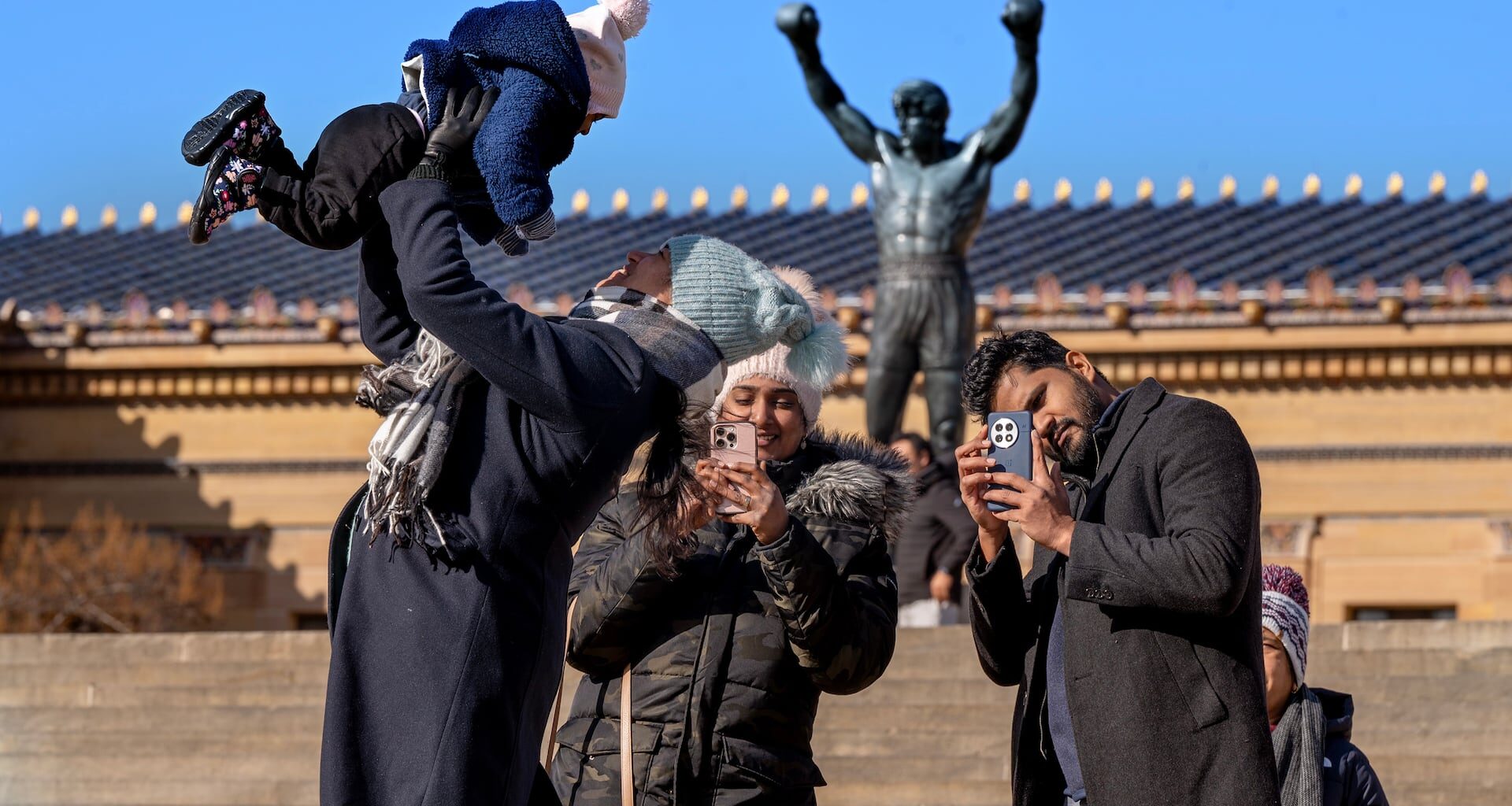
The newspaper already has lots of photos from the steps, including many of that movie prop, but I knew the city’s Art Commission is voting next week to see if it stays, or not.
So what’s one — or two — more? (There are currently two versions at the museum!)
If it stays, the “original” version of the statue from 1982’s Rocky III that now sits at street level would be moved inside the museum for an exhibit this summer, then go back outside and installed at the top of the steps “permanently.” And the “second casting” statue there now “temporarily” would be returned to Sylvester Stallone.
(If it sounds like I have more than a passing interest in this, I do. Reporter Mike Vitez and I spent an entire year on the steps to produce the locally best-selling book Rocky Stories: Tales of Love, Hope, and Happiness at America’s Most Famous Steps.)
It was that really nice, warm sprint-like day we had on Wednesday, following those bitterly cold first days of 2026, so I didn’t mind being outside making “stock” photos.
And THAT’S when I spotted a real moment — the kind photographers live for — of the family taking selfies on the steps, and how I ended up making the photo at the very top of this column.
Since 1998 a black-and-white photo has appeared every Monday in staff photographer Tom Gralish’s “Scene Through the Lens” photo column in the print editions of The Inquirer’s local news section. Here are the most recent, in color: