
Vienna Elementary School’s Vienna.i.Lab is transforming education by introducing students to AI and advanced technology.
This page contains a video which is being blocked by your ad blocker.
In order to view the video you must disable your ad blocker.
Elementary students are learning the ‘how’ behind AI
David Lee Reynolds, Jr. spent two decades working as a music teacher before transitioning to teach technology.
When he made the switch, Vienna Elementary School didn’t have a Science, Technology, Engineering, Arts and Math, or STEAM, lab. To best set students up for success, he knew the Northern Virginia campus needed one.
That thought came around the same time the first large language models were debuting, and artificial intelligence was becoming more mainstream. So he knew once a lab was put together, it would have to be advanced. A traditional STEAM lab would come later.
Eventually, Reynolds created the Vienna.i.Lab with the goal of helping students understand how the tech works, all so they’re set up to use it more effectively.
“This is the new stuff, and it’s here to stay,” Reynolds said. “But if you don’t know what it is, then it’s not helpful to you. So let’s fix that.”
To do it, Reynolds collaborated with the school’s parent-teacher association, which helped raise money so students could use new tools instead of traditional laptops.
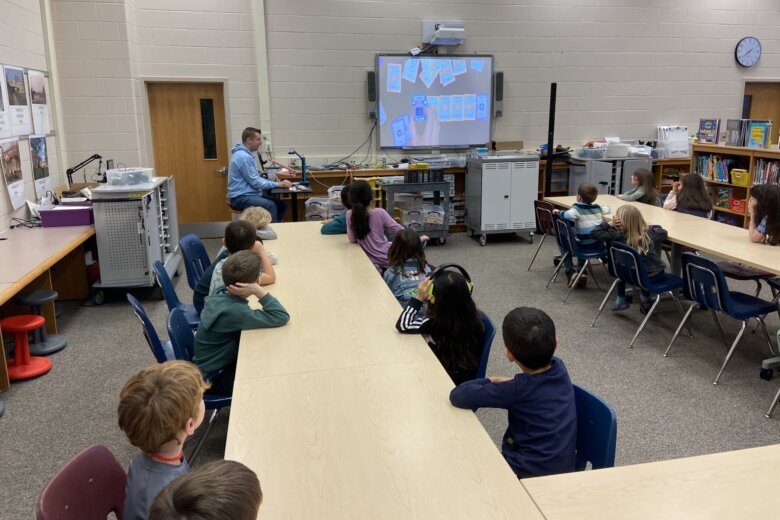
During a lesson on Friday afternoon, a group of first graders used KaiBots. They scanned a card with a code describing how the robot should move, and watched it either follow the instructions or identify an error.
Even for some of the school’s youngest students, Reynolds said the lesson revealed the “building blocks of where you would eventually get to learning about machine learning, learning about large language models, learning about how ChatGPT works.”
One student, Nora Vazeen, said the activity is different from what she does in most classes, and “It’s silly.”
Another student, Callum, echoed that sentiment, saying, “The robot does silly stuff.”
But, once a week during their technology special, students from kindergarten to sixth grade participate in hands-on activities. While the younger kids use KaiBots, the older students are programming drones.
The work emphasizes problem solving skills, collaboration and coding skills, Reynolds said.
“For kids, if they understand how the tool works, they can do amazing things with the tool,” he said. “But if they don’t, they’re going to use the tool like it’s a search feature, and the next thing you know, they’re doing things that are wrong and they’re learning things that are incorrect.”
While the AI lab is largely the tech cart Reynolds oversees in the corner of the school’s library, he’s hoping one day it can evolve into an innovative space.
“Let’s build it in a green way,” Reynolds said. “Let’s build it underground. Let’s use geothermal heating and cooling. Let’s build a space, when you walk into it, you’re inspired to go and create.”