
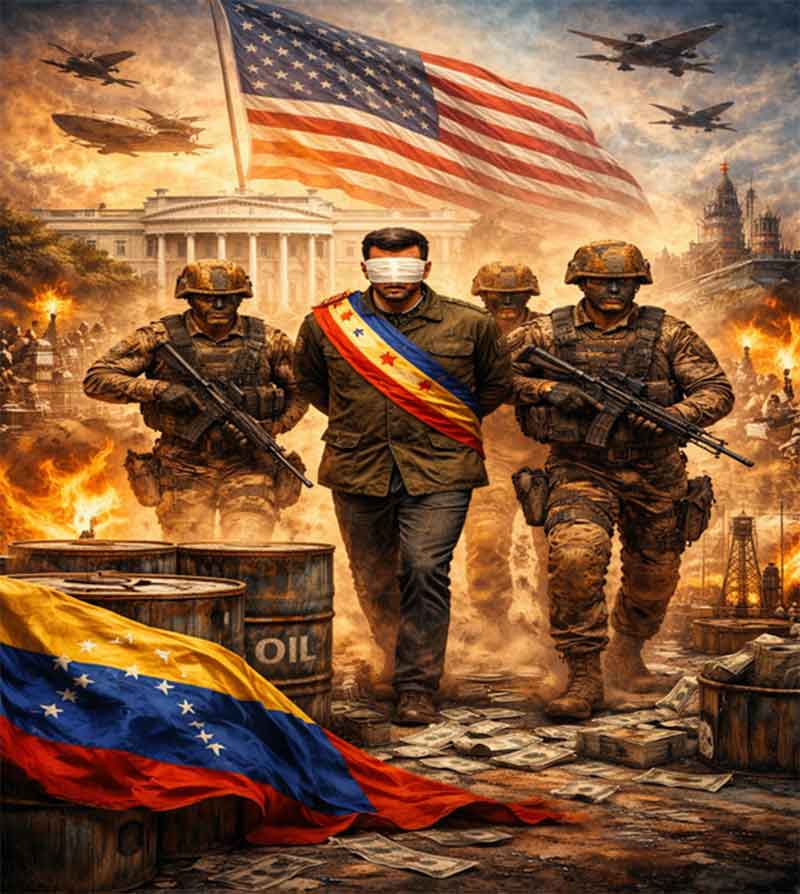
In the opening days of 2026, Washington’s posture toward Venezuela shifted with remarkable speed, transforming from sustained pressure and maritime containment into direct intervention and a sweeping redefinition of U.S. foreign policy in the Western Hemisphere. What had long been framed as sanctions enforcement and counter-narcotics operations rapidly escalated into a broader political and military engagement that has fundamentally altered the narrative the United States presents about Venezuela’s place in regional and global affairs.
For much of 2025, the U.S. strategy toward Venezuela rested on an expanded naval presence in the Caribbean and aggressive operations against vessels alleged to be linked to drug trafficking. American officials justified these actions by invoking the language of narco-terrorism and domestic security, portraying them as defensive measures to curb illicit drug flows. The emphasis during this phase was enforcement rather than overt confrontation with the Venezuelan state, allowing Washington to maintain pressure while avoiding direct acknowledgment of regime-targeted action.
This posture shifted dramatically in early January 2026 when U.S. forces conducted a high-profile operation inside Venezuelan territory that resulted in the capture of President Nicolás Maduro and his wife. The U.S. administration publicly announced that Maduro would face prosecution in the United States, framing the action as the execution of justice against an alleged architect of state-backed criminal networks. Soon after, senior American officials made statements suggesting that the United States would temporarily oversee Venezuela’s transition until a new political order could be established, signaling a decisive departure from indirect pressure to overt political intervention.
Alongside military developments, economic considerations quickly entered the official narrative. U.S. policymakers highlighted Venezuela’s vast oil reserves and argued that restoring and expanding production under American oversight could stabilize global energy markets and benefit U.S. consumers. Discussions with major U.S. oil companies intensified, accompanied by public assurances of legal and physical security for future investments. While some industry leaders expressed cautious optimism, others warned that long-term engagement would require extensive regulatory reform and political stability.
The administration also reinforced its position through legal framing. U.S. authorities formally designated the Cartel of the Suns, which they allege is directed by senior Venezuelan officials, as a terrorist organization. This move allowed Washington to recast its actions as part of a broader global counter-terrorism effort rather than a unilateral intervention, strengthening the legal and rhetorical basis for extraordinary measures. Critics, however, questioned whether this conflation of criminal prosecution, counter-terrorism, and regime change blurred important distinctions in international law.
The speed of escalation has not gone uncontested within the United States. In Congress, a war powers resolution seeking to limit executive authority over military operations in Venezuela advanced narrowly, reflecting unease over the scope and pace of actions undertaken without explicit legislative authorization. These debates underscored concerns about constitutional oversight even as the administration pressed ahead with its policy.
International reactions have been swift and divided. Several governments condemned the U.S. actions as violations of sovereignty and warned of dangerous precedents, while others adopted a more cautious stance, calling for stability and negotiated outcomes. The mixed response highlighted the limits of Washington’s narrative beyond its immediate allies and demonstrated how claims of legality and moral necessity remain contested in global forums.
Perhaps most striking has been the rapid shift in diplomatic signaling. Within days of the operation, U.S. officials began exploring the reopening of the American embassy in Caracas and initiating talks aimed at restoring formal diplomatic relations with Venezuelan authorities willing to cooperate with Washington. Parallel discussions over sanctions relief and the future role of U.S. companies in Venezuela’s energy sector moved forward with unusual speed, reinforcing the impression of a policy transitioning from coercion to managerial oversight.
The pace and breadth of these developments reveal how swiftly the United States has moved from a long-standing posture of pressure and isolation to a narrative embracing direct intervention, legal prosecution of a foreign leader, and plans for economic reintegration. Whether this narrative will stabilize into a coherent long-term strategy or generate sustained geopolitical backlash remains uncertain. What is clear is that within a matter of months, the U.S. story on Venezuela has expanded from counter-narcotics enforcement to a comprehensive reordering of military, legal, diplomatic, and economic claims, carrying profound implications for regional politics and the future of international norms.
Subscribe to Our Newsletter
Get the latest CounterCurrents updates delivered straight to your inbox.
Ashish Singh has finished his Ph.D. coursework in political science from the NRU-HSE, Moscow, Russia. He has previously studied at Oslo Metropolitan University, Norway; and TISS, Mumbai.