
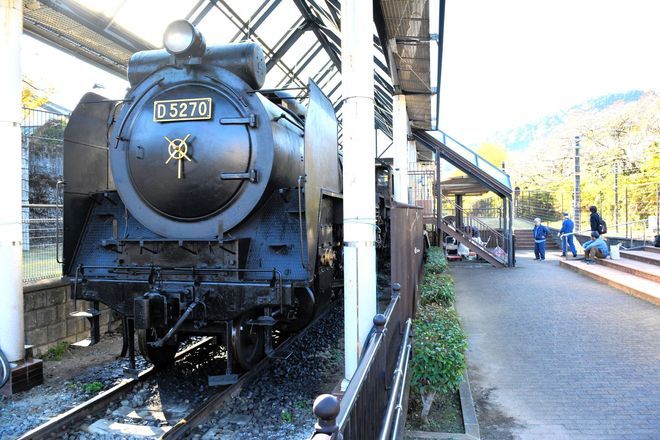
Tobu Railway Co. operates the SL Taiju excursion service in the Nikko and Kinugawa regions of Tochigi Prefecture, while a Class D52-70, which runs on compressed air, is displayed in working condition in Yamakita, Kanagawa Prefecture. (Ayateru Hosozawa)
Belching out black smoke, steam locomotives (SLs) boasted an unyielding presence on Japan’s rails decades ago.
Even now, in the age of electric trains, SLs still enjoy deep-rooted popularity, and some have been brought back into service as excursion locomotives.
However, most of the reborn SLs were built more than 80 years ago. So, parts are difficult to come by, and maintenance costs can soar.
But a technology using compressed air to drive the locomotives could solve the problem.
The technology was developed by Takahito Tsunematsu, a former steam locomotive engine driver at Japanese National Railways (JNR), about 20 years ago. It negates the need to reconstruct an SL’s boiler, which is estimated to cost several hundred million yen (several million dollars).
COMPRESSED AIR POWER
JR Yamakita Station in Yamakita, Kanagawa Prefecture, once thrived as a maintenance and refueling hub for trains running on the Tokaido Line through the Hakone mountains until the Tanna Tunnel opened in the early Showa Era (1926-1989).
A Class D52, one of Japan’s largest steam locomotives that traversed steeply sloping sections along the Gotenba Line, had been on display at a railway park in front of the station for nearly 50 years.
But in 2016, Tsunematsu and other experts converted the D52 to run on compressed air generated by two compressors.
When compressed air is delivered to the cylinders, the pistons start reciprocating. The four pairs of driving wheels rotate via main connecting rods, causing the large black locomotive to slowly move forward.
It can make five round trips on the 12-meter-long tracks.
The steam engine is now operated once a month for maintenance purposes.
A Class 8620 locomotive, which operated as the SL Hitoyoshi, has been put on static display near JR Hitoyoshi Station in Hitoyoshi, Kumamoto Prefecture, since November 2024.
However, in November 2025, 103 years after it was built, it was converted to run on compressed air and remains preserved in working condition.
Wakasa Railway Co., based in Tottori Prefecture, restores D52s, 8620s and other steam locomotives from across the country using Tsunematsu’s technology.
“Children with no firsthand knowledge of working steam locomotives say things like, ‘Amazing’ and ‘We must cherish them,’” said Takashi Taniguchi, 51, chief of the company’s rolling stock section. “We want to activate as many engines as possible.”
SL LOVE
The adoration for SLs is evident around Japan.
In the center of the Rolling Stock Station of the Railway Museum in Saitama’s Omiya Ward, a Class C57-135 steam locomotive sits on a turntable.
Nicknamed “Kifujin” (noble lady), it is the actual steam engine that ran on the Muroran Line in snow-covered Hokkaido on Dec. 14, 1975, featuring a special emblem reading, “Sayonara SL.”
In one of the museum’s popular events, the C57 turntable turns twice a day as Kifujin’s whistle echoes throughout the building.
Tokyo-based Tobu Railway Co. has been operating a steam locomotive since 2017 as a new centerpiece of tourism in the Nikko and Kinugawa regions of Tochigi Prefecture.
The excursion service started with a single-car train, but three trains are now operated almost daily.
The accumulated number of passengers exceeded 500,000 in March 2024.
A turntable set up at Shimo-Imaichi and Kinugawa-Onsen stations in Nikko have become tourism hotspots for train enthusiasts.
HIGH MAINTENANCE COSTS
Trains running on conventional lines last between 30 and 40 years.
But the steam engines brought back to life were originally built in the 1930s and 1940s. Each locomotive requires more than 10,000 parts to run, and most of these items have long been out of stock.
Operators can salvage parts from SLs on display, but these pieces are beginning to run out.
Parts can be newly built. However, such endeavors add more costs for the operator.
In 1988, Kyushu Railway Co. (JR Kyushu) brought back to service a Class 8620 locomotive, first as the SL Aso Boy and later as the SL Hitoyoshi.
But it was retired in 2024 after falling into disrepair. JR Kyushu had difficulties securing engineers for maintenance work.
Moka Railway in Tochigi Prefecture announced in November that it will cancel all SL Moka steam locomotive excursions in the business year starting in April 2026 to overhaul its only steam engine, a Class C12.
The services had been provided since 1994.
Moka Railway had also operated a Class C11, but overwhelmed by maintenance costs, it sold the engine to Tobu Railway in 2020.
That made it difficult to offer steam locomotive excursions throughout the year.