
By Jack Ballard
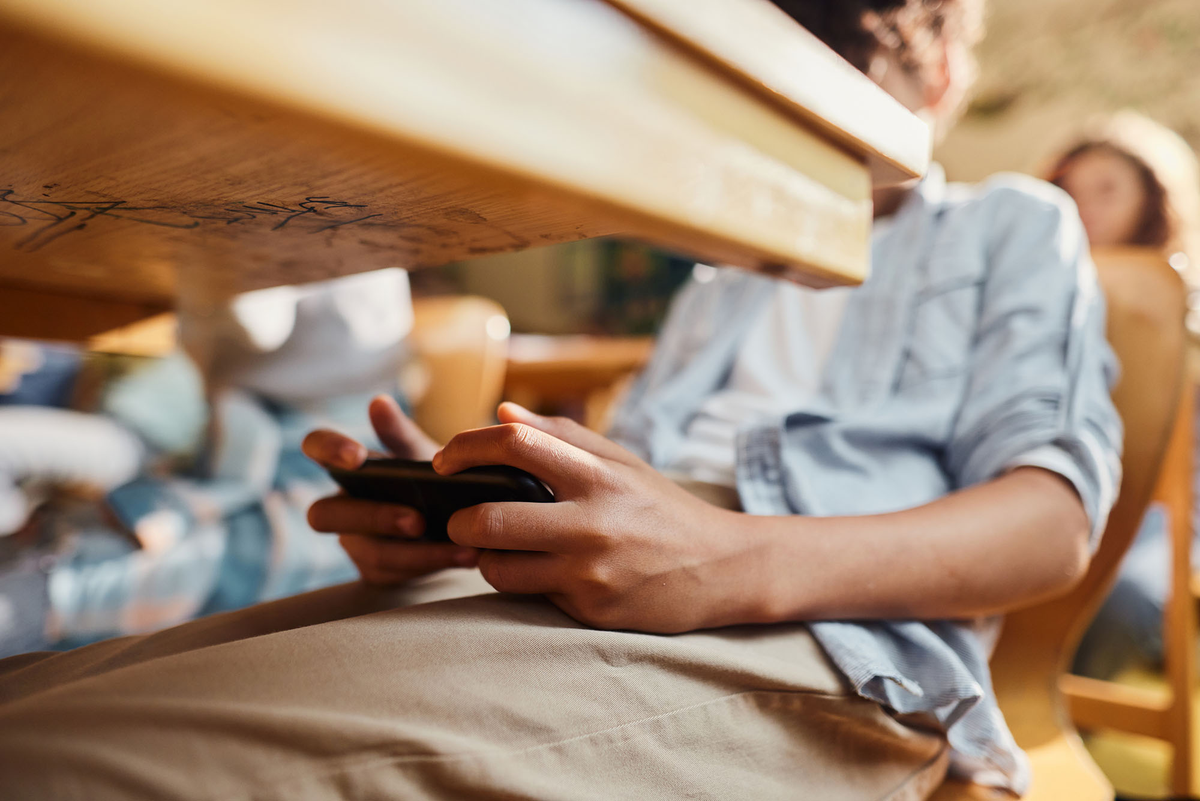
Teenagers in the United States and across the world have a phone problem. In 2023, more than 50% of teens in the U.S. spent 4 hours a day or more on social media, per Gallup. That’s more than half of a school day! It’s common sense that phones, and especially social media, are distractions for America’s teenagers, especially in school. Understandably, many see phone bans in schools as the solution. In the short term, bans work — but they lead to students who have no idea how to exercise self-control with their phones. For that reason, blanket bans are not the best solution for phones in high schools.
I don’t deny that phone bans have significant advantages. Especially for younger students, like those in elementary and middle school, having phones out of the classroom has huge benefits. In high school, however, banning phones is a harder decision.
I graduated from high school in May, and I saw firsthand what school was like with and without a district-wide cell phone ban.
Before we had a phone policy, students could keep their phones in their pockets all day. Most teachers would confiscate phones if they were misused, so phones typically stayed out of sight. Then, our school board enacted a new district-wide phone policy.
The policy, enacted before my junior year, directed teachers to confiscate phones at the beginning of class and return them to students at the end. Students had their phones during passing periods, lunch, and unscheduled hours — but not in class. This policy applied everywhere across the school, from freshman-level art classes to the most rigorous courses.
To the board’s credit, the system helped. Students were generally more focused and social during class. However, the policy had a problem. When students would retrieve their phones at the end of every class, chatter would instantly cease, and almost every student ended up with their nose buried in their screens — watching TikTok, responding to texts or Snapchat messages, completely zoned out. This revealed the real problem. Phone bans may suppress symptoms, but they don’t address the cause: the epidemic of phone addiction.
Phone bans like the one adopted at my school are better than nothing, but the key question is: What does that mean? What does success look like? Is success having students off of their phones and paying attention in class? Great, let’s ban phones. Easy.
But if the goal is to address our relationships with phones, it’s not quite as simple. The high school I attended often said that their goal as an institution was, “to prepare 100% of students for meaningful post-secondary opportunities.” I think we can agree that this is a worthy goal; high school should be a time of transition, a time where students can learn how to learn and eventually be prepared for their futures.
That, then, should be the ultimate goal. Not to have more students paying attention in third-period history, but to prepare them to be adults. With spouses. Kids. Responsibilities.
Self control.
When you become an adult, nobody will take away your phone. No boss is going to ask you to put your phone in a pocket on the wall before a meeting. So why should every teacher until you walk across a stage wearing a cap and gown?
When I entered college, it was jarring to transition from having my phone taken from me every class to unfettered technology access, with no immediate consequence for using my phone during a lecture. If students don’t get the opportunity to learn how to learn with their phone in their pocket by the time they walk onto a college campus (or worse yet, the workplace), they are going to struggle. That’s why phone policies are dangerous; they provide a band-aid solution that sets students up to fail in the long run. In my experience, they only delay the problem instead of solving it.
Teachers, schools, and governments need to recognize that students should be given more responsibilities as they get older. Specifically, as students enter high school and especially as they become upperclassmen, they should be allowed to keep their phones more and more.
In his take on the issue, Isaac said, “Trying to strong-arm students, especially teenagers, inherently risks eliciting rebellious behavior. If phones become forbidden fruit the same way alcohol or marijuana are for teenagers, then we know what’s going to happen: Kids will just misbehave and deceive in order to use their phones.” I think this is absolutely true. Despite a clear policy and consequences for breaking it, many students in my high school found a way to use their phones in class.
This is why it is so critical that students be allowed to make choices with their phones for themselves. High schoolers want to be treated like adults. Full stop. They want responsibility and are usually willing to rise to the occasion.
I was a student who took many AP (Advanced Placement) and other college-level courses through high school. Despite being college courses, they were subject to the exact same set of rules and regulations as a freshman-level English course. Frankly, it was a little bit insulting that I wasn’t trusted with my phone in class. I had chosen to take college-level classes, and I wanted to be treated like a college student. Because of the phone ban, I wasn’t.
Ultimately, teachers are in the best positions to have conversations with their classes at the beginning of the school year about phones, followed by a written agreement for phone usage. In my time in high school, the class policies that most people followed were the ones they helped create, because students who feel respected enough to have a say in their policy are far more likely to follow it.
This system would allow teachers to gradually give more autonomy to students as they get closer to graduation. Then, students can slowly learn the life skill of how to pay attention despite distractions. Plus, this policy is flexible enough to account for the massive variability in classes, teaching styles, and students’ needs found throughout a high school.
I actually had a high-school teacher who tried something similar. She had our class discuss phone usage on the first day of school, giving us prompts for rules and guiding us but allowing the class to decide on a fair set of expectations.
For example, a class of freshmen might agree to put their phones in a basket during class, with a chance to check their phones occasionally. Then, as they become sophomores, they might keep their phones in their backpacks. Moving closer to graduation, classes may agree to allow phones in pockets, with a clear and fair consequence for misuse. With these rules, or whatever other rules classes and teachers may come up with, students will gradually learn self-control with their phones.
This model also closely follows the proven Gradual Release of Responsibility (GRR) model. GRR is an educational model commonly used in K–12 education that encourages teachers to slowly move students from dependence to independence. If a teacher is using the GRR model to teach a math problem, they begin with the “I do it” step, showing students how they solve the problem. They then move to “we do it,” where the teacher does a problem alongside students. Then, “you do it together,” where the teacher has a student solve a problem with their supervision. Finally, “you do it,” where the student solves the problem independently.
Phone policies can work in the same way — elementary and middle school teachers should regulate phone usage tightly, collecting students’ phones (“I do”). Then, as students begin high school, they have the opportunity to help create phone policies with their teachers (“we do”). As they move through high school, students can move all the way to self-regulation, letting students keep their phones on their person (“you do”). This is a proven system in education, and it can serve as a framework for creating phone policies in schools.
Some will ask, “Do we trust our teenagers to self-regulate?” This is a fair concern. Loosening or removing phone bans probably will lead to some students losing focus. Still, if students don’t learn to regulate themselves in high school, then when will they learn? Will it be in an advanced college class, where the consequence could be a failed class? Will it be at work, where the consequence could be a denied promotion — or firing?
The hard truth is that all of us have to learn to live with an on-demand dopamine pump in our pockets. Phones are not going away anytime soon. Is banning all phones in classrooms really the best way to prepare our students for life?
I think not. I think that, instead of shielding students from the reality of the devices inside their pockets, schools need to mirror the reality that students will have their phones with them in the future. One of the best ways we can equip students for life is to give them the chance to handle distractions, and pay attention to the things that matter. Ultimately, I believe that most successful adults will be those who have mastered their attention in a distraction-filled world.
Jack is a freshman studying business at University of Colorado Boulder. When he’s not in the classroom (with his phone in his pocket), he loves spending time in the wilderness, traveling, playing guitar, and reading.