
Bruce Goff’s work is profoundly weird. His wildly outrageous 1947-48 Myron Bachman House in Uptown wraps masonry and corrugated metal around a modest 1889 wood house in a manner that foreshadows Frank Gehry’s house in Santa Monica.
And the Bachman House, a Chicago Landmark since 1992, is a relatively sedate work within Goff’s oeuvre.
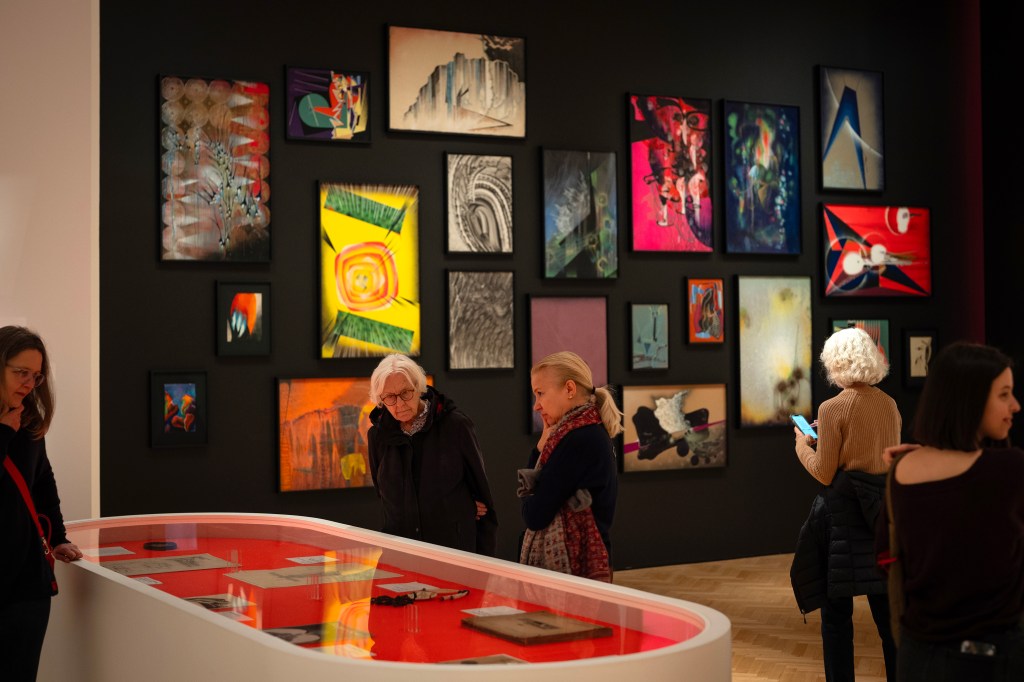
That’s made clear in the new exhibition “Bruce Goff: Material Worlds” at the Art Institute of Chicago through March 29.
Providing context for such idiosyncratic work isn’t easy. But it’s a task deftly tackled by curators Harold and Margot Schiff, Alison Fisher and Craig Lee.
More than 200 works are displayed, including architectural drawings and models, paintings and “realia” — objects of all sorts collected by Goff throughout his life for creative inspiration and everyday decoration. Some 80% of the work shown is drawn from the Art Institute’s extensive Goff archives.
Goff was born in Kansas in 1904 and was a child prodigy, starting his career with a firm in Tulsa at the age of 12 and producing a significant body of work there before moving to Chicago in 1934. He was an architectural vagabond, following job opportunities across the Great Plains throughout his life. But he is mostly closely associated with Oklahoma, where he directed the architecture school at the University of Oklahoma from 1947 to 1955, despite his own lack of academic training. While Goff’s work was mostly located outside the established cultural capitals, he was hardly an unknown during his lifetime. His houses were featured in such prominent periodicals as Life magazine in the 1950s and Vogue in 1972.
The precocious young Goff corresponded with Louis Sullivan and Frank Lloyd Wright early in his career. Both encouraged him to skip architecture school, advice that he followed. And unlike most architects who would come to define “modern” architecture, neither Sullivan nor Wright was a minimalist; neither was Goff.
The quote, “One doesn’t invent a new architecture every Monday morning,” is often attributed to Ludwig Mies van der Rohe. Goff was committed to creating a new architecture every day of the week. His work embodies highbrow and lowbrow materials through a time in the 20th century when architecture was trending hard toward highbrow minimalism.
The exhibit opens with some of the most atypical elements — selections of realia from Goff’s extensive personal collections. A mini disco ball, shag carpeting samples and assorted glass cullets, which are broken or waste glass, set the stage for the architect’s unorthodox work.
A cathedral sketch from 1914 when Goff would have been 10 years old demonstrates his early talent that would lead him to a professional job just two years later. Two unbuilt works from his teens, the carefully designed and rendered “A Modern House of the Midwest Type” from 1919, demonstrates his early enthusiasm for Wright, while the Grant McCullough Mausoleum from the following year builds on Louis Sullivan’s work.
The amazingly mature art deco-derived Boston Avenue Methodist Episcopal Church South in Tulsa, Oklahoma, was designed by Goff in 1928 while he was still at Rush, Endacott and Rush architects. He’s 24 at this time, an age when most architects are still in school.
Goff’s most iconic work is the Eugene and Nancy Bavinger House in Norman, Oklahoma, from 1950. An eccentric wood and steel door hints at the residence’s remarkable forms. An intricately rendered plan, elevation and interior perspective illustrate the soaring frenzy of space within the house’s logarithmic spiral.
The stunning unbuilt Viva Casino and Hotel in Las Vegas from 1961 looks as if the Jetsons held a circus at a parking garage. His last major public commission, completed after his death in 1982 by colleague Bart Prince, is the Pavilion for Japanese Art at the Los Angeles County Museum of Art. Its strikingly unusual forms might have risen from the ooze of the adjacent La Brea Tar Pits.
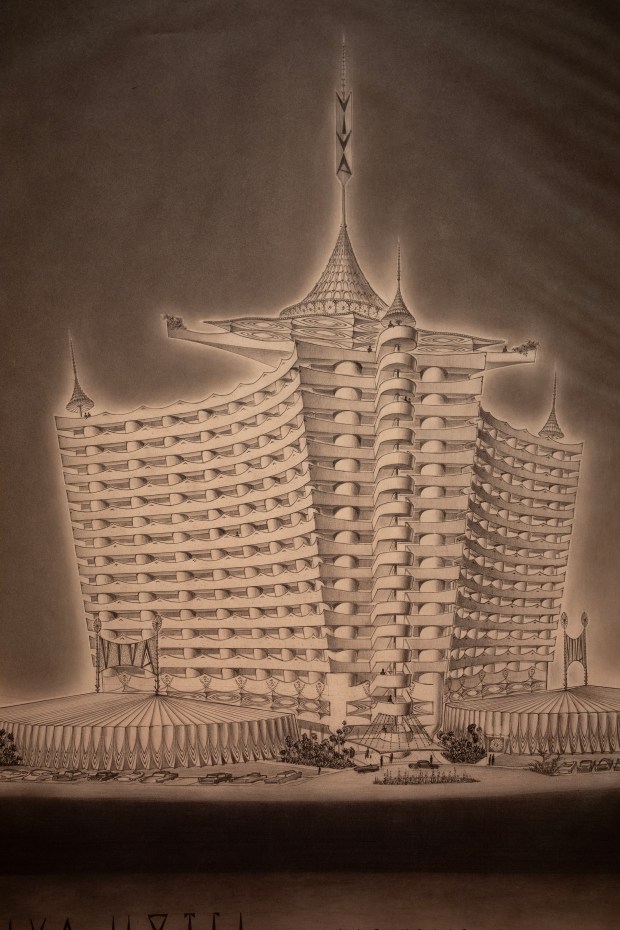 Bruce Goff’s unbuilt 1961 design for the Viva Casino and Hotel in Las Vegas in the exhibition “Bruce Goff: Material Worlds” at the Art Institute of Chicago, Jan. 9, 2026. (E. Jason Wambsgans/Chicago Tribune)
Goff spoke of the “continuous present” — a term used by curator Pauline Saliga as the title for the last major retrospective of Goff’s work at the Art Institute in 1995. With 30 years hindsight, it’s even easier to see the applicability of this term. While the work is constantly changing based on program and client, it’s hard to date each project and even harder to decipher the progression.
Goff’s vision remains singular more than 40 years after his death. His work is marked by unusual, even bizarre, material choices that encrust spatial compositions reminiscent of Frank Lloyd Wright’s innovative open space plans. Complex geometries are deployed to resolve atypical spaces including triangles, circles and quadrilaterals that defy conventional rectangular rooms, or furnishings. His work can sometimes seem like a bit of an architectural freak show, worthy of an HGTV series more than a museum exhibition.
It hasn’t always been properly appreciated. Goff’s best-known project, the Bavinger House, was demolished in 2016, despite widespread acclaim that included the American Institute of Architect’s 25-Year Award in 1987 and listing on the National Register of Historic Places in 2001.
“Bruce Goff: Material Worlds” is not your typical architecture exhibit, much as Goff was not your typical architect. Fundamentally, it’s a show about stuff: the stuff of creativity, the stuff of life and the stuff of an accomplished hoarder. And while the curators have definitely taken chances with how they’ve presented the material, the installation feels a bit too conservative for the work. A truer representation of Goff would have been a little less tidy and shown even more of his fascinating stuff. The installation 30 years ago, placed within the old horseshoe-shaped architecture and design galleries, was far more kinetic. Some of that spatial energy and drama would have added to this exhibit.
You may love the work, you may hate the work, but if you care even a little bit about design, you should get to the Art Institute before it closes, because this is architecture that surprises and challenges.
Edward Keegan writes, broadcasts and teaches on architectural subjects. Keegan’s biweekly architecture column is supported by a grant from former Tribune critic Blair Kamin, as administered by the not-for-profit Journalism Funding Partners. The Tribune maintains editorial control over assignments and content.
Submit a letter, of no more than 400 words, to the editor here or email letters@chicagotribune.com.