
Introduction: A New Era of Intelligent Healthcare
The United States healthcare system is undergoing one of the most profound technological shifts in its history. Artificial intelligence (AI), once confined to research laboratories and pilot projects, is now embedded across hospitals, diagnostic centers, pharmaceutical research, and administrative operations. From detecting diseases earlier to automating complex workflows, AI is redefining how care is delivered, managed, and optimized.
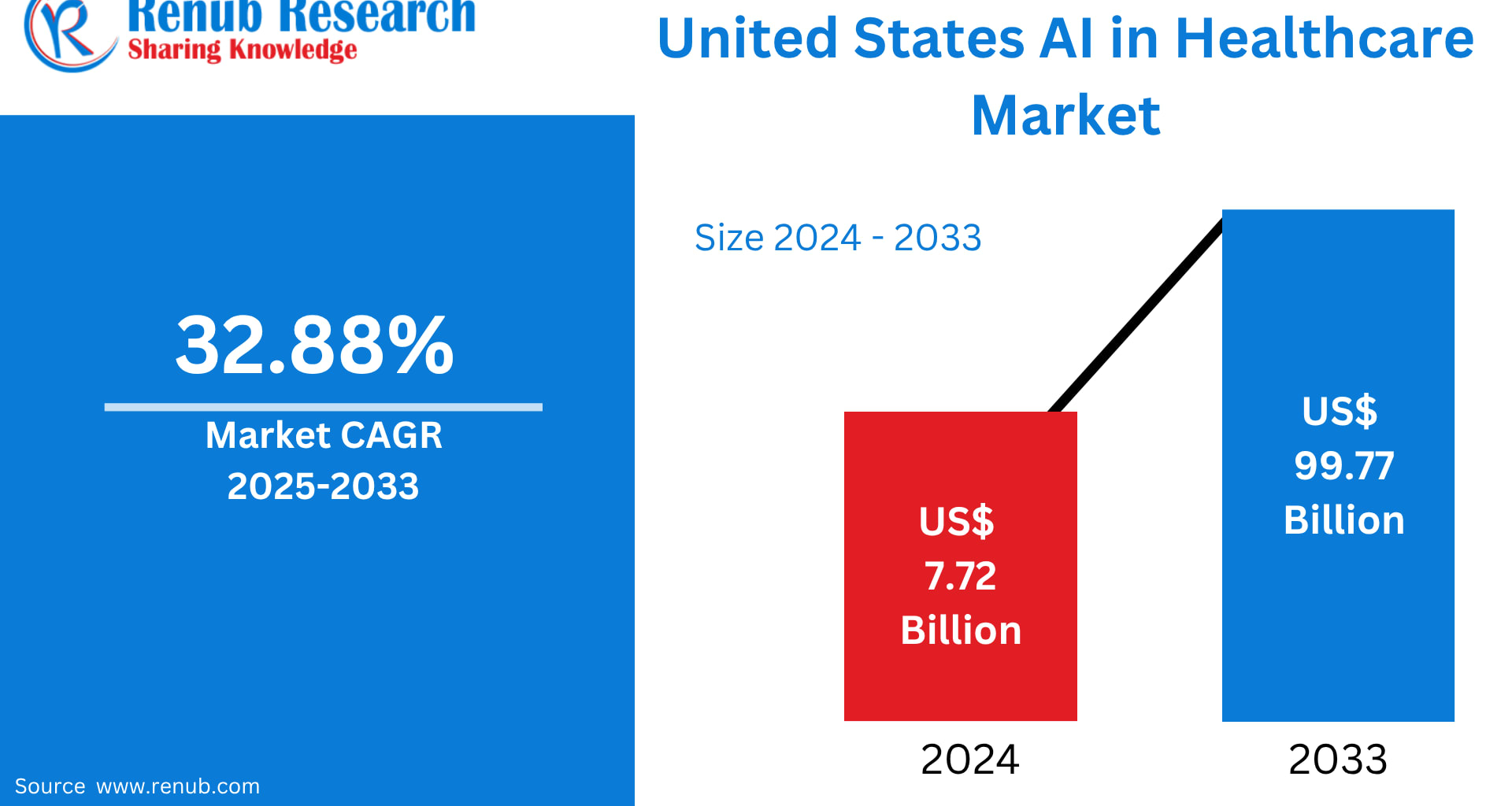
According to Renub Research, the United States AI in Healthcare Market is expected to grow from US$ 7.72 billion in 2024 to US$ 99.77 billion by 2033, registering an impressive compound annual growth rate (CAGR) of 32.88% from 2025 to 2033. This rapid expansion reflects a convergence of digital transformation, the push for precision medicine, rising healthcare costs, and growing investments in intelligent technologies.
Market Overview: What Is AI in Healthcare?
Artificial intelligence in healthcare refers to the application of advanced algorithms, machine learning models, and data analytics to enhance diagnosis, treatment planning, clinical workflows, and patient management. These systems can analyze massive volumes of medical data—from electronic health records (EHRs) and imaging scans to genomic profiles and clinical notes—at speeds and scales far beyond human capability.
Key applications include:
Medical imaging and diagnostics: AI models identify patterns in radiology, pathology, and cardiology images, improving early detection and diagnostic accuracy.
Predictive analytics: Algorithms assess patient risk, forecast disease progression, and optimize treatment strategies.
Drug discovery and development: AI accelerates molecule screening, clinical trial design, and real-world evidence analysis.
Virtual health assistants and automation: Chatbots, voice assistants, and intelligent scheduling tools streamline patient interactions and administrative tasks.
By automating repetitive processes and augmenting clinical decision-making, AI reduces operational costs, minimizes errors, and enhances patient outcomes. As healthcare systems confront growing demand, workforce shortages, and rising expenses, AI is emerging as a critical tool for sustainable transformation.
Key Growth Drivers
1. Expanding Integration of AI in Clinical Decision-Making
One of the strongest catalysts for market growth is the increasing use of AI in clinical decision support. AI-powered systems process imaging data, laboratory results, genomic information, and patient histories to deliver real-time insights that assist physicians in diagnosis and treatment planning.
Hospitals and research institutions across the United States are deploying AI to improve early disease detection, identify at-risk patients, and predict treatment responses. These tools not only enhance diagnostic accuracy but also reduce clinician workload by automating data interpretation.
A notable development occurred in April 2025, when Tempus partnered with Illumina to combine AI-driven clinical data with genomic sequencing. This collaboration strengthens precision medicine by enabling clinicians to tailor therapies based on a patient’s genetic profile. Such integrations demonstrate how AI is transforming evidence-based medicine into highly personalized, data-driven care.
2. Growing Adoption of Personalized and Precision Medicine
The U.S. healthcare sector is rapidly shifting from standardized treatments toward individualized care models. AI plays a central role in this transformation by analyzing genetic, environmental, and lifestyle data to design personalized treatment pathways.
In oncology, neurology, and cardiology, AI algorithms identify molecular markers, predict disease risk, and recommend targeted therapies. The integration of genomic sequencing with machine learning allows clinicians to anticipate how patients will respond to specific treatments, reducing trial-and-error approaches and improving outcomes.
The expanding digitization of health records, combined with big-data analytics, provides a robust foundation for predictive modeling. As precision medicine becomes a cornerstone of modern healthcare, AI enables providers to move beyond “one-size-fits-all” care, delivering treatments that are more effective, efficient, and cost-effective.
3. Advancements in Natural Language Processing (NLP)
Natural Language Processing (NLP) is revolutionizing how unstructured healthcare data is utilized. Physician notes, discharge summaries, medical transcripts, and patient communications contain valuable insights that were previously difficult to analyze at scale. NLP algorithms now extract, structure, and interpret this information for clinical decision-making and operational optimization.
NLP also powers conversational AI tools that support clinicians with real-time information retrieval and assist patients through symptom checkers, appointment scheduling, and post-care guidance.
In December 2024, California enacted Assembly Bill 3030, requiring healthcare providers to disclose when generative AI is used in patient communication. This legislation reflects both the rapid adoption of AI-driven language tools and the growing emphasis on transparency and ethical implementation. As hospitals expand AI-enabled documentation and communication systems, NLP is becoming a cornerstone of digital healthcare transformation.
Market Challenges
Data Privacy and Regulatory Compliance
Despite strong growth, the U.S. AI in Healthcare market faces significant regulatory and ethical challenges. AI systems depend on vast amounts of sensitive patient data, making data security and compliance with regulations such as HIPAA and emerging state-level laws critical.
Healthcare organizations must ensure transparency, prevent algorithmic bias, and safeguard against cyber threats. Inconsistent data-sharing standards and limited interoperability between systems further complicate AI integration.
Addressing these issues requires robust cybersecurity infrastructure, standardized governance frameworks, and ethical AI guidelines that balance innovation with patient trust and legal compliance.
High Implementation Costs and Skill Gaps
The cost of implementing AI technologies remains a barrier, particularly for small and mid-sized healthcare providers. Integrating AI requires substantial investment in software, hardware, and workforce training. As a result, adoption is often uneven across regions and institutions.
Additionally, the healthcare workforce faces a skills gap in using advanced AI tools effectively. Many clinicians lack training in data science and AI-driven decision systems, creating a disconnect between technological capability and real-world clinical application.
Overcoming these challenges will require affordable AI solutions, expanded educational programs, and stronger collaboration between technology providers, healthcare institutions, and academic organizations.
State-Level Market Insights
California: The Innovation Leader
California dominates the U.S. AI in Healthcare market, supported by its world-class technology ecosystem, research institutions, and venture capital networks. Silicon Valley’s AI startups, in partnership with leading hospitals and universities, are driving advancements in diagnostics, automation, and precision medicine.
While regulations such as the California Consumer Privacy Act (CCPA) demand strict data protection, they also promote ethical innovation. With its strong infrastructure and continuous investment in digital health, California remains the benchmark for AI-enabled healthcare in the United States.
Texas: A Rapidly Expanding Hub
Texas is emerging as a major growth market, fueled by expanding medical research centers and increasing health-tech investments. Hospitals in Houston, Dallas, and Austin are adopting AI for imaging, predictive diagnostics, and patient monitoring.
The state’s large and diverse population provides rich datasets for algorithm development, enhancing disease prediction and personalized treatment models. While challenges such as interoperability and rural healthcare access persist, Texas’s business-friendly environment and strong academic-industry partnerships are accelerating AI adoption.
New York: Research-Driven Growth
New York’s market is shaped by its advanced medical institutions, strong investment community, and supportive innovation policies. Academic medical centers are integrating AI into drug discovery, diagnostics, and patient management, while collaborations between AI startups and healthcare systems continue to grow.
Although high costs and privacy concerns remain challenges, New York’s combination of research excellence and financial strength positions it as a key contributor to the national AI healthcare ecosystem.
Florida: Meeting the Needs of an Aging Population
Florida’s AI in Healthcare market is expanding rapidly, driven by its growing elderly population and rising demand for efficient care delivery. Healthcare networks in Miami, Tampa, and Orlando are leveraging AI for remote monitoring, chronic disease management, and predictive analytics.
Public-private partnerships are helping integrate AI into geriatric care, cardiology, and telehealth. While workforce readiness and data integration remain hurdles, Florida’s investment in digital health infrastructure is making it a rising player in AI-driven healthcare innovation.
Recent Industry Developments
The U.S. AI in Healthcare market has witnessed a surge in high-impact collaborations and technological breakthroughs:
March 2025: Solventum and SprintRay launched the first permanent, chairside 3D-printed crowns, inlays, and onlays, enabling same-day dental restorations and enhancing patient experience through digital dentistry.
July 2024: Microsoft partnered with Mass General Brigham and the University of Wisconsin–Madison to develop AI models for medical imaging across over 23,000 conditions, boosting diagnostic accuracy and radiologist productivity.
June 2024: Tempus received FDA 510(k) clearance for Tempus ECG-AF, an AI-driven algorithm designed to detect patients at risk of atrial fibrillation, supporting early diagnosis and preventive care.
January 2024: Siemens and Amazon Web Services (AWS) integrated Amazon Bedrock into the Mendix low-code platform, enabling easier development of generative AI applications and expanding AI accessibility across industries.
These developments highlight the accelerating pace of innovation and the increasing involvement of technology giants, medical institutions, and regulatory bodies.
Market Segmentation
By Offering
Hardware
Software
Services
By Technology
Machine Learning
Context-Aware Computing
Natural Language Processing
Others
By Application
Robot-Assisted Surgery
Virtual Nursing Assistants
Administrative Workflow Assistance
Fraud Detection
Dosage Error Reduction
Clinical Trial Participant Identification
Preliminary Diagnosis
Others
By End User
Healthcare Providers
Pharmaceutical and Biotechnology Companies
Patients
Others
Geographic Coverage
The market is analyzed across 29 U.S. states, including:
California, Texas, New York, Florida, Illinois, Pennsylvania, Ohio, Georgia, New Jersey, Washington, North Carolina, Massachusetts, Virginia, Michigan, Maryland, Colorado, Tennessee, Indiana, Arizona, Minnesota, Wisconsin, Missouri, Connecticut, South Carolina, Oregon, Louisiana, Alabama, Kentucky, and the Rest of the United States.
Competitive Landscape
Key players shaping the market include:
Amazon Web Services Inc.
General Vision Inc.
Google Inc.
Intel Corporation
Medtronic
Micron Technology Inc.
Microsoft Corporation
Next IT Corporation
Nvidia Corporation
Siemens Healthcare
Each company is analyzed through five strategic dimensions:
Company Overview, Key Persons, Recent Developments & Strategies, SWOT Analysis, and Sales Analysis.
Final Thoughts: The Future of AI-Powered Healthcare
The United States AI in Healthcare Market stands at the forefront of a digital revolution that is reshaping the way medicine is practiced, managed, and experienced. With market size projected to soar from US$ 7.72 billion in 2024 to US$ 99.77 billion by 2033, AI is no longer an experimental tool—it is becoming the backbone of modern healthcare.
Driven by precision medicine, advanced analytics, NLP breakthroughs, and supportive regulatory momentum, AI is enabling earlier diagnoses, personalized treatments, and more efficient healthcare delivery. While challenges related to data privacy, costs, and workforce readiness remain, continued collaboration between policymakers, healthcare providers, and technology innovators will determine the pace and equity of adoption.
As the U.S. continues to lead global healthcare innovation, artificial intelligence will play a defining role in building a smarter, more accessible, and more patient-centric healthcare system—one where data, intelligence, and compassion converge to deliver better outcomes for all.