
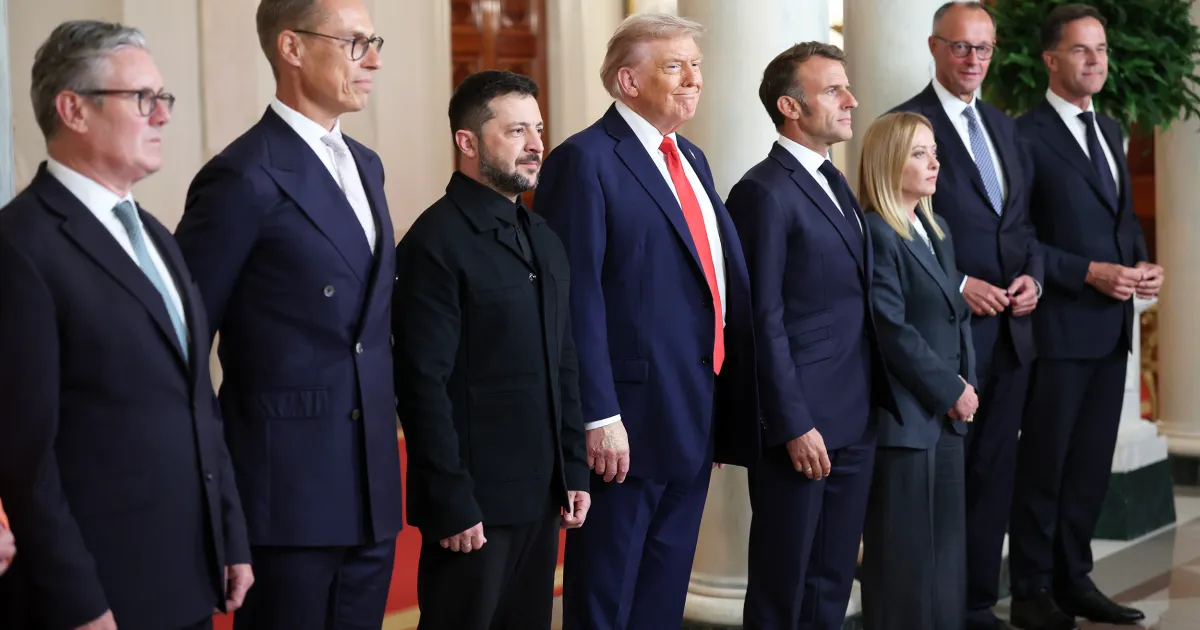
As Donald Trump considers a maximalist foreign policy vision rooted in his whims and “psychological” needs, it’s worth appreciating the degree to which the rest of the world has taken note of the president’s erratic radicalism. Consider some of the developments from the past week:
The leaders of France, Germany, Britain, Italy, Poland, Spain and Denmark issued a joint declaration this week that warned the United States that they would “not stop defending” the values of sovereignty and territorial integrity following Trump’s threats related to Greenland.
The U.S. faced a rare rebuke at an emergency meeting of the United Nations Security Council this week, where even our allies said Trump’s military offensive in Venezuela violated the U.N. charter and “chips away at the very foundation of international order.”
German President Frank-Walter Steinmeier, who has a largely ceremonial role, warned of a major global realignment this week, insisting that there had been a “breakdown of values by our most important partner, the USA, which helped build this world order.”
The Netherlands announced this week that it’s scaling back its participation in U.S.-led missions to counter drug trafficking in the Caribbean because of its opposition to the Trump administration’s deadly military operations against civilian boats. That came on the heels of a related announcement from Great Britain, which said it would stop intelligence sharing with the U.S. about boats in the Caribbean for the same reason.
If we look back just a few weeks earlier, Denmark’s military intelligence service for the first time also described the U.S. as a potential security risk.
In isolation, each of these stories was and is important, but taken together, the emerging picture is one in which much of the world is not only afraid of what’s become of the United States, but is also forging new partnerships and alliances that leave us behind.
As The Washington Post’s Max Boot put it in a late-November column, much of the world has started to see the U.S. as a “rogue nation,” and as a result, traditional allies “are looking elsewhere.”
The New York Times had a related report in June, noting, “New trade deals. Joint sanctions against Israel. Military agreements. America’s closest allies are increasingly turning to each other to advance their interests, deepening their ties as the Trump administration challenges them with tariffs and other measures that are upending trade, diplomacy and defense.”
Six months later, this dynamic continues to intensify.
At a campaign-style event in Pennsylvania last month, the American president repeated one of his favorite boasts. “We’re respected again as a country,” the Republican declared. He had pushed a similar line a week earlier at a White House Cabinet meeting, claiming, “America is strong and respected again. On the world stage, we’re really respected.”
Recommended

Steve Benen is a producer for “The Rachel Maddow Show,” the editor of MaddowBlog and an MS NOW political contributor. He’s also the bestselling author of “Ministry of Truth: Democracy, Reality, and the Republicans’ War on the Recent Past.”
Latest Post
National Portrait Gallery changes Trump portrait, removes text about Jan. 6