
The new year has started where 2025 ended – with soaring share prices on both sides of the Atlantic and bubbling enthusiasm among Wall Street investors about the –glorious prospects ahead.
There is widespread and unguarded belief in the alchemy of artificial intelligence (AI), and limitless faith that large-scale investment in smarter chips and bigger data centres will drive equity prices into ever higher territory.
The world’s biggest banks and private credit lenders have embraced AI as the gateway to financial utopia.
In the past year, they shelled out $100 billion (£75 billion) in loans to Silicon Valley and its AI pioneers. Sam Altman‘s OpenAI expects to burn through $17billion (£13 billion) of borrowed cash in 2026.
The enthusiasm is infectious. Today, hordes of inexperienced Gen Z investors exchange financial information on social media, notably Reddit, and are plunging into speculative share-dealing.
With investors everywhere fearful they might miss out on the quick gains promised by the supposed democratisation of markets, the power of the herd is on terrifying display.
So, reading Andrew Ross Sorkin’s masterful new book, 1929: The Inside Story Of The Greatest Crash In Wall Street History, over Christmas was as troubling an experience as it was intriguing.
Today’s unshakeable belief in rising markets – that the direction of stocks and shares is forever upwards – seems disturbingly familiar.
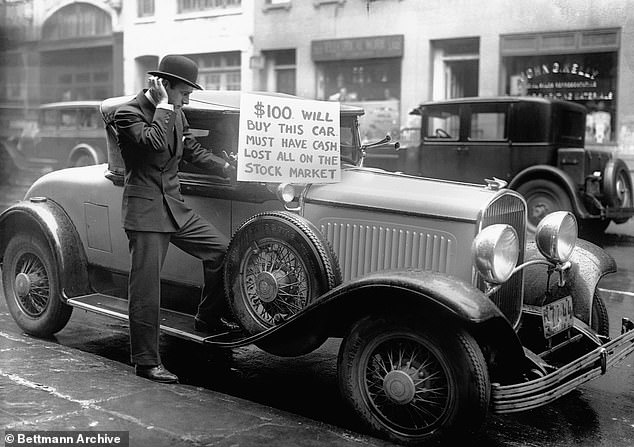
A bankrupt investor in New York tries to sell his car after 1929 crash
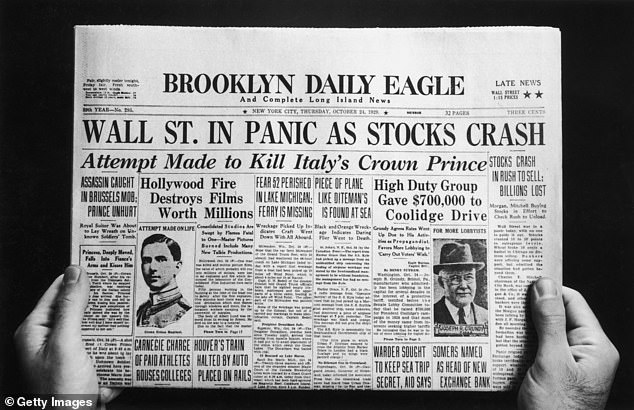
Sorkin’s very human account of ‘Black Thursday’, October 24, 1929, and the subsequent Great Depression of the 1930s is less literary and analytical than John Kenneth Galbraith’s classic, The Great Crash 1929. But he is terrific on the opulent lives and motives of the Wall Street players who created the 1920s bubble by offering cheap and easy credit to anyone wanting shares. Anyone at all.
It was not just bankers and speculators who were sucked into the euphoria, but people from Main Street America. Even the bootblacks buffing the shoes of Wall Street deal makers absorbed the gossip and passed it on to fellow punters.
Humble messengers carrying brokers’ buy-and-sell orders got in on the act. So, too, did the women manning switchboards who eavesdropped on conversations between bankers and their clients.
It was an era of seductive illusion, a time when New York and the nation were transfixed by the idea that share markets rise but never come down.
Ordinary Americans – the equivalents of today’s social-media investors – were sucked into the vortex. Speculation was so much easier than a hard day’s work.
They bought into the idea that everyone had the right to profit from rocketing share prices. Many borrowed money to buy shares ‘on margin’, when the down payment was only a fraction of the total price. And access to cash was easy: banks right across the republic offered credit.
Even the supposed experts, the financial Titans of their day, made huge personal bets on surging stock prices, buying and selling for themselves and their families.
But the enormous borrowings funnelled into Wall Street could not be paid back. A trickle of sales became a torrent. Banks and individuals alike were forced to exhaust wealth and savings in a vain, Canute-like attempt to turn back a tide of selling which soon engulfed the nation.
A staggering 13 million people were thrown out of work. Thousands of community banks across the 48 states would eventually fail. Demoralising ‘Hoovervilles’, shanty towns for dispossessed Americans without homes, jobs or income, sprang up around the country
In October 1929, the markets finally imploded. The streets in and around Wall Street, at the foot of Manhattan, filled with ordinary investors. New York cops arrived to control the increasingly angry crowds.
In Washington, blind belief prevailed. President Herbert Hoover and veteran US Treasury Secretary Andrew Mellon were certain that free markets would steady themselves. As history records with terrible certainty, they were wrong.
A staggering 13 million people were thrown out of work. Thousands of community banks across the 48 states would eventually fail. Demoralising ‘Hoovervilles’, shanty towns for dispossessed Americans without homes, jobs or income, sprang up around the country.
Even today, the experience is seared into the soul of America – but that is not to say that all the lessons have been learned.
Take, for example, the striking failure of leadership from what was then a relatively new and inexperienced central bank, the Federal Reserve. Lacking power or influence, it was all but paralysed as the crisis unfolded.
Almost a century later, we have another crisis of financial leadership, albeit in a different form. Donald Trump’s dispute with Fed chairman Jay Powell – whom he accuses of keeping interest rates too high for too long. Disputes between governments and central banks are a known factor in market meltdowns.
Trump is mocked for deploying his real-estate associate, Steve Witkoff, as peace envoy to the Middle East and Ukraine. But there is nothing new about cronyism.
As Wall Street soared to dangerous new heights ahead of the 1929 crash, Herbert Hoover dispatched Thomas Lamont, managing partner of blue-blooded bankers
JP Morgan, to negotiate an updated reparations deal between France and Germany.
Now, as then, delusion reigns on both sides of the Atlantic. In 1929, the daily exultation was fed by a belief that easy wealth was there for everyone. Bankers and financiers fed the myth by providing the easy credit to fuel share purchases – which sent the stock markets ever higher.

Trump is mocked for deploying his real-estate associate, Steve Witkoff, as peace envoy to the Middle East and Ukraine, but there is nothing new about cronyism
I detect similar blind faith today. At the core of the current equities boom is the domination of the tech giants – the likes of Meta (Facebook) and Alphabet (Google). There is a widespread conviction that the trillions of dollars wagered so far on AI will usher in a new industrial revolution and open the floodgates to even greater wealth.
Some see the enormous investment deals in artificial intelligence and data centres as evidence that the world is on the cusp of a great leap forward.
On this reading, mega deals such as Softbank’s $41 billion (£31 billion) bet on OpenAI, a $10billion (£7 billion) cash-raise by Anthropic and Nvidia’s $3 billion (£2 billion) investment in Israeli AI21 are welcome symbols of confidence.
The race to build power-hungry data centres for AI is necessarily built on debt, because the costs are so astronomically high. And that means completely unproven tech businesses must borrow heavily to stay in the game.
The great wealth and high values of the ‘Magnificent Seven’ – Alphabet, Amazon, Apple, Meta, Microsoft, Nvidia and Tesla – have been built on vast sales and cashflows. Yet now they are spending without, it seems, any imminent prospect of financial return.
Even Silicon Valley has its doubts. Data from PitchBook, a leading supplier of financial information, shows that tech start-ups have quietly raised $150 billion (£112 billion) of funding to build ‘fortress’ balance sheets to protect them if – or perhaps when – the air comes out of balloon.
The behaviour of investors is striking, too. Even as share markets rise, vast sums of money continue pouring into precious metals.
Gold and silver are seen as a ‘hedge’, an insurance policy, against a stock market implosion – which is hardly a vote of confidence. Gold bullion has risen by 60 per cent in the past 12 months. Silver has gone up by a staggering 160 per cent.
In fact, the warnings are persistent. Bank of England governor Andrew Bailey has suggested that AI might eventually usher in a new industrial revolution. But he accompanied that upbeat assessment with a warning about an ‘artificial-intelligence-induced bubble in markets’.
Meanwhile, as the debt piles up, the practical difficulties of developing AI are largely glossed over. A lack of building capacity, for example, means that it might take years before sprawling new data centres start generating revenue.
Big tech claims that an obvious shortage of energy to run data centres will be met by nuclear power in the shape of small modular reactors. Yet not only are these new reactors as yet unproven, they are nowhere near regulatory approval.
And what if it turns out that AI is already old hat? Technology is advancing at bewildering speed. What if, for example, so-called quantum computing turns out to be the next big thing? If so, we would be left with surplus AI computing power, unwanted data centres and a cascade of financial defaults.
Last month, speaking to The Wall Street Journal, global investment firm Alliance Bernstein put it plainly: We just have to be much more pessimistic and not buy into the hype.’
Is anyone listening? Despite these and other such warnings, the markets have stormed ahead in 2026. Britain’s FTSE100 index has climbed above 10,000 for the first time.
Yet there are good reasons to fear that the current share-price boom is built on the same sort of wobbly foundations that gave way so disastrously in 2008.
Then, it was the mountain of debt plus the complexity of ‘financial engineering’ – based on the flimsy security of sub-prime mortgage lending – that brought global capitalism to a shuddering halt.
In the aftermath, central banks around the world came together to make banking safe once again.
Imposing tough new regulations and lending limits, they wanted to protect depositors and reassure borrowers that lines of credit will not suddenly dry up.
There has, however, been this consequence: instead of borrowing from banks with deep reserves of capital, entrepreneurs and speculators have turned to private credit markets, away from the prying eyes of regulators.
And it is to this shadow banking sector – dominated by speculative hedge funds, private equity sharks and avaricious Gulf-based wealth funds – that AI investors have been turning.
As 2025 drew to a close, the international Financial Stability Board warned that private finance has usurped regulated banking as the biggest provider of debt at $257 trillion (£192 trillion).
There are huge differences between 1929 and now. In particular, governments are more prepared to intervene.
Yet, while I hate to be a harbinger of doom, there are still too many awkward similarities for my liking. My fear is that successive firestorms in the 21st century – including the 2008 crisis, the pandemic and Russia’s invasion of Ukraine – have left our financial defences in a parlous state.
It is increasingly clear that governments and central banks across the West lack the power and resources to intervene effectively. Our global defences against a tsunami of crashing markets and financial failure remain as fragile as in Hoover’s time.
Today, the technology has changed but the basic facts remain the same. Don’t say we haven’t been warned.
DIY INVESTING PLATFORMS

AJ Bell
AJ Bell
Easy investing and ready-made portfolios

Hargreaves Lansdown
Hargreaves Lansdown
Free fund dealing and investment ideas

interactive investor
interactive investor
Flat-fee investing from £4.99 per month

Freetrade
Freetrade
Investing Isa now free on basic plan

Trading 212
Trading 212
Free share dealing and no account fee
Affiliate links: If you take out a product This is Money may earn a commission. These deals are chosen by our editorial team, as we think they are worth highlighting. This does not affect our editorial independence.