
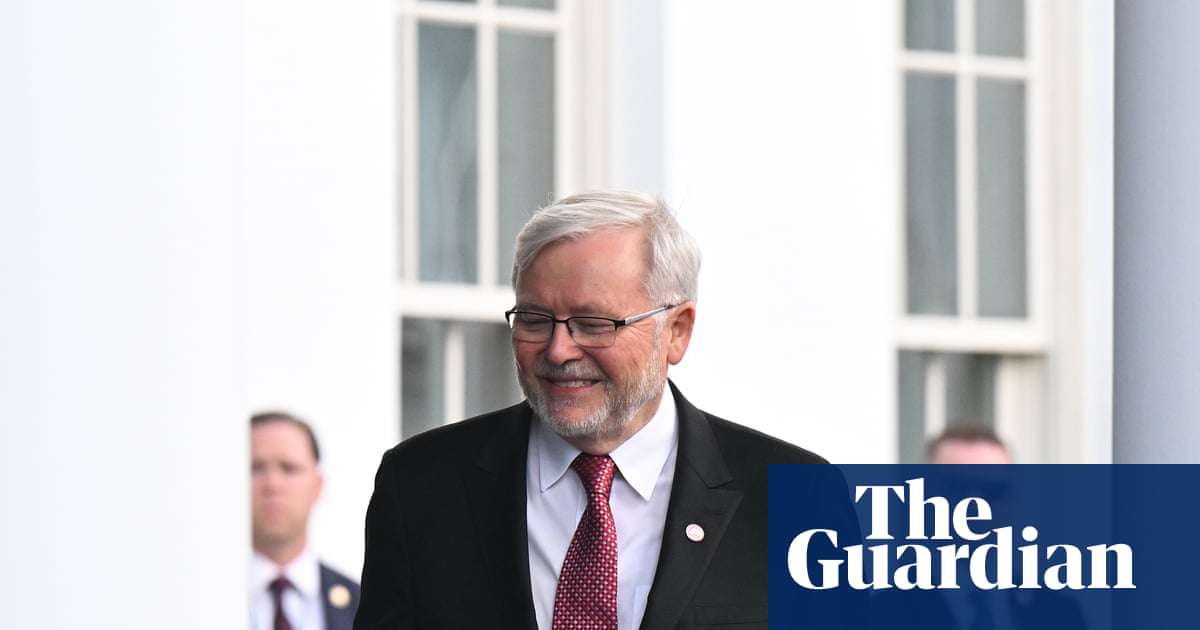
Kevin Rudd will step down as Australian ambassador to the US at the end of March, Anthony Albanese announced on Tuesday morning.
The former prime minister and foreign minister will leave the role a year early, on 31 March, after being appointed global president of the international relations thinktank the Asia Society. Rudd will also head the society’s Centre for China Analysis.
Appointed as Australia’s envoy to Washington in December 2022, Rudd will be departing after locking in ongoing support for the Aukus nuclear submarine agreement from US President Donald Trump, helping negotiate the release of WikiLeaks founder Julian Assange, and securing agreements on critical minerals and AI.
A controversial figure within Labor, due to lingering enmity from his leadership battles with rival Julia Gillard, Rudd’s appointment has not been without controversy.
His social media commentary about Trump proved a diplomatic sticking point with the White House. In 2020, he called Trump “the most destructive president in history”, leading to an awkward moment during Albanese’s first face-to-face meeting with Trump in October.
Albanese said the decision had been Rudd’s alone, praising his contribution to ties between Canberra and Washington under both Trump and his Democratic predecessor, Joe Biden.
Before serving as ambassador, Rudd was president and chief executive of the Asia Society from 2021 to 2023. He is a recognised expert on Chinese-American relations and the Chinese president, Xi Jinping.
“I have seen first-hand how hard he works, not just in the last few years but throughout his public life,” Albanese said.
“He’s always brought an extraordinary level of energy and discipline to public service.
“He applied his relentless effort, his experience, intellect and determination to advance Australia’s interests in Washington, and Kevin Rudd has served the nation well.”
The government is expected to announce a new ambassador in coming weeks.
Trump is yet to name his own envoy to Canberra, nearly a year into his second term.
The foreign minister, Penny Wong, praised Rudd and his wife, the businesswoman Thérèse Rein, saying their work in Washington had helped strengthen the Australian economy and security.
“Kevin has helped unlock billions of dollars in new investment and collaboration, including AI datacentres and quantum in sectors that will strengthen the Australian economy and our security for decades to come.
“He’s put Australia’s superannuation industry up with the United States, turbocharging our engagement and investment and strengthening our credentials as a financial services centre of the Indo-Pacific.”
Labor was criticised for not adequately preparing for the possibility of Trump winning the November 2024 presidential election, but Albanese pointed out Rudd that had maintained close ties with leaders of both major American political parties and had personally predicted Trump’s victory over Democrat Kamala Harris.
Albanese sidestepped a question about whether he might appoint former Liberal prime minister Scott Morrison as ambassador.
“The relationship that Kevin has had with members of the Trump administration … whoever follows Kevin, if it’s as good as that, I’ll be pretty happy.
“We’ll make decisions down the track about the right person with the right skills and the right skills to be able to reach across a broad spectrum of support. That was something that Kevin Rudd was able to do.”
In a statement posted to social media on Tuesday morning, Rudd thanked Albanese and Wong, describing his appointment to Washington as “an honour.”
“I will be remaining in America working between New York and Washington on the future of US-China relations, which I have always believed to be the core question for the future stability of our region and the world.
“As a ‘think and do’ tank, Asia Society’s formidable Center for China Analysis will be an important platform to that end.”
Both Labor and the Coalition have appointed former politicians to serve in Washington, including former Liberal treasurer Joe Hockey, Howard adviser Arthur Sinodinos, and former Labor leader Kim Beazley.