

The calendar has flipped to a new year and we’re now less than a month away from the opening of spring training. Though we are only in the second week of January, the MLB news cycle has already been filled with notable and sometimes puzzling developments. Here are a few news items that have me taking notice and, in some cases, shaking my head:
The Tigers’ arbitration filing number for their Cy Young ace, Tarik Skubal
Tarik Skubal had yet another standout season in 2025, leading the league in ERA+, FIP and WHIP, amassing 6.5 bWAR and winning his second consecutive Cy Young Award. He was just as outstanding in 2024, posting 6.4 WAR. He’s clearly been the best pitcher in the AL the last two seasons.
The Tigers are a file-and-trial organization, which means if they file, they go to a salary arbitration hearing and don’t settle. Last week, the Tigers filed at $19 million, while Skubal and his agent, Scott Boras, filed at $32 million. Keep in mind just two years ago Juan Soto broke the record when he and the Yankees agreed to a $31 million salary in his final year of arbitration. That came right after Soto finished sixth in the NL MVP voting.
You’re telling me that in his final year of arbitration-eligibility, Skubal shouldn’t earn more than Soto did? How do the Tigers rationalize their filing number? Compare it to David Price’s arbitration figure from 11 years ago — $19.75 million — which was even more than the Tigers’ offer to Skubal. The next year, Price landed a long-term deal in free agency with the Red Sox worth $31 million a year.
I spent over two decades in arbitration rooms doing these deals and quickly learned that decisions by the panel are usually driven by the player’s platform season and the season prior, with very little regard for how much of a raise the player is getting or what he did three years ago.
Skubal has five-plus years of MLB service time, which means during the arbitration hearing he can be compared to players who have already reached free agency. Dylan Cease’s new contract with the Blue Jays gives him an AAV of $30 million after going 8-12 with a 4.55 ERA with the Padres last year. Nick Martinez, a spot starter and middle reliever for the Cincinnati Reds, earned $21.05 million last year after he received and accepted the qualifying offer. If the arbitrator sides with the Tigers’ $19 million figure, Skubal would be paid even less than Martinez was in 2025 and significantly less than Cease.
When we look at all active pitchers, the only ones making more than $32 million are Zack Wheeler, Jacob deGrom, Gerrit Cole and Tyler Glasnow. Skubal has been better than all of them over the last two years — and it’s not even close. It’s hard to understand how the Tigers think they can win a case at $19 million.
The Tigers had already embarrassed themselves with their long term-offer to Skubal, which was not even in the ballpark of what he’s looking for, and now they want to alienate him even further by treating him like this?
Skubal should be in a good position regardless. I believe he’ll get the record award of $32 million once the case is heard and then he can wait for whenever the Tigers decide to trade him, which will probably be in July. The Tigers, meanwhile, will continue to lose face. Former big-league stars like Josh Donaldson are calling them “a trash organization” on social media over this decision. I think they’ve mishandled the entire situation.
In the meantime, the Tigers probably should be pursuing Framber Valdez or Ranger Suárez in free agency so they can replace Skubal when the inevitable divorce takes place.
Labor talk rings in the new year
With the collective bargaining agreement between the league and the players’ union set to expire in December, 2026 is going to be a year of labor talk.
There is strong sentiment that MLB is looking for a new player compensation/revenue system in the next CBA. Last week, commissioner Rob Manfred spoke about several potential changes the league might pursue. One of the ideas he floated was a winter free-agent signing deadline that would ostensibly create more of a media frenzy around free agency by consolidating the amount of time teams and players had to negotiate.
Based on comments MLBPA president Tony Clark made to my colleague Evan Drellich of The Athletic, the union is looking for significant changes to the system, too, but not the same ones outlined by Manfred.
“Free agency thrives when competition thrives — on and off the field,” Clark said in a statement to The Athletic. “If the owners are genuinely interested in improving free agency, there are many ways to get there, and we look forward to having that discussion in the coming months.
“But if their true interest is to blow up the very system on which our streak of uninterrupted seasons has been built — with the game reaching record heights and poised to go even higher, no less — that would be a self-defeating miscalculation of massive proportions.”
Like everyone in the industry, I will be tracking how these discussions evolve over the next several months. Baseball needs significant changes to its player compensation and revenue system. A perfect system is likely going to take compromises from both sides.
Currently, we have a system that has resulted in the teams from the bottom-15 revenue markets not winning a World Series since the Kansas City Royals did it in 2015. We have a system under which the players don’t get even 50 percent of the league’s overall revenues, a percentage cut that’s less than all the other major U.S. sports. Half of the players have no chance to win a World Series this year and many of those players can’t get to free agency for as many as six years to be able to sign with a big-market team.
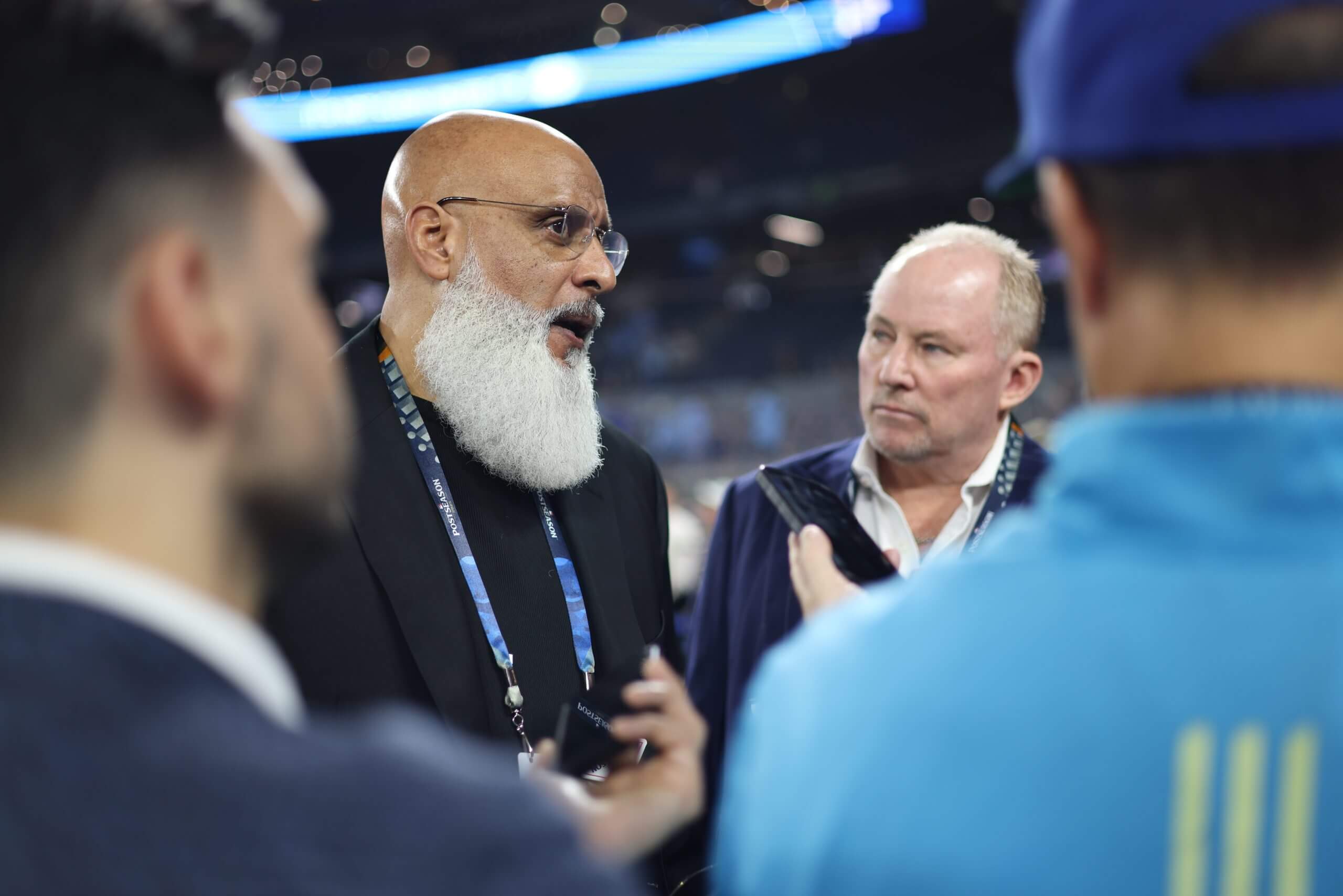
MLBPA president Tony Clark chats with the media during the 2024 World Series. (Rob Tringali / MLB Photos via Getty Images)
We have a system designed for the Los Angeles Dodgers and other big-market teams that caters to the top superstars but ignores the vast majority of players who are mostly underpaid relative to what they deserve based on the amount of revenue the industry is generating.
The MLBPA should be screaming for a bigger share of the pot for their players. And both sides should be interested in a system that allows all 30 teams some type of shot at a title and not just a wild-card berth.
The big-market teams are always going to have an advantage and the top superstars are always going to get paid more than the rest of the industry regardless of the system. But don’t you want to see more balance? Don’t you want to see a salary floor to make all teams spend the money they receive from revenue sharing? Under the current system, there isn’t much motivation for smaller-market owners to spend more than they are already spending. If your team is among the bottom-15 markets and the odds are severely stacked against you winning the World Series, like they are in the current system, why would you spend more money if you know you can’t win a title?
That’s an unacceptable system. In a better system, there should be a salary floor and a requirement that all teams spend a certain portion of their revenues. From there, figure out what’s fair. You also need to close the gap between the small and big markets payroll-wise. How much of an advantage should they get? Should the difference be $100 million? $200 million? $300 million? I know the current system doesn’t work because the Dodgers’ luxury tax bill this year is more than 16 teams’ total player payrolls.
The MLBPA should be banging on the table for a better labor agreement because their union is not getting their fair share of revenue, the majority of their members aren’t getting their fair share in terms of salary because it’s too disproportionately skewed to star free agents, and the majority of their members don’t have a chance to win a ring.
Yes, the current system is reaching new heights in terms of salaries and the rule changes have been a huge hit, but it can also get a lot better, so both sides need to improve it.
How Don Mattingly’s contract was handled by the Blue Jays and Phillies
Don Mattingly is one of the classiest people in baseball. He made it clear to the Blue Jays this offseason that he wanted to move on from their bench coach job to join the Phillies, where he would have the opportunity to work with his son Preston, who is the GM in Philadelphia.
Toronto understood his reasoning and empathized with it, so why did Mattingly have to wait until his contract ran out on Dec. 31 to secure his new deal in January with the Phillies? Seems curious to me.
Mattingly had already done his work with Toronto, which expired after the last out of the World Series. The Blue Jays should have just paid him the rest of the deal and let him move on instead of this bizarre decision to make him wait the contract out. I felt like both teams could have made this work a different way.
Cody Bellinger is over-playing his hand with the Yankees
According to industry sources, Cody Bellinger and his agent, Scott Boras, are looking for a seven- or eight-year deal worth somewhere between $210 and $250 million. This has not been confirmed by the clubs or the Boras Corporation. However, if it is true, this demand is ridiculous. Kyle Schwarber, Pete Alonso and Alex Bregman all got five years and have been way more consistent over the last five seasons than Bellinger. In addition, a year ago the Cubs had to pay down Bellinger’s salary in order to trade him to the Yankees. I understand that he’s had injuries in his career, but he still slots in after Schwarber, Alonso and Bregman in the pecking order of free agents.
That said, he’s coming off a strong 5.1 bWAR season with 29 homers and an .813 OPS, and he can play all three outfield positions, as well as first base, above-average. However, that contract length is too risky based on his track record.
The only way Bellinger’s demands to the Yankees can be in that stratosphere is if he has that number on the table from another team, and it doesn’t appear that he does, unless there is a mystery team no one knows about.
At the end of the day, just because he’s at an impasse with the Yankees in negotiations doesn’t mean he can’t circle back and take their last offer if it’s the best deal he has in front of him. He may not have that option for long, however, as the Yankees are now pivoting to other scenarios. If suddenly they sign someone like Bo Bichette or trade for someone like Corey Seager, then they won’t have the money to sign Bellinger.
The best solution is probably for Bellinger to take the Yankees’ last offer and if he doesn’t, he’ll likely have to do what Alonso and Bregman did last offseason and accept a short-term deal with an opt-out, which worked out for both of them in the long run.
The Diamondbacks’ oddly public willingness to trade and then not trade Ketel Marte
I never understood the Diamondbacks’ willingness to make it public that they were trying to trade star second baseman Ketel Marte, who has been one of their best position players over the last five years — unless the player himself had asked to be traded.
The Diamondbacks fielded several offers for Marte and were looking for young pitching in return, but never found an offer they liked. Now they have proclaimed they are no longer going to trade him.
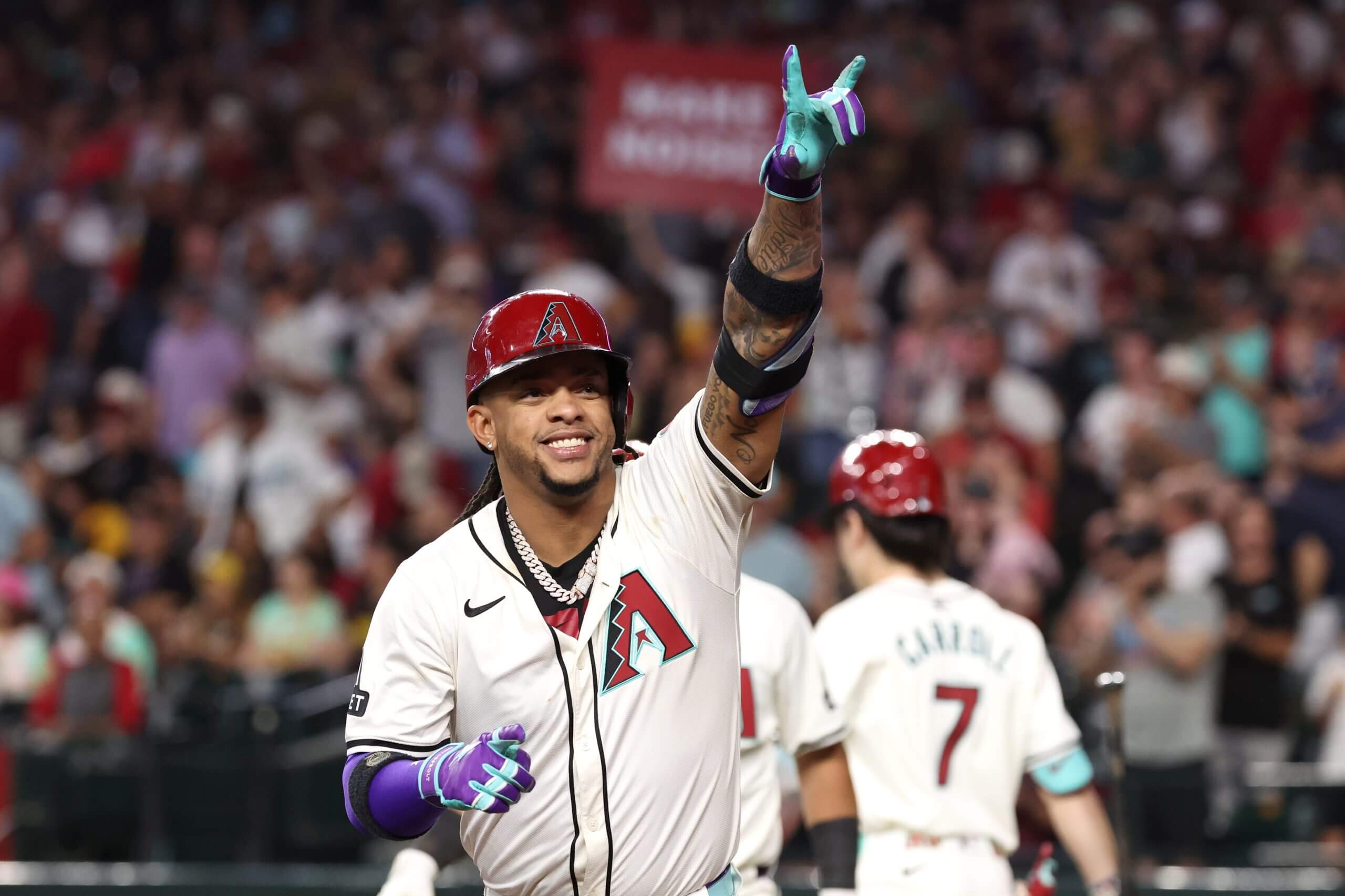
It’s been strange to see the Diamondbacks so open about their willingness and then unwillingness to trade Ketel Marte. (Chris Coduto / Getty Images)
What if a team they’d been talking to comes back to them and offers what the Diamondbacks were originally looking for? Of course in that circumstance they would trade him, but if they do after saying they weren’t going to move him, it could reflect poorly on the organization. I thought it was curious they wanted to make it known that he was available and then no longer available so publicly, but I guess as a media member I should be thankful because it gave us more to talk about, so thank you.
The A’s finding out now they can’t get the trademark for “Las Vegas Athletics”
The Athletics suffered a recent setback when the U.S. Patent and Trademark Office denied their applications for “Las Vegas Athletics” and “Vegas Athletics,” ruling the terms were too generic and geographically descriptive. The A’s can appeal and seem likely to secure the trademarks once they are fully operating in Las Vegas, but to find this out now makes you wonder why they waited so long to apply.
Since they’re planning to move to Las Vegas in two years, maybe they should consider changing their name from the Athletics to something more appropriate for Las Vegas like the Vegas Gamblers? They have two years to figure out the trademark issue or a new name — either way the news of the ruling is interesting.
The Giants not pursuing front-of-the rotation starters while touting the acquisition of the Curran Theatre
As was announced by the Giants president Larry Baer, the team’s ownership group has purchased the historic Curran Theatre in San Francisco from its longtime owner Carole Shorenstein Hays in a move to expand their overall business portfolio into the performing arts. The acquisition gives the Giants business group a new venue for hosting events and aligns with their strategy of leveraging assets.
However, if you’re going to invest in theaters, then why not invest in a top-of-the rotation arm to go along with Logan Webb and Robbie Ray rather than backfilling the rotation with Tyler Mahle and Adrian Houser?
I’m happy the Giants group has acquired the Curran but would be more happy for their fans if they invested in Framber Valdez or Ranger Suárez to give them a better shot to win the NL West or secure a wild-card berth.