
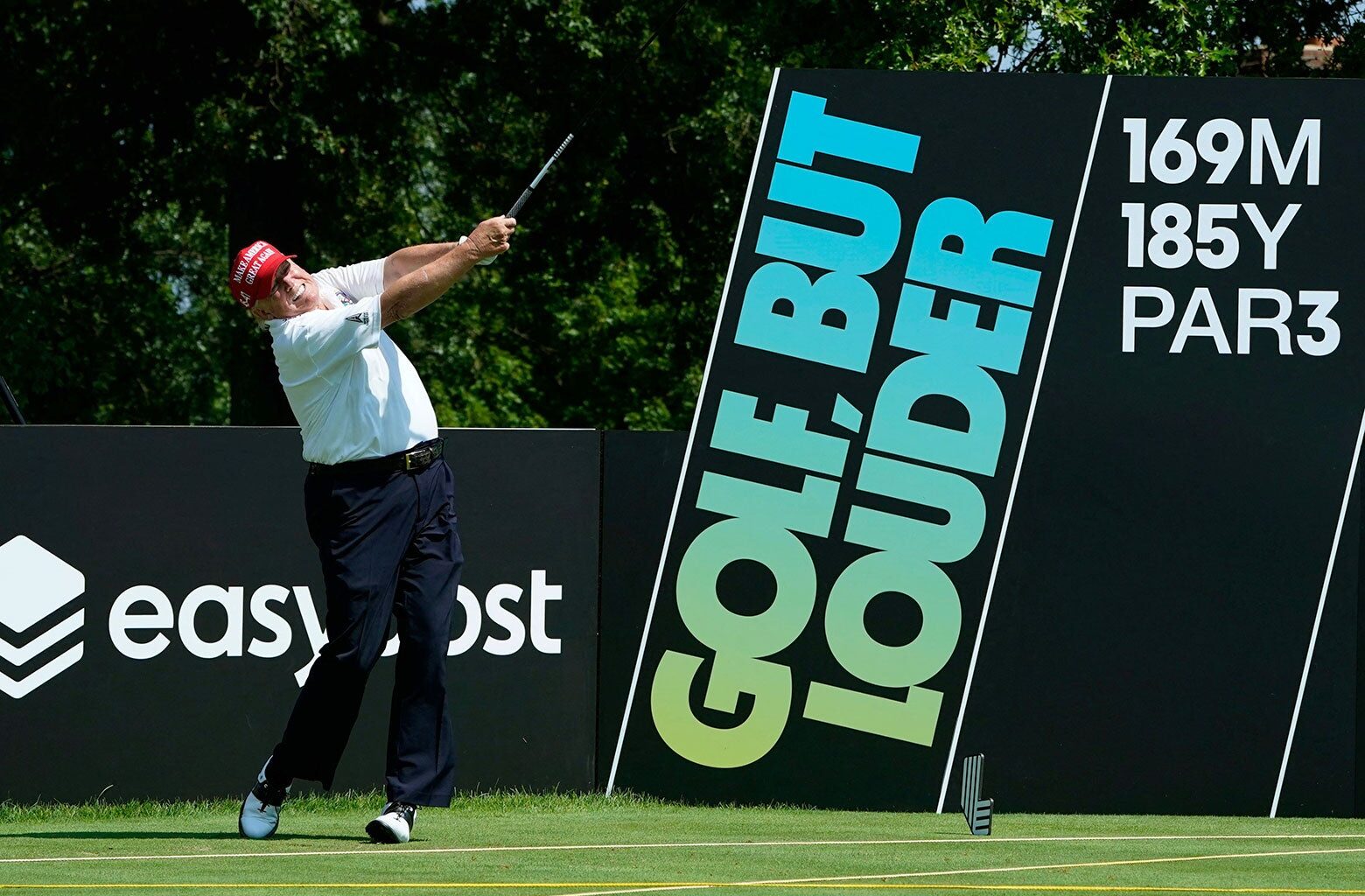
Can you kill a sports league whose owners are committed to losing what may well be infinite money in the service of keeping it alive? We might be about to find out. After nearly four years of fighting, including a brief period in which the parties looked close to a truce, the PGA Tour is on the verge of finishing off LIV Golf as any kind of serious player in the global golf scene.
This week’s big development is the PGA Tour’s reacquisition of Brooks Koepka, one of the most famous players in the world and the key piece of LIV’s poaching strategy that began in 2022. After spending the last few years playing for the Saudis, Koepka is returning to his old tour this month. He’ll miss out on equity in a new PGA Tour venture, donate $5 million to charity, and get back to his life.
Koepka’s return does two things that are very bad for the Saudi-backed influence operation–cum–golf tour. First, it robs the tour of one of its few marketable stars, and one of even fewer who can still contend in events golf fans actually care about. Second, it lays the groundwork for the PGA Tour to reclaim some or all of the other players who defected to LIV who might move the needle with the general public.
It was already clear that the “framework agreement” the sides announced in 2023 was not going to become a living, breathing agreement. But it’s now super-duper mega-clear that there will be no unification of the two golf tours. In one corner will be the PGA Tour. In the other, the Saudis will now have to decide whether they’re comfortable continuing LIV Golf as a circus act or if it’s time to cut their losses and spin them as a victory. Saudi Crown Prince Mohammed bin Salman will not take control of elite professional golf, but he may take some measure of pride that his doomed tour cost the PGA Tour a lot of money.
It did not always look like LIV Golf’s story would unfold this way. In 2022, the league poached a handful of very famous PGA Tour members, some of whom were even still good at golf. The league’s headliner was Phil Mickelson, one of the great players of all time and a legendary pitchman. Mickelson was well past his prime, and he can no longer contend in serious events. (These days, he is mostly a case study in what consuming right-wing media does to a person’s brain in the 2020s.) But Mickelson had long been an antagonist of the PGA Tour’s leadership, which he thought lacked vision and should have been directing more of the tour’s revenue into players’ pockets. LIV found a handful of serious talents who seemed to agree, or who at least enjoyed collecting guarantees in the tens or hundreds of millions.
When the league was nascent, players had to answer some obvious questions about joining a tour funded by the guy who had Jamal Khashoggi murdered. But the money was green, and LIV established a rather serious roster of big names and good players, including Cameron Smith, the 2022 British Open champion; Koepka, who’d already won four majors and would add a fifth during his time on LIV; and Bryson DeChambeau, who’s become a huge YouTube star.
The PGA Tour was worried enough about LIV that it tried to make peace with its Saudi rival in the summer of 2023. The two tours announced a “framework agreement” that was heavy on good vibes but light on details. The PGA Tour’s then-boss, Jay Monahan, sat grinning on a TV set with Saudi Public Investment Fund governor Yasir al-Rumayyan as they rolled out their commitment to a deal. But the deal never came together, as the sides failed to hash out difficult issues like what LIV Golf’s presence would be in a new, merged organization with the PGA Tour and how that organization would treat players who had defected. The PGA Tour kept its head down and worked on finding outside investors who weren’t the PIF. LIV continued to try to take the PGA Tour’s players, and in December 2023 it got its biggest fish yet: the Spaniard Jon Rahm, one of the world’s best players and in the prime of his career.
LIV had a few problems all this time, though. Most importantly, nobody cared, no matter how hard the Saudis tried to make it seem otherwise. The tour’s TV ratings never rose above the level of embarrassing, even as it got a deal with Fox Sports. LIV generated a lot of social media hype, but the golf reporter Joel Beall, in his book about the PGA Tour–LIV fight, Playing Dirty, talked with social media analysts who estimated that anywhere between 16 percent and 71 percent of LIV chatter on Facebook and Twitter was from inauthentic accounts. Why the lack of humanoid excitement? The tour’s main competitive innovations were 54-hole tournaments rather than 72 and the establishment of teams that LIV’s executives just assumed people would care about. Few people did, although somewhere I’m sure there’s a man who will tell his grandkids about the three times he watched the Crushers. LIV’s events were on second-rate golf courses, and the competition did not generate widespread interest. (Its own talent didn’t help here: Rahm, for example, told reporters that his streak of Top 10 finishes on LIV was not really that impressive.)
LIV tried to lure away more PGA Tour players but kept running into problems. The PGA Tour spent the past few years rolling out a bunch of financial carrots to get top players to stick around, and LIV’s lack of progress helped its rival retain talent. The Saudis also may have made a political miscalculation. When Donald Trump returned to power in January, they might have been under the impression that a major Saudi business partner would use his office to help them boost LIV Golf, which had held a series of events at Trump properties. This interpretation of Trump would be understandable! But when Trump held a confab between the two tours shortly after taking office, the guy in charge of LIV reportedly left furious that he hadn’t gotten more support from the president. Trump had antagonized the PGA Tour in recent years, but he was also close with tour loyalist Tiger Woods. With the PGA Tour placating Trump by bringing an event back to one of his courses this year, it appears LIV is no longer Trump’s special golf tour.
Jim Newell
I Knew the Ryder Cup Was Going to Be a Disaster—and Man Did It Deliver
Read More
LIV Golf has not added a player that even a casual fan of pro golf would care about since early 2024. Its contracts with its initial spate of stars are thought to mostly be expiring right around now. The PGA Tour has improved its bargaining position dramatically. Now LIV is subtracting rather than adding for the first time. That could get worse now that the tour has figured out the thorny issue of how to bring players back. The basic answer: If you left, you’re gone. But if you’re a certain level of star, you can return. That opens the door to Rahm, Smith, and DeChambeau, who, like Koepka, have recent major victories that would qualify them for a return to the PGA Tour with minimal consequence if they acted quickly.
This Awards Season Officially Has Its Villain
It Was Supposed to Be the Future of Pro Golf. Then It Collapsed Spectacularly.
The LIV party, to the extent it was ever a party, could be over soon. That is not exactly the same as the tour ceasing to exist, though. The PIF has infinite money, and al-Rumayyan is a golf nut who appears to still enjoy the support of the crown prince. There is even a chance that this year, LIV players begin to receive Official World Golf Ranking points for their participation in LIV events. To date, LIV players haven’t gotten those points, because LIV’s competition format falls outside the earn-your-way-up structure that characterizes other major golf tours. (For the most part, players are merely invited into the club.) Even if LIV loses more stars, it could keep existing as something that 47 people watch. It’s not like the people in charge are going to run out of money, so long as they don’t mind operating a sideshow.
There is no great moral win here. The PGA Tour ended that possibility when it tried to make a deal with a rival it had once criticized on the grounds of being insensitive to Sept. 11 survivors. With the exception of a few dozen professional golfers who have taken advantage of this geopolitical market distortion to make a lot more money, nobody is better off for LIV Golf having come into the world. Fans have missed out on three years and counting of watching the best players compete head-to-head on a regular basis, and a nation-state has burned billions of dollars that it could have spent doing literally anything else. Whether it continues to spend cash or finally ends this charade, nobody involved should be proud of their work.
Get the best of movies, TV, books, music, and more.