
At the best of times, virtual reality can enable the type of gaming experiences you would be unable to find anywhere else – over the last several years, owners of Meta Quest headsets have been treated to a steady release cadence of games delivering on that promise. Yet, I find myself at least a little bit mixed when it comes to Deadpool VR, courtesy of Twisted Pixel Games.
As the name suggests, Deadpool VR has players taking control of the merc with a mouth, as he shoots, slashes, and blows his way through a number of missions. Abducted by Mojo, you are tasked with tracking down and “inviting” a number of other promising fighters to act as interdimensional bloodsport entertainment. All while being treated to an embarrassing riches of banter between Deadpool himself and his various handlers.
This banter, depending on who you ask, is either Deadpool VR’s weakness, or its greatest strength. During a Capture-the-Flag match in one of the various Mojo Arena missions, you can hear him crack a reference to Tribes. Sliding under a half-opened hangar door, you’ll hear a spiel about how underrated Vanquish was; during a retro-polygonal shoot-em-up segment that brings to mind games like Tempest, Deadpool will wonder aloud about how he found himself in something out of the mind of Jeff Minter.
To my mind, while the references themselves are fine, the long-running gags between Deadpool and Spiral wore thin by the end of the first real mission after the tutorial. That being said, the game definitely doesn’t lead off with its best foot, as I found its pacing only kept improving with each new level idea – the latter half of the game is markedly more engaging, mostly owing to how it continues to eschew the game’s normal mechanics for increasingly elaborate bits. The above-mentioned on-rails shooter segment, extended periods where players take control of an incredibly mobile tank complete with an attachment of the mechanism that maimed Squidward during that one episode of SpongeBob SquarePants.
Let’s back up a moment. As a niche, virtual reality games come with their own level of expectations – and as this holiday’s major selling point to grab a Quest 3 headset, you would hope Deadpool VR doesn’t just do a good job of being an engaging experience, but also one that can showcase the benefits and immersive qualities of VR gaming. To a certain extent it succeeds, yet that success is almost entirely in spite of its core mechanics, rather than because of them.
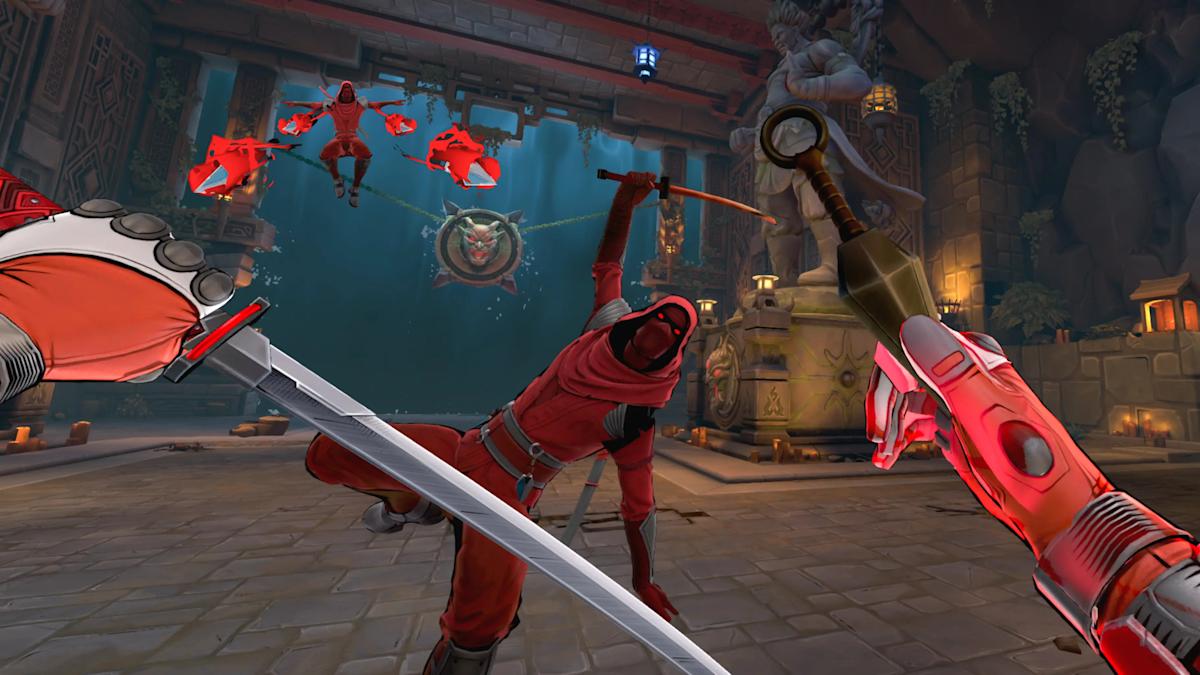
During normal combat, players have access to dual katanas, which they can grab by reaching for either shoulder, before unsheathing them by holding down the Touch controller’s grip button; these can be used for melee attacks, sure, but their usefulness was tenuous at best until a late game replacement that greatly expanded my slashing range. From your thighs, you can grab either of Deadpool’s pistols, which work about as you’d expect, and assuming you have decent aim are markedly more effective than your swords. Finally, explosives can be found on your left forearm, which are thrown by making a throwing motion and releasing the grip button at the same time as you would while tossing a ball.
The problem with combat is that there really isn’t all that much to it. There’s a scoring system, wherein you will be ranked for how stylish a kill is, but it all feels a little bit arbitrary most of the time. Filling up a meter allows you to use a Big Money Time power-up that gives you access to a powerful weapon for the duration of a licensed song, which is very reminiscent of 2021’s Marvel’s Guardians of the Galaxy.
Kills within this mode are always graded perfectly, and drop extra currency that can be spent for cosmetics and upgrades back in the hub; that being said, I didn’t feel the default Big Money Time weapon was very fun to use, or very consistent, especially compared to the alternatives that become available to you later.
That isn’t to say that I think Deadpool VR’s combat is bad, per-se – but combined with doors found in levels that require you to replay chapters as other, alternate Deadpool skins such as Lady Deadpool, distinctly makes me feel like the game was designed to feel best once you’ve acquired a stronger kit, even if the fundamentals of combat don’t actually change all that much. Even then, setpieces that came with their own unique combat abilities consistently impressed me far more than the basic fare, even once I’d kitted out Deadpool with a more impactful arsenal.
What certainly doesn’t help matters, and may very well be outright damning, is the game’s technical performance. Visually, it looks great most of the time – maybe not quite as impressive as last year’s Arkham Shadow, but Deadpool VR is still a real showcase for just how capable headsets like the Quest 3 are when it comes to standalone VR experiences. Unfortunately in Deadpool’s case, it’s also a stark reminder that at the end of the day you’re essentially strapping a mobile phone to your head.
Performance dips in traditional “flatscreen” gaming experiences are a concern when evaluating a game for review, but dropped frames are a considerably larger demerit for VR. You aren’t just seeing a choppy screen, when you’re in VR those dropped frames manifest as freezes and stutters to your own movement, including the tracking of your arms. Even for those already well-seasoned in VR, poor performance can be headache-inducing, and for those still getting their bearings, a bad experience which potentially leaves them feeling physically ill straight-up feels unacceptable for a game that is likely to be many, many player’s first real experience in VR.
To the game’s credit, Deadpool VR does attempt to make great use of VR as a medium in other ways. True to the character, if your arm gets blown off you can experience the sensation of a new one sprouting forth from the stump left behind; several segments play around with Deadpool being vivisected, leaving you to proceed through a segment at a much diminished height from usual. There are even a number of especially fantastical setpieces – intense enough that the game goes out of its way to let you know that players can skip them at any time if they can’t handle them. Though, if anything, that level of consideration makes the glaring performance issues all the worse.
At its best, Deadpool VR matches up to the standard that Meta has set for its first-party VR releases – which makes the stumbles all the more disappointing. If you’re someone who is already experienced in VR and loves Deadpool, the game is an easy recommendation even with those caveats. If you’re just now looking to enter the VR market, though, maybe save this game for a rainy day. Maybe by the time you get around to it those pesky performance hiccups will be fixed.