
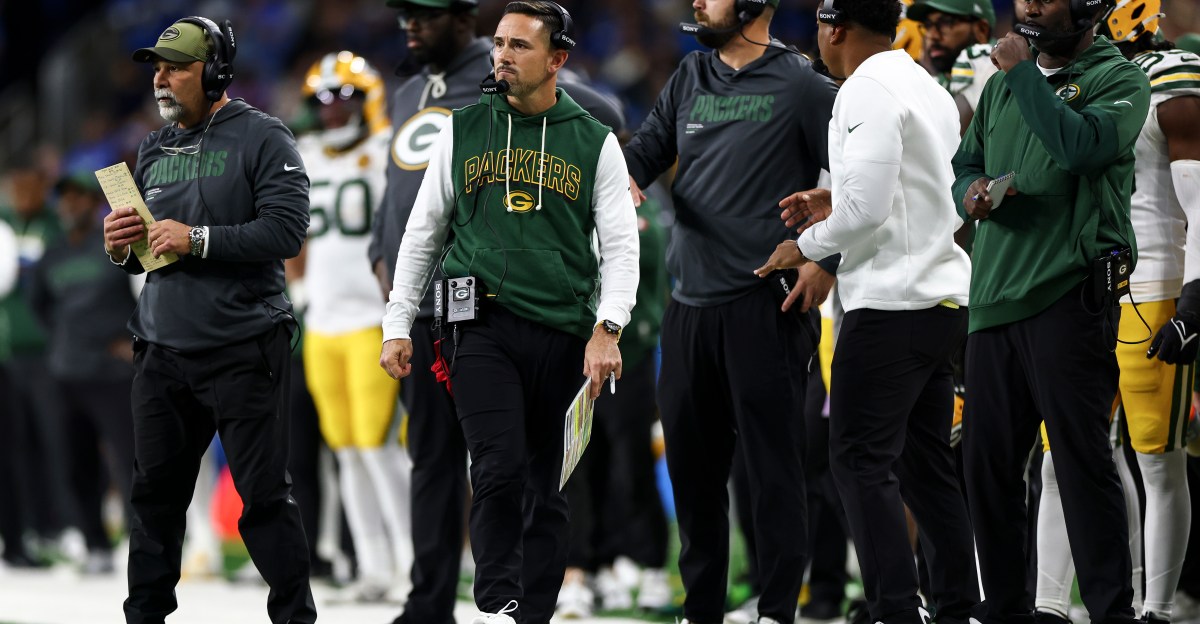
One of the things I continue to keep hammering, ever since ESPN’s Adam Schefter reported that the Green Bay Packers holdup with head coach Matt LaFleur isn’t his performance but his cost, is that the Packers run a cheap shop when it comes to coach pay. Why am I doing this? Because I hear it almost every year. If I hear the Darren Rizzi low-ball story one more time from an agent representing coaches, I might explode.
But, for some of you, these anecdotes don’t seem to be convincing enough. I asked a source how to better paint the picture of the Packers’ lack of funding for the coaching staff (since there is no database of coaching salaries), and he told me to compare Green Bay’s coaching experience to other playoff teams. So, I ran those numbers for you, all by hand. You’re welcome.
The way the Packers have worked, for a long time, is that when someone is promoted out of a job, they try to fill the role internally. They will look to the outside and spend when they make several misfires in a row (like the hiring of Rich Bisaccia after several special teams coordinator flubs or the addition of DeMarcus Covington after bombing back-to-back defensive line hires), but their instinct is not to spend at the position (they made an internal promotion at linebackers coach this year when they lost Anthony Campanile to the Jacksonville Jaguars on a defensive coordinator promotion, for example).
Here’s another one of those anecdotes again: Take the Packers’ replacement for Jason Vrable, who was promoted from receivers coach to passing game coordinator in 2024. Did Green Bay search the globe and run an extensive search to find their next receivers coach? No, they hired their assistant offensive line coach (the guy who gets coffee for the offensive line coach), Ryan Mahaffey, to the position.
That’s sort of par for the course right now with the Packers. They’re a draft and develop team that isn’t supporting much of that development.
That’s why, whatever you do with head coach Matt LaFleur (sincerely, make a decision and stick to it, understand the cap timeline of the roster, but build up a good assistant staff), my biggest problem with the organization right now isn’t the man at the top so much as the funding for all of the other guys underneath him.
Hopefully, some of these numbers I’m about to list will open your eyes.
First, I want to look at all of the on-field coaches (this is really a college football term, but I’m short of a better phrase) and their experiences outside of their current organizations as on-field coaches. We’ll define on-field coaches as coordinators or true positional assistants. For example, we’ll count a defensive line coach as a positional assistant but not the assistant defensive line coach (the guy who gets the defensive line coach coffee).
We will also include the title senior assistant, as it makes sense in this context. A good example of why these should be included is the Los Angeles Rams’ senior defensive assistant Jimmy Lake. Lake comes from a defensive back background, and the Rams don’t have a secondary coach, defensive backs coach, cornerbacks coach or defensive passing game coordinator on the team. Essentially, some of these senior defensive assistants are just positional assistants who got a better title for a raise (the Packers’ staff has said in the past that nothing changed when special teams coordinator Rich Bisaccia got the title bump to assistant head coach, other than a raise).
Including all of these coaches, here’s how every playoff team’s on-field NFL coaching experience sits, outside of their time with their current programs:
Seattle Seahawks: 129 yearsCarolina Panthers: 125Chicago Bears: 121Buffalo Bills: 108San Francisco 49ers: 102Denver Broncos: 97Jacksonville Jaguars: 95New England Patriots: 91Los Angeles Chargers: 89Pittsburgh Steelers: 89Philadelphia Eagles: 85Houston Texans: 78Los Angeles Rams: 59Green Bay Packers: 47
Uh oh! That’s not good! The other 13 teams that made the playoffs this year average 97.5 years of outside experience on the coordinator and assistant level. The Packers have less than 50 percent of that on the staff.
That strategy, as agents put it, is Green Bay’s way of saving money on the coaching level. (They have no issue spending on players, and I’ve been told their front office spend is above the league average).
Why hire Rizzi when you can hire Shawn Mennenga, who came to the Packers with one year of special teams coordinator experience — leading the 2018 Vanderbilt Commodores, who went 6-7 playing under very different special teams rules in college football? Mennenga was eventually replaced by one of his assistants, Maurice Drayton, another move made to avoid having to go into the market and getting into a bidding war. Neither has received another opportunity to be a special teams coordinator in the league since their time in Green Bay. That’s why they spent on Bisaccia. The development tree that they were hoping for had completely rotted.
Speaking of special teams coordinators, Bisaccia is clearly the most veteran coach on the Packers’ roster, coming in with 20 years of NFL service as an on-field coach outside of Green Bay. The Packers also didn’t have a problem grabbing Jeff Hafley as their defensive coordinator, either. Their real problem has been at the non-coordinator level, the true assistant coaches. So, what does the team’s true assistant pool experience match up compared to the other playoff teams?
Seattle Seahawks: 119 yearsCarolina Panthers: 117Chicago Bears: 97Buffalo Bills: 93Jacksonville Jaguars: 89San Francisco 49ers: 86New England Patriots: 74Los Angeles Chargers: 71Denver Broncos: 60Houston Texans: 58Los Angeles Rams: 49Philadelphia Eagles: 48Pittsburgh Steelers: 48Green Bay Packers: 21
This…is where the Packers really stick out like a sore thumb. The 13 other NFL playoff teams average 77.6 years of on-field experience at the assistant level (outside of their own programs). Green Bay is at just 21 years, 27 percent of the average. Even on defense, where they have, to their credit, spent for Covington and passing game coordinator Derrick Ansley (one of these two is expected to be Hafley’s defensive coordinator, if he leaves for a head coach gig), they still rank just 13th out of the 14 NFL teams, only ahead of the Los Angeles Chargers, who essentially imported their entire defensive staff from the University of Michigan (meaning they don’t have NFL on-field experience, but did have on-field experience at high-level college football) when head coach Jim Harbaugh bolted for the job after winning a national title. Offensively, the coach who has the most on-field experience outside of Green Bay is running backs coach Ben Sirmans, who spent four years with the ST. LOUIS Rams before joining Mike McCarthy’s staff in 2016. He was kept in the transition from McCarthy to LaFleur, like many on the defensive staff at the time.
LaFleur did not have full control of his initial staff, which was on a budget, and the team wanted to avoid buyouts when possible. I’ve been told that a condition of any coach willing to take the head coach job in 2019 was that defensive coordinator Mike Pettine was locked into his job, in part because of the buyout cost. It is industry standard to have contracts essentially be fully guaranteed at the NFL level.
This, to me, is the crux of the issue with the Packers and has been for a long time. It’s always the assistant spend.
The organization’s hope that the Packers’ coordinators (or head coach) can also develop their assistants and ALSO their assistants’ replacements at the same time as developing the young players on the roster has clearly not worked. It’s time for the team to spend on the assistant pool, whoever the head coach is in 2026. At least if they want to keep up against playoff teams. (I’d start with the offensive line and linebackers.)