
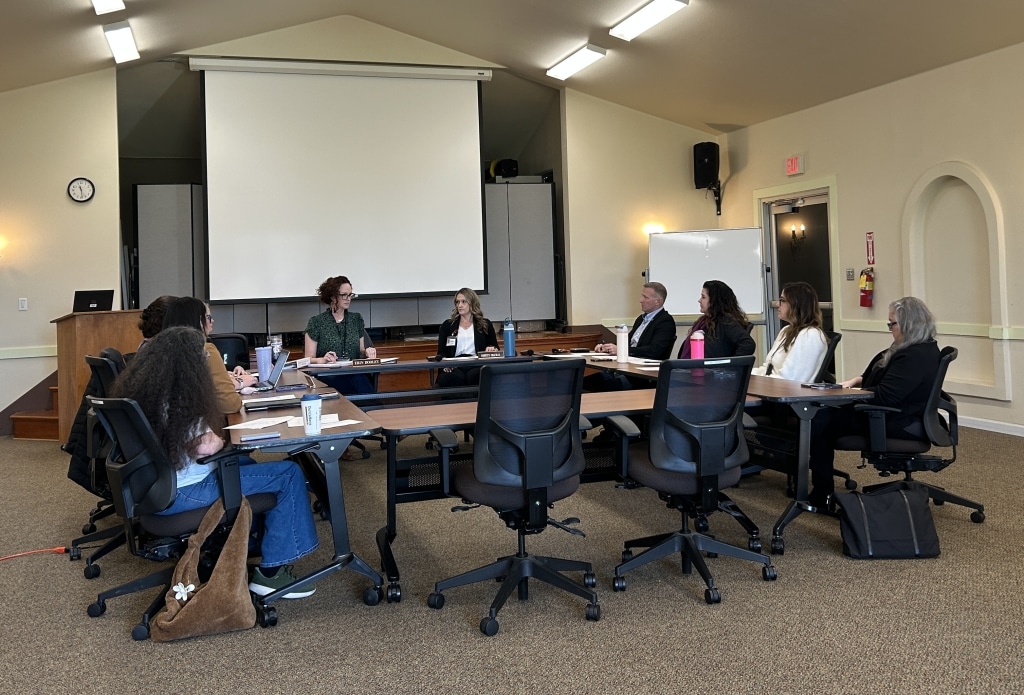
 County staffer and MHADAB Board Chair Erin Dooley, in glasses, leads an informal MHADAB Executive Committee meeting with HHSA Director Christy Coleman beside her. Photo by Annelise Pierce.
During an executive meeting of Shasta’s Mental Health Alcohol and Drug Advisory Board (MHADAB) yesterday, a phalanx of Health and Human Services Agency staffers “pre-gamed” — Supervisor Kevin Crye’s term — how the larger advisory board should operate in future.
They did so in the presence of only two MHADAB members, new board chair Erin Dooley — who herself is an HHSA staffer — and Crye.
The discussion was held during what was originally slated as an executive meeting of MHADAB, a smaller meeting held monthly that includes the leadership of the larger MHADAB group. When only one of the two current executive MHADAB members showed up to the meeting, it might have been cancelled and rescheduled. Instead, Dooley held the meeting informally with those present, a group made up almost solely of her peers and supervisors.
MHADAB is a state-mandated board that’s supposed to provide advisory oversight of county mental health services and work to ensure the voices of the public, especially those most impacted by mental health and substance use, are included in county decision-making.
Much of yesterday’s discussion was led by the county’s HHSA Director Christy Coleman, who sat between Dooley and Crye, frequently taking the lead during the meeting. At one point Supervisor Crye, who sat next to Coleman, asked how long presenters would be allowed for their presentations during future MHADAB meetings. When Coleman authoritatively answered, “10 minutes,” Crye asked if that decision had already been made.
“Well, we’re kind of making it now,” Coleman said, before being reminded by Dooley, who works under her, that such decisions would have to formally be made by a vote of MHADAB. Crye, who’s been unfailing in his praise of Coleman since before he voted to appoint her to HHSA’s top position said it was “stupid” that Coleman, who runs HHSA, doesn’t have a vote.
State law regarding community mental health boards lays out a number of parameters regarding the number and type of individuals who must be included on the board. Coleman cannot legally sit on MHADAB because she holds a role on the county’s mental health team, as the county’s Mental Health Director.
A recent clash between MHADAB and Coleman
HHSA is the county’s largest department, overseeing not only mental health but also public health, child and adult services, and a variety of other county community health functions. Coleman has led the agency for a little more than a year after being brought on as second-in-command a few years ago.
Over those years, HHSA has faced scrutiny for ongoing financial shortfalls and staff turnover even as the county continues to face a steep uphill battle when it comes to addressing pervasive community health needs, including suicide rates that are the highest in the state and double the state’s average.
Coleman has clashed with MHADAB in recent months, specifically when the advisory board voted to issue a letter of support for a proposed behavioral health facility known as True North. MHADAB’s support for True North was among a flood of other public support for the project which Coleman at first strongly rejected, asking supervisors to send a letter of opposition to the state instead. Coleman later reversed her stance on True North, asking supervisors to support the project, something four of the five supervisors — all but Crye — have now done.
This month Crye and three other county supervisors voted not to reappoint two key MHADAB members including fellow supervisor Matt Plummer, who helped lead support for the True North behavioral facility and community member Ron Henninger who’s been among the most outspoken MHADAB members when it comes to insisting on accountability for county mental health funding.
Some community members who regularly attend MHADAB meetings have described Plummer as an advocate for community mental health needs. And MHADAB members voiced their support for his work by electing him as vice chair of the group just last month. Nevertheless, supervisors voted to replace Plummer with Crye as the county’s MHADAB member last week. It’s not clear if such action was legal, given that state law mandates three-year terms for board members and Plummer took up his role on MHADAB only a year ago. Shasta Scout has reached out to the county attorney for comment.
Possible reductions to public participation
The agenda for the first meeting of the year for MHADAB’s executive board included a number of organizational items. While a number of informal decisions were made by a consensus of county staff yesterday, none are binding since they were not made by MHADAB itself.
Discussions on so-called “board decorum” and public comment recurred again yesterday after a similar discussion at MHADAB’s last full group meeting in December. County Counsel Joe Larmour and Shasta County CEO David Rickert both attended that meeting with Larmour opining on the need for the MHADAB chair to take more control over public comment periods.
Since MHADAB is a board designed to serve the needs of those with mental health and substance use challenges, it’s unsurprising that some, especially those coming from vulnerable communities, may have difficulty following established policies. Larmour recommended in December that when they fail to do so the meeting should be halted — much like board meetings have been in recent months — and law enforcement officers called in, with the probability of a subsequent arrest.
Yesterday, Crye probed board members on how many members of the public attend meetings and how they participate, questioning whether such participation has been productive. Board Chair Dooley said over the last six months more of the public have been attending meetings and sharing comments, achieving a MHADAB goal. She also noted that the board has also been unusually productive over the last year, with more collaboration between MHADAB and county staff — something she hopes to continue under her leadership.
Coleman suggested that presentation times should be reduced to 7-8 minutes, followed by a period for questions and answers of 7-8 minutes. During this time, the public could be allowed to ask questions to keep them happy, but the board wouldn’t necessarily have to provide any answers, Coleman suggested. She also advised that the board’s overall discussion time should be held to no more than 20 minutes on each topic a decision that would ultimately be made by MHADAB itself.
On the question of how many MHADAB meetings should be held this year, Crye said county staff should push for the number they feel is appropriate, saying he would “back” their suggestions during the upcoming full MHADAB meeting. Coleman proposed holding fewer MHADAB meetings saying they’re costly for the county because so many HHSA staff attend them. Asked by a reporter why so many HHSA staff are tasked to attend, Coleman said she feels it’s important for them to be there for administrative reasons.
The meeting yesterday also included discussion about who might take up the position of MHADAB vice chair. Crye said that the county’s Veteran Service Officer, Troy Payne, sounded like a good fit. Dooley noted that Payne had said previously he didn’t have time the role but Crye said he should be “voluntold” to take it anyway.
“I’ll call him later,” Crye said.
1.14.2025: We have updated the story to clarify a statement about Payne’s interest in the seat.
Do you have a correction to share? Email us: editor@shastascout.org.