
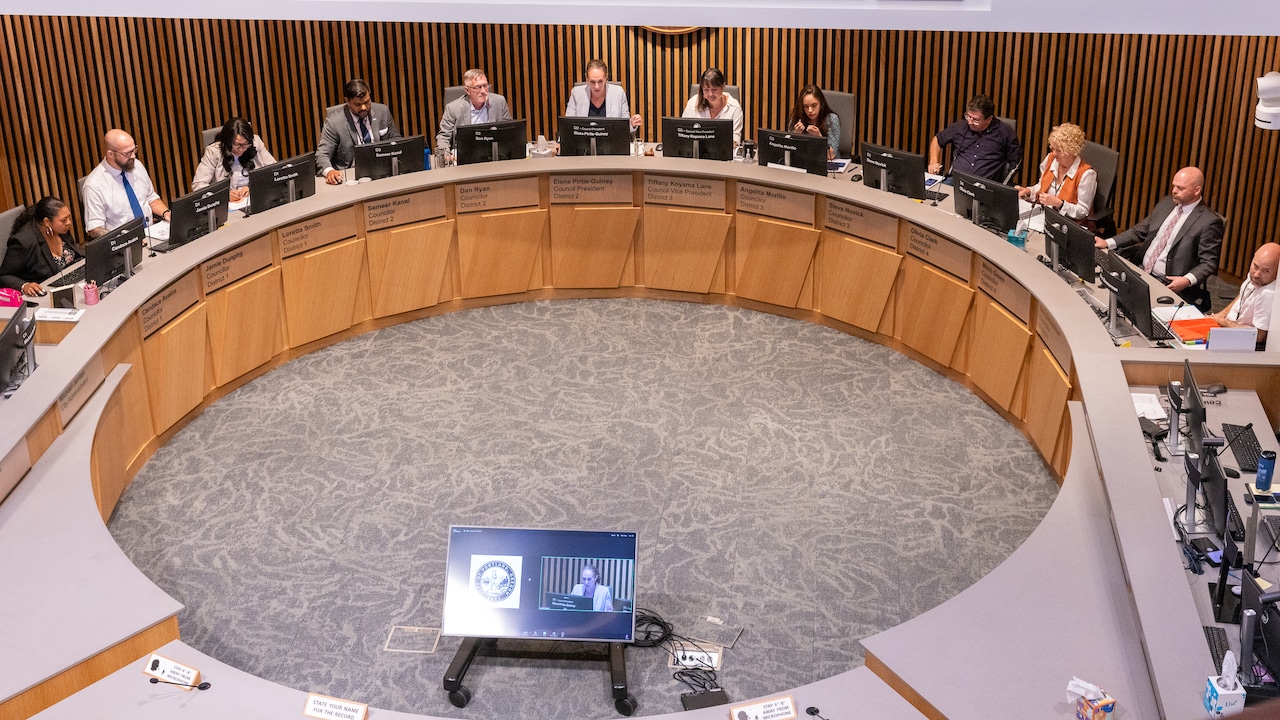
After hours of deadlock, debate and deepening signs of discord, the Portland City Council elected its next president Wednesday.
Councilor Jamie Dunphy, an east Portland representative and member of the council’s progressive caucus, secured the post in a 9-3 vote in a 13th round of voting that occurred across three separate days.
Four additional councilors — Elana Pirtle-Guiney, who served as council president last year, Sameer Kanal, Steve Novick and Loretta Smith — had also vied for the role but could not muster a majority of support.
Kanal, a fellow progressive caucus member, added Dunphy’s name to the list of nominees after securing six votes in 11 consecutive rounds. Pirtle-Guiney, who earlier Wednesday had thrown her support behind both Novick and Smith, subsequently cast the first and only vote for Dunphy in the 12th round.
By the next round, eight other councilors — Dunphy, Kanal, Candace Avalos, Olivia Clark, Mitch Green, Tiffany Koyama Lane, Angelita Morillo and Eric Zimmerman — had all joined Pirtle-Guiney.
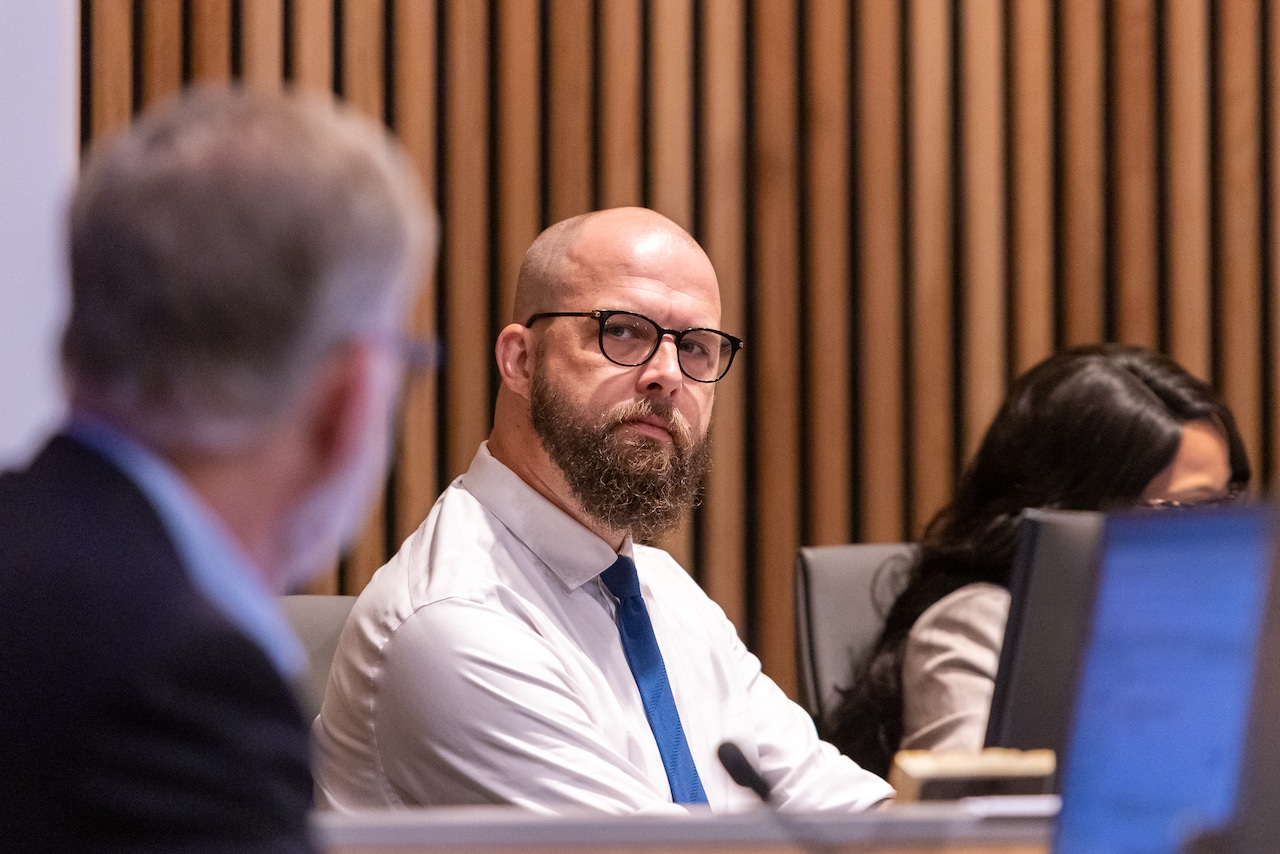 Portland Council President Jamie Dunphy. Sean Meagher/The Oregonian
“This is not something that I have been seeking and is not something I am excited about,” said Dunphy, as deliberations that began in a meeting seven days ago neared their 12th and final hour Wednesday afternoon. “But if the only way out of an entrenched 6-6 stalemate is for me to step into this role, then I’m willing, not happy, but willing to do this in service of this institution.”
After Dunphy assumed the role of council president, the body nominated and approved Councilor Olivia Clark, who represents the city’s westside and a portion of Southeast Portland, as council vice president in an 11-0 vote.
Smith declined to support Clark’s candidacy.
Dunphy’s election caps a chaotic week at City Hall in which council factions remained deadlocked over their preferred picks, refused to budge and ratcheted up attacks on colleagues.
It also puts a representative and champion of a historically neglected part of Portland, one that is also the city’s poorest and most racially diverse, as the most powerful figure on the council, with special agenda-setting authority.
Dunphy, however, made it clear that he intended to disperse some of those duties across the legislative body, and would even “invite my sharpest critics to be advisors.” He also said that he would not run for the position again next year and agreed to step back from his work on the progressive caucus.
Members of the group, including Dunphy, currently face a state ethics investigation into whether they violated public meetings law when they held a retreat last summer.
“I will use this role to distribute power, not consolidate it,” he said. “To build systems that treat each of us the same and protect this council as an equitable body for our colleagues and our constituents. I really don’t want this to be a yearly ritual of hardened battle lines. This has hurt my heart.”
Dunphy’s willingness to serve as a compromise candidate drew strong praise from some of his colleagues.
“You’re a reluctant hero, and I think sometimes that’s the type of person that is best suited for power, someone who doesn’t strive to have it,” Morillo said.
Indeed.
Speaking with The Oregonian/OregonLive last month, Dunphy had called the role he now possesses the “worst job in politics” and said he would consider it “under no circumstances.”
“There’s no upside, and almost all downside. The majority of the time you’re just reacting to other people’s priorities,” he said at the time. “I am deeply uninterested in it. I came here to do policy work. I don’t even want to be a committee chair.”
Deep divisions — both personal and political — have been part and parcel of the legislative body since Pirtle-Guiney narrowly became Portland’s first council president under the city’s new form of government last January. Her victory 12 months ago came in a ninth round of voting.
Over the last year, the council has been evenly split on a range of issues, often between the closely aligned six-member progressive caucus — known as “peacock” — and the other six councilors, including Pirtle-Guiney, who are less in lockstep.
While disagreements between various factions have flared on policing, livability and other contentious topics, there have also been sharp differences on governance and council operations.
Members have at times bristled at Pirtle-Guiney’s leadership and struggled to find a functional framework for doing business or to even agree on what that might look like. Pirtle-Guiney last year was also unable to forge a governing majority or cement a coherent council policy agenda.
For nearly seven hours last Wednesday, she and challenger Kanal, the first choice among Dunphy and other progressive caucus members, remained deadlocked at six votes apiece over nine successive rounds and amid a swirl of increasingly personal and bitter accusations.
At one point, Zimmerman took several minutes to pointedly question Kanal’s temperament, claiming his colleague routinely displayed “juvenile, disruptive” behavior at council meetings and jeopardized the body’s standing with the city administration.
The remarks prompted intense pushback from several of the council’s members of color, who said they were often held to a different standard than their white counterparts.
“I reject and frankly just do not agree with the narrative that is being painted right now about Councilor Kanal,” Koyama Lane, who served as council vice president last year. “Also, it isn’t lost on me that he is the only man of color on council.”
Tensions spilled into the following day, when Novick and Smith entered the council president contest. But the contentious election was soon delayed again after a federal immigration agent shot two people in east Portland.
Councilors resumed voting Wednesday morning. Four hours later, Dunphy had been chosen as the body’s leader.
While Portland’s council president position comes with some agenda-setting authority, it holds far less power than leaders in other legislative bodies.
Under current rules, the council president sets meeting agendas but is required to bring forth any item proposed by a councilor or committee within 90 days. The president doesn’t unilaterally appoint committee chairs or vice chairs like the House Speaker or Senate President in the Oregon Legislature.
Meanwhile, any councilor can send a proposal to the committee of their choosing for discussion. And a group of four councilors can send an item to the full council if it does not make its way out of committee.