
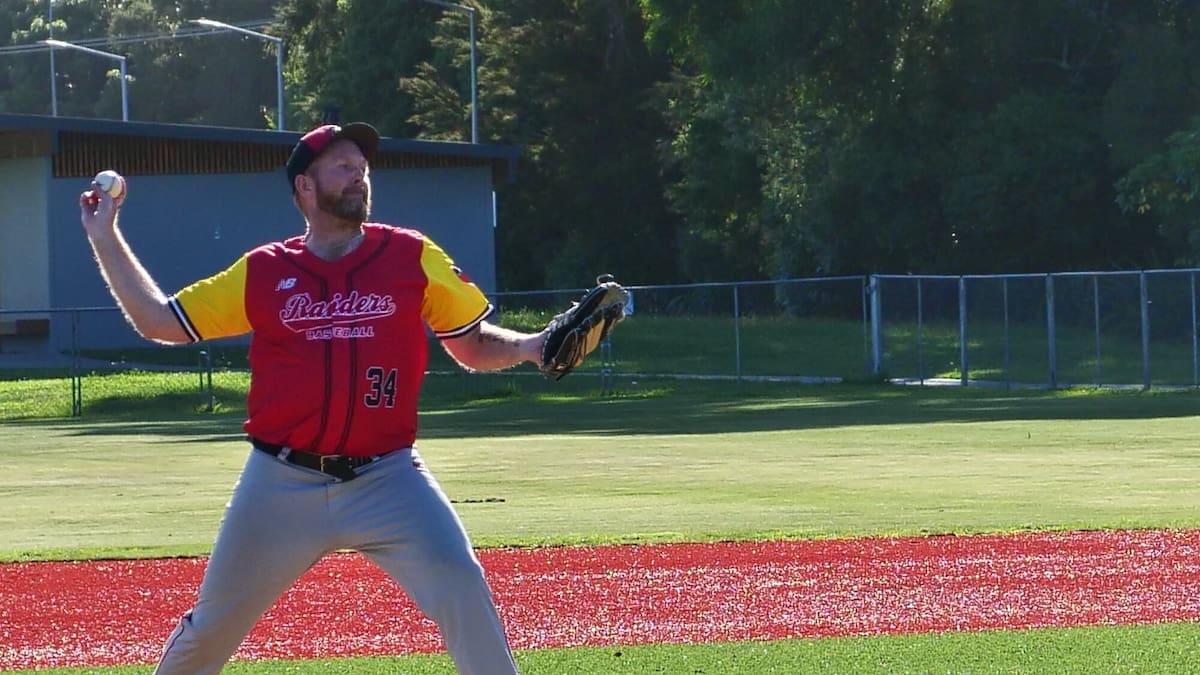
“They see talent down here and raw talent. [The Padres] know that we’re athletic.”
Among the talent that impressed the Padres coaches was Tauranga-based teenager Blake Percy, who was travelling to Hamilton to train, Tuhoro said.
“He has clocked [thrown] pitches at 91 miles/hour (146km/h). He’s only 16.”
The Padres’ involvement in New Zealand is facilitated by Don Tricker, a former head of high performance for New Zealand Rugby who is now the Padres’ director of player health & performance.
The relationship between Baseball New Zealand and the Padres granted Kiwi coaches access to elite development systems rarely seen outside North America.
“This isn’t about scouting players,” Tricker said.
“It’s about improving coaching capability so kids get better experiences and better development.”
A small but growing sport
Crockett said the visiting Padres coaches identified a fundamental challenge for New Zealand baseball: a lack of early exposure to the sport.
“Kiwis grow up with a rugby ball, a football and a hockey stick. They don’t grow up with a glove and a ball.”
Around 4000 players are registered with Baseball New Zealand across the country.
Baseball is a niche sport in New Zealand, but hugely popular in the US. Photo / 123rf
The sport attracts a mix of homegrown athletes and families who have lived overseas in countries where baseball is more established, including the United States, Canada and parts of Asia.
Despite being a niche sport here, New Zealand has produced baseball players who have reached professional levels in the US.
Aucklander Mark Marino became the first New Zealand-born player to sign with a Major League organisation when he joined the California Angels as a free agent in 1985.
However, no New Zealander has yet played in an MLB regular-season game.
Several players currently compete in the minor leagues in the US, including fellow Aucklander Jason Matthews.
NZ baseball’s weakness
The lack of early exposure to the sport was most visible in pitching, the throw of the baseball toward home plate to start a play, Crockett said.
New Zealander Jason Matthews plays baseball in the minor leagues in the US. Photo / Brett Phibbs
“Our pitching depth is shallow. You need a large enough pitching staff on any team, and at the moment, we don’t have that.”
While throwing skills from other sports, including cricket, can be transferred to baseball, Crockett said pitching is unique.
“Bowling and pitching are fundamentally different,” she said. “There’s biomechanics around baseball pitching that are very specific.”
Strengthening pitching knowledge has become a key focus of the Padres’ visits, with specialist pitching coaches included in both New Zealand visits.
Learning from spring training
As part of the partnership, Baseball New Zealand also sent local coaches to San Diego to attend MLB spring training, where players compete for roster spots ahead of the season.
“Spring training is pretty brutal,” Crockett said. “But it’s a huge learning opportunity for our coaches to see how high-performance environments actually operate.”
Those lessons are then brought back to grassroots clubs like the Hamilton Raiders, where the emphasis is on improving coaching quality rather than identifying elite talent.
Infrastructure challenge
As a minority sport, baseball competes not only with New Zealand’s major codes for participants, but also for facilities.
“The outside of our baseball [diamonds] often becomes part of a corner of a football or rugby field,” Crockett said.
A standard baseball diamond has 27.4m between bases, with the pitcher standing 18.4m from home plate.
Outfield distances can stretch beyond 120m to centre field, making it difficult to fit regulation diamonds into shared spaces.
A Hamilton Raiders hitter takes a swing at Mahoe Park. Photo / Tom Eley
There is only one purpose-built baseball diamond in New Zealand, located in Hamilton’s Mahoe Park.
The Hamilton diamond acts as a national training facility, Crockett said.
Another diamond is under development in Auckland’s Unsworth Heights, Crockett said.
Despite the challenges, Crockett believes international support can help baseball continue to carve out its place in New Zealand.
“Any time you get access to that level of expertise, it lifts the whole system,” she said.
Tom Eley is a multimedia journalist at the Waikato Herald. He previously worked for the Weekend Sun and Sunlive.