
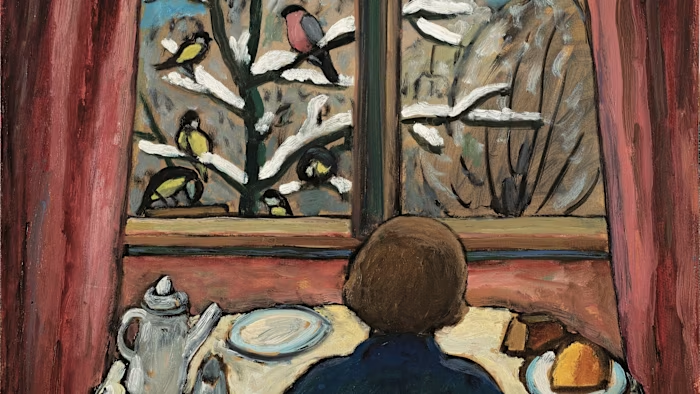
In New York’s grey, white and sludge midwinter, Gabriele Münter’s lavender snowscapes and fervent interiors bring consoling bursts of colour. The German painter felt tones and tints deep in her bones, filtering her perceptions through creamy mauves, velvety purples, joyous yellows and crisp greens. These were not exhalations of the psyche, just what she saw around the house.
“I will never dispense entirely with nature,” she said, late in life. “You cannot compete with God, after all.”
Münter, the star of a delicious Guggenheim retrospective titled Contours of a World, periodically switched techniques, from finely wrought portraits to evocations of children’s drawings, to intricate formal experiments. Her sensibility and interests remained constant, though.
In almost all her work, she observes from a cool distance, sometimes by craning past an obstacle. Once she burrows into a scene, she stays long enough to extract its juice: the melancholy blue of a shadow in the snow, the defiant curl of a New Woman’s lip, a cosiness shot through with tension. One buzzing view of the home she shared with Wassily Kandinsky might almost be titled “Ambivalence”. A long, bright runner crosses the living room diagonally, leading the eye from his shoes to hers. And yet her lover lies in bed, through a doorway and off in a different corner of the house, clearly preoccupied with something that isn’t her.
 ‘Living Room in Murnau (Interior)’ (c1910) © 2025 Artists Rights Society (ARS), New York / VG Bild-Kunst, Bonn
She was born in Berlin in 1877, but her early story is inseparable from the US. Her politically restless father, caught up in the liberal ferment of the mid-19th century, was driven into exile when the 1848 revolution failed. He found refuge in Savannah, Tennessee. There, he married another German émigrée and trained as a dentist. But his outspoken opposition to slavery soon made him a political outcast again, and the couple moved back to Prussia, where they raised four children.
Münter was 21, recently orphaned, and financially independent when she and her sister returned to the US in 1898, taking a two-year tour from New York through Missouri, Texas, and Arkansas to reconnect with their scattered family. Along the way, she bought a Kodak box camera and, though she didn’t yet think of herself as an artist, she quietly assembled a visual diary of rural life — images that would prove formative in her own career.
 ‘“Home sweet home at aunt Annie’s,” Plainview, Texas’ (c1899-1900) © 2026 Artists Rights Society (ARS), New York / VG Bild-Kunst, Bonn‘“Home sweet home at aunt Annie’s,” Plainview, Texas’ (c1899-1900) © 2026 Artists Rights Society (ARS), New York / VG Bild-Kunst, Bonn
 ‘Snowy Landscape with a Red-Roofed House’ (1935) © 2026 Artists Rights Society (ARS), New York / VG Bild-Kunst, Bonn
Those photos look less like the pastime of a cultured visitor from Berlin than the field notes of a settler with mud on her boots. The simple Plainview, Texas shack, which seems to be sliding off its flat plot, resurfaces almost unchanged in a 1935 landscape: “Snowy Landscape with a Red-Roofed House”. An 1899 photo of a Christmas tree in Texas, draped in dolls, tinsel and other oddments, reappears 10 years later in the painting “Christmas Still Life”, a stunning ode to domesticated nature, now decked out in rainbow ribbons, lights and lickable shades of blue, pink and green.
 ‘Tree with dolls and other objects, Plainview, Texas’ (1899) © 2026 Artists Rights Society (ARS), New York / VG Bild-Kunst, Bonn
 ‘Christmas Still Life’ (c1908–09) © 2026 Artists Rights Society (ARS), New York / VG Bild-Kunst, Bonn
Photography taught her to frame objects and people idiosyncratically. In one mysterious and allusive snapshot, the camera sits on a dining room table, shooting across the sea-like surface so that the granite-faced Aunt Albertine’s head rises like a distant peak. And what’s that weird castle-like confection of turrets and spires between our eyes and hers?
That sort of composition, with an ill-defined shape hulking in the foreground, blocking the putative view, became a standard Münter technique. It’s there in “The Blue Gable” (1911), a white mound standing before the polychrome buildings that recede into the distance. And there it is again, in “Boating” (1910): a rower faces away from the viewer, so that all we see of her is a mountainous blue hat.
After her American sojourn, Münter enrolled in Munich’s Phalanx School, a progressive arts programme co-founded by Kandinsky. She was still single at 25; he was 36 and married. In their relationship, art and romance were impossible to tease apart. They first summered in Murnau, near Munich, in 1908, and together they transfigured the sweet Bavarian town into an unruly stage for the imaginative interplay of form and hue. In her paintings, violet massifs cradle miniature homes. Each facet flickers with unexpected hues. Snow dips into riotous expanses of colour. A bubble-gum-pink house clings to a hillside, the lone anchor in a perplexing maze of walls, trees and paths.
Münter bought the house where they worked side by side and helped bring the movement known as Der Blaue Reiter into being; Kandinsky claimed the spotlight and the credit. He “had to express his ideas in words, so he was constantly forging new theories of art,” Münter recalled. In her domestic scenes, he is often seen holding forth, talking and talking while she lurks outside the frame or slumps on a windowsill. (That remains her perpetual role; even now, her retrospective is shunted into a set of cramped side galleries while Rashid Johnson’s loud and showy exhibition sprawls through the main spiral.)
Münter largely ignored Kandinsky’s lectures: while he spiralled off into spiritual abstraction, she lingered in the visible world, testing it with ever-greater rigour, training herself to see it afresh. (By 1915, he had wandered out of her life, too.) The Guggenheim’s greatest boon is the sequence of resplendent portraits, interiors and still lifes.
 ‘Man in Armchair (Paul Klee)’ (1913) © 2026 Artists Rights Society (ARS), New York / VG Bild-Kunst, Bonn
“Man in Armchair” (1913) depicts Paul Klee as if he were one of his paintings, which has broken off from the whole constellation of Klees hanging on the wall. His blocky face — squared at the crown and cleaved by a thick black moustache — is instantly recognisable from his copious self-portraits. The torso faces forward, while the legs point left, in the manner of an Egyptian frieze. His sapphire armchair shimmers in layered tones that range from midnight to cobalt. Behind him, a raucous flock of tchotchkes jostles for space on a table while paintings crowd the green wall. Klee seems perfectly attuned to his surroundings, harmonising with them like Whistler’s mother on steroids.
“Still Life on the Tram (After Shopping)” (1909-12) takes a radically different approach, zooming in on a woman’s lap and severing her head from view. Münter lingers over the shopper’s plush tower of parcels, with a decoratively dangling handbag and the vivid red splodge of a potted geranium. The composition presses the woman into service as a surface, a human shelf for this intimate, almost voluptuous pile; only a pair of hips and two gloved hands remind us that the consumer is flesh and blood.
 ‘Still Life on the Tram (After Shopping)’ (c1909-12) © 2025 Artists Rights Society (ARS), New York / VG Bild-Kunst, Bonn
Curator Megan Fontanella wisely organises the show by theme rather than date. Münter was only intermittently prolific, and well before she died at 85 in 1962, her output had diminished markedly.
One of the exhibition’s most compelling works dates from 1934: a woman, again seen from behind, pauses over breakfast as she gazes out a window. Crimson curtains part, revealing a stage-like view of birds capering along a tree’s snow-encrusted branches. One member of this avian choir flaunts a red breast, echoing the warm tones of the interior. Nature looks in on the artist looking out, setting up the exchange between what has always existed with what remains to be made. And there is Münter at her table, quietly completing the circuit.
To April 26, guggenheim.org
Find out about our latest stories first — follow FT Weekend on Instagram, Bluesky and X, and sign up to receive the FT Weekend newsletter every Saturday morning