
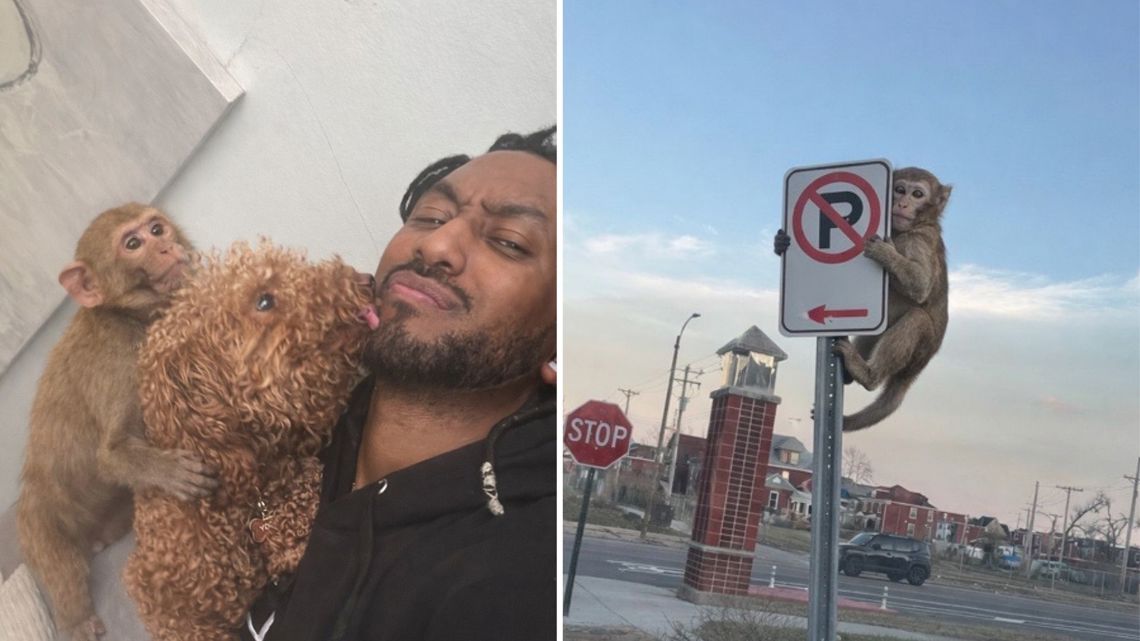
AI-generated images, expert analysis, and one verified sighting have become one of St. Louis’ strangest viral moments.
ST. LOUIS — Nearly a week after reports of vervet monkeys roaming in north St. Louis first surfaced, the city is still obsessed with the “monkey mystery.” What began as neighborhood sightings quickly exploded into a viral phenomenon, spawning memes, late-night jokes and even chocolate treats, but one central question remains unanswered: were the monkeys ever real?
Officials said the four monkeys were first spotted by neighbors near O’Fallon Park on Red Bud Avenue on Thursday afternoon.
The St. Louis Department of Health confirmed earlier this week it called off the search for the animals, citing only one verified sighting of one money, confirmed by a St. Louis police officer. Officials also acknowledged that AI-generated monkey images circulating online made the investigation more difficult, muddying the waters between legitimate tips and fabricated posts.
As the internet ran wild, 5 On Your Side took a closer look at the original four photos shared by a resident, the images that sparked the citywide frenzy.
Before turning to experts, our newsroom ran all four photos through a Google reverse image search. The results showed no matches, indicating the photos were not previously posted elsewhere or digitally altered, offering no clear proof they were fake, but also no confirmation they were real. So we brought the images to an AI researcher.
AI expert: “This could absolutely look real and still be fake”
Abby Stylianou, an associate professor of computer science at Saint Louis University who specializes in artificial intelligence and computer vision, reviewed each of the original images individually.
“This image isn’t obviously fake,” Stylianou said while examining one of the photos. “A year ago, when people were sharing generated images, there were things that were really obvious that were wrong. Do the shadows match the thing that’s in the image? Now, this is particularly challenging because it’s a cloudy day, which means there aren’t a lot of shadows. Here, it does look like it kind of matches the scene around it, so there aren’t any really obvious cues that this is necessarily a fake image.”
Stylianou explained that lighting, shadows, and image consistency are common indicators for spotting AI-generated images, but those clues are becoming harder to rely on.
“Now what’s really hard today is that it’s not a year ago. These tools are so good at generating images that this could absolutely look real, yet still be fake,” she said.
One image, she noted, raised questions not because of pixels or lighting, but because of how perfectly it was framed.
“One of the hints that something could be AI-generated is if it fits with a narrative so perfectly,” Stylianou said. “The monkey is sort of perfectly in the middle of the scene, just looking at the camera. That kind of perfect composition is something AI models really do.”
Still, she stopped short of calling any of the photos fake.
“What I will say about all four of these images is that none of them are so obvious that they’re AI-generated,” Stylianou said. “If I were asked, I would say I don’t really know.”
That uncertainty, she said, is the bigger issue.
“I think this really captures what’s hard about AI-generated imagery because we can’t make decisions about whether things are real or not just by looking at the pictures and the videos anymore,” she said. “Now we have to think about where did something come from? It used to be the case that if you saw something, you could believe it. That’s not the case anymore.”
Stylianou added that viral misinformation doesn’t just confuse the public; it can impact real-world decisions.
“Our city had to make choices about where to allocate resources, where they were going to send animal control,” she said. “It’s a small version of what I think is a much bigger problem. How do you decide where to allocate resources, and are you choosing to do it based on factual information?”
Exotic animal vet: “I think it was probably real”
While the AI expert couldn’t reach a definitive conclusion, an exotic animal veterinarian with decades of experience working with primates believes the situation likely began with a real sighting.
“I think it was probably real from everything I’ve heard secondhand,” said Dr. Doug Pernikoff, a veterinarian trained in exotic animals, primatology and anthropology.
Pernikoff said the lack of recent sightings may actually support that theory.
“If the animals haven’t been seen recently since Friday, in my mind, there’s a good chance whoever owns them has recovered them,” he said. “They may just be harboring them.”
Health officials previously identified the animals as vervet monkeys. Pernikoff said they are also known as African green monkeys, a species native to sub-Saharan Africa and not suited for Missouri winters.
“They would have a really difficult time surviving these evenings,” Pernikoff said. “You would expect to see them milling around looking for food unless, again, they’ve been recaptured.”
Pernikoff also warned that private ownership of primates can be dangerous for both the animals and the public.
“Primates in captivity are not traditionally a good pet,” he said. “You start very young, and they’re cute as can be, and then all of a sudden you don’t have a tame little pet, you’ve got a potentially dangerous animal.”
A viral moment — and a lasting lesson
As the mystery grew, the monkeys became the punchline of late-night monologues and social media jokes nationwide. Locally, businesses leaned into the fun, including Crown Candy Kitchen, which is selling solid chocolate monkeys during the height of the frenzy.
But experts said the bigger takeaway goes beyond the laughs.
“Everybody just needs to slow down a little bit,” Stylianou said, “and really check where something comes from instead of just believing what you see.”
So, were the monkeys ever real?
One police officer verified at least one sighting. The rest may be a mix of truth, technology, and viral momentum, a reminder that in the age of AI, even a monkey on the loose can turn into a citywide mystery with no clear ending.