
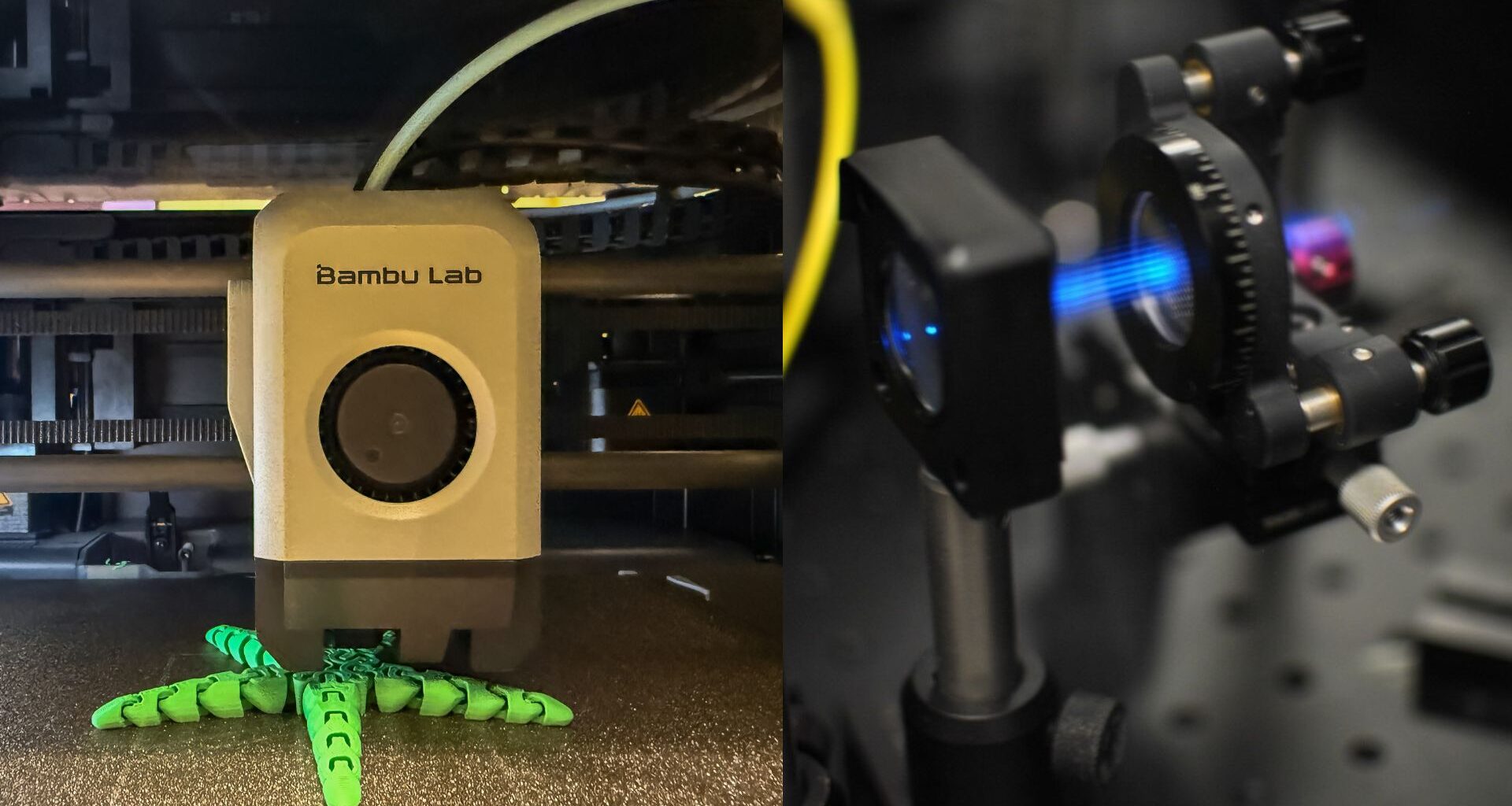
Researchers have demonstrated that consumer-grade 3D printers and inexpensive materials can produce advanced optical components capable of super-resolution imaging.
Each custom lens costs less than $1 to make. The work could significantly expand access to high-performance imaging tools that were once limited to specialized laboratories.
The team showed that low-cost, customizable optical parts can support imaging beyond the traditional diffraction limit. Their approach combines 3D printing, silicone molding, and UV-curable resin to fabricate multi-element lenses.
The researchers used these lenses to build a multifocal structured illumination microscope that resolved biological structures at the nanoscale.
“We created optical parts that enable imaging of life’s smallest building blocks at a remarkable level of detail,” said lead author Jay Christopher from the University of Strathclyde in the UK.
“This approach opens the possibility for customized imaging systems and unlocks imaging scenarios that are traditionally either impossible or need costly glass manufacturing services.”
They described how their low-cost lenslets enabled imaging of microtubules within a cell’s cytoskeleton.
The system achieved a resolution of about 150 nanometers, comparable to commercial super-resolution microscopes.
“Our new approach could empower scientists and companies to access tools previously locked behind specialist technology with high costs,” Christopher said.
“Using budget-friendly 3D printers and materials, they could manufacture their own components to solve problems they are facing and, in turn, generate unique research and product development solutions.”
The work builds on earlier studies showing that basic optical elements produced using consumer-grade printers could match factory-made optics. Those earlier lenses supported the construction of a fully 3D-printed microscope.
“With consumer-grade 3D printing technologies becoming more sophisticated and precise every year, our ambitions grew from seeing whether 3D printed lenses could be used for biological imaging, in general, to just how far 3D printing lenses could really go within the latest advanced imaging concepts,” said research team lead Ralf Bauer.
Overcoming optical limitations
For advanced microscopy, the team needed lenses that worked well with laser illumination. Standard 3D printing introduces optical scattering because it builds objects layer by layer. This structure can diffract light and degrade image quality.
To solve this, the researchers developed a molding-based refinement process. They first printed a raw optical design using standard CAD software.
They then added additional printing material to smooth the surface layers.
This additive method replaced time-consuming polishing techniques.
The team used the refined lenslets to create a lenslet array. This single optical component contains many tiny lenses on one surface.
The design allows the microscope to illuminate a sample at multiple focal points simultaneously.
Molds to microscopes
After refining the printed array, the researchers created a silicone mold. They filled it with an inexpensive UV-curable clear resin. This step eliminated the diffraction effects seen in the original printed parts.
Precision surface measurements showed that the low-cost lenses closely matched both high-end and budget commercial optics.
When tested in a lab-built multifocal structured illumination microscope, the printed lenses produced biological images nearly identical to those from commercial glass arrays.
Next, the team plans to explore more complex designs.
Future work may include three-dimensional focal patterns, bio-inspired optics, and hybrid components combining transparent and opaque materials in a single part.
The study is published in the journal Biomedical Optics Express.