

NASA has announced 16 launch windows between February and March for the Artemis II mission, the first crewed flight of the Artemis program.
Artemis II follows the successful uncrewed Artemis I flight test completed in late 2022. The four-person crew, including astronaut Christina Koch of North Carolina, bring a combined 700 days in space in their assignment to further validate the Orion spacecraft and its systems along with the operational procedures required for sustained human exploration beyond low Earth orbit.
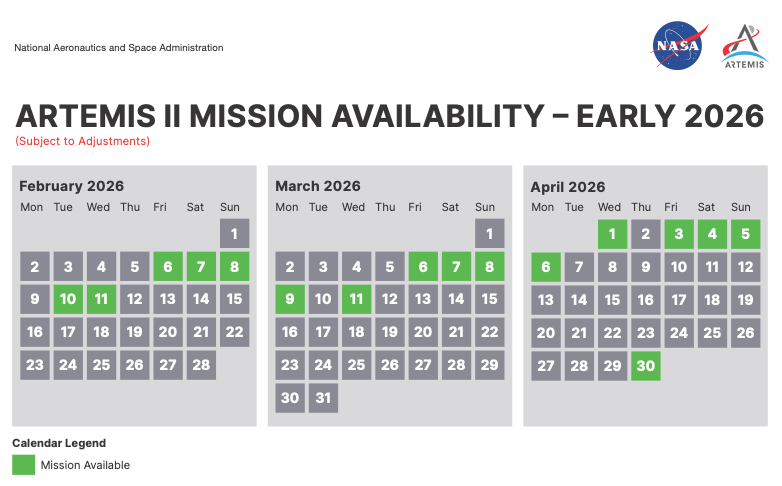 16 launch opportunities are available to launch the Artemis II mission
Available launch windows
Each day offers launch window because the Moon is in the right position for only two hours, beginning at these times, each day.
Feb 6 9:41:00 PM EST Feb 7 10:46:00 PM EST Feb 8 11:20:00 PM EST Feb 10 12:06:00 AM EST Feb 11 1:05:00 AM EST Mar 6 8:29:00 PM EST Mar 7 8:57:00 PM EST Mar 8 10:56:00 PM EDT Mar 9 11:52:00 PM EDT Mar 11 12:48:00 AM EDT Apr 1 6:24:00 PM EDTApr 3 8:00:00 PM EDT Apr 4 8:53:00 PM EDTApr 5/2026 9:40:00 PM Apr 6/2026 10:36:00 PM Apr 30/2026 6:06:00 PM
Launch windows shift about 40 minutes later each day. This accommodates two motions: Earth’s rotation, which sets the “next-day” timing, and the Moon’s continued orbit around Earth, which accounts for the roughly 40-minute delay.
Gaps in the nearly week-long sequence of launch opportunities are built in to accommodate range conflicts. The pads at Launch Complex 39, one pad used by NASA and the other by SpaceX, along with four additional active pads at Cape Canaveral Space Force Station operated by Blue Origin, SpaceX, and United Launch Alliance, make up the eastern range and the busiest spaceport in the world.
The schedule also allows ground crews time to replenish super-cold propellants that slowly boil off even at cryogenic temperatures, and to top off oxygen, nitrogen, and other gases essential to both the spacecraft and its crew.
How are launch days selected?
The days available for launch are constrained by the Moon’s phase, a factor that will be critical for Artemis III, when astronauts are scheduled to land on the lunar surface for the first time in nearly 60 years.
The Sun’s angle above the lunar surface controls the length and contrast of shadows, impacting astronauts’ ability to judge terrain, manage their descent, and safely traverse the Moon. Apollo 11-17 were launched toward a thin crescent Moon, ensuring low Sun angles at the landing sites.
Artemis II, which will not land on the Moon, is less concerned with where shadows fall on the Moon, and may completed with more of the Moon’s Earth-facing surface lit. This also ensures sufficient sunlight reaches the solar panels that the crew will deploy soon after launch on their Orion capsule.
The April 1 launch opportunity even coincides with a full Moon.
How are launch times selected?
The biggest factor in determining where a space craft goes is when it’s launched. The Moon has to be in the right place at launch time in order to reach it.

Each launch window opens about 90 minutes before moonrise at the Kennedy Space Center. This puts the moon within reach of the Orion capsule following a full day of checkouts of the Orion capsule “Integrity” and widening its orbit to put it in position for translunar injection.
The 10-day mission will bring the crew approximately 4,700 miles beyond the Moon’s far side, far beyond the distance from Earth achieved by any previous human spaceflight. Apollo astronauts traveled only a few hundred miles above the lunar surface.
For comparison, Apollo 11 launched during its first launch window on July 16, 1969 with additional windows available every two days. But this was a different mission and a very different spacecraft and vehicle.
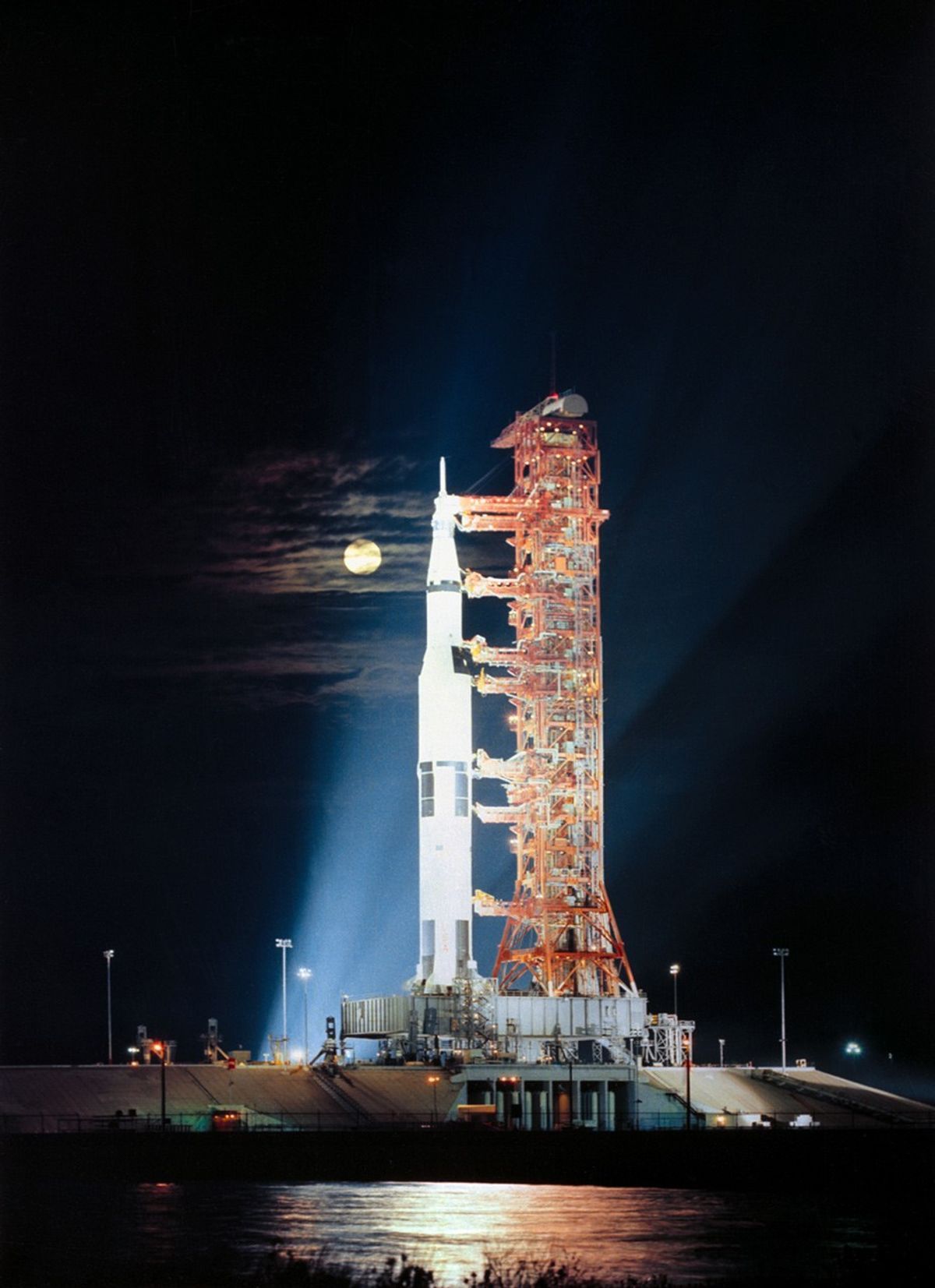
Apollo 11 also launched within a little more of an hour of moonrise. Images of the towering Saturn V with its lunar target shown high above the launch pad were taken long before launch, in the weeks between rollout and launch.
NASA is preparing to begin rollout of tthe 11-million-pound stack at about one mile per hour along the four-mile route from the Vehicle Assembly Building to Launch Pad 39B.
39B was first used to launch Apollo 10, which also took astronauts around the Moon to validate systems and procedures before the next mission touched down on the lunar surface.