
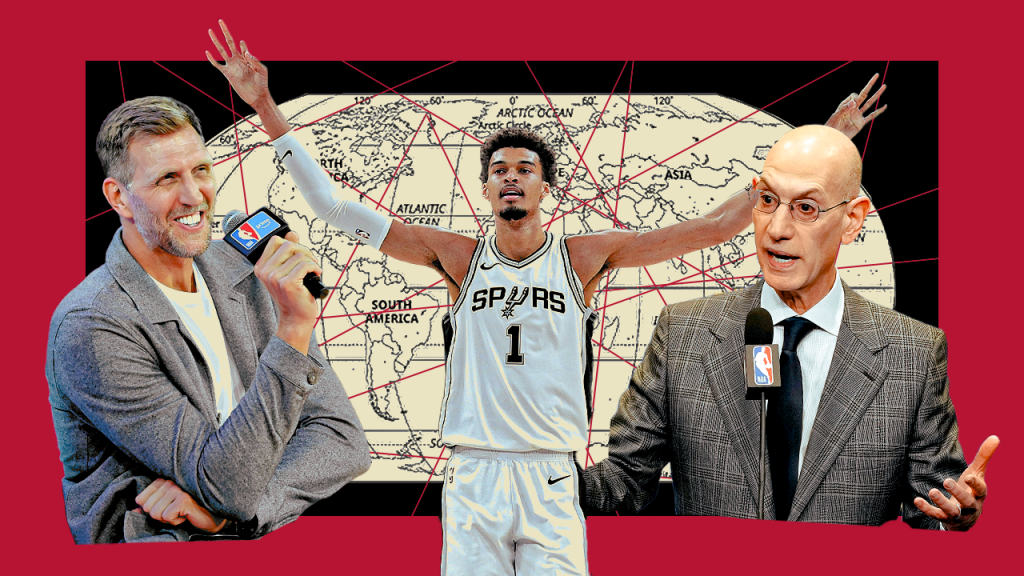
Amazon Prime Video will stream the NBA’s first regular season game in Berlin—the Memphis Grizzlies against the Orlando Magic—on Thursday, with German legend and analyst Dirk Nowitzki playing a starring role. The Prime team then travels to London for a second European tilt featuring those teams Sunday.
But that pair of games is just a small piece of the world-spanning partnership between Amazon and the NBA. Beyond the U.S., Prime Video is carrying games in more than 220 countries and territories as part of its 11-year, $19.8 billion rights deal. That meant taking on a herculean technological challenge—and seizing a chance to highlight all the tech giant can offer U.S. leagues looking to grow internationally.
Amazon is now streaming its games in 14 languages, each with its own set of announcers working from studios in their home countries, on top of intricate internet architecture to localize the presentations.
Live video feeds are delivered to those announcers and then synced with their play-by-play calls. In-game graphics are tweaked. Commercial breaks come with different content by location. Streams are beamed through a production center in London for encoding and quality control before being sent to myriad devices in far-reaching locales. When all of that is done, producers oversee the handoff of the 14 announcing teams to a new set of speakers for a second game in most cases. Occasionally (like Thursday) there’s a third tilt too. Oh, and much of this is playing out in the wee hours of the morning local time.
“It’s the most complicated dang thing we’ve ever done,” Prime Video Sports director of production and tech operations Ken Miller said. He added that the entire system might not be possible were it not for remote production and coordination technology advances made during the COVID-19 pandemic.
But the effort is paying off.
The league said that European viewership for NBA games on Prime Video is up 184% through Jan. 2 of this year, versus comparable games on linear TV last season. In Germany, the audience has grown 246% over a similar number of 2024-25 games on DAZN. In the U.K., there’s been a 312% jump above last year’s average viewership on TNT Sport UK through the same timeframe.
Heading into negotiations for the current media deal, Amazon had regional rights to NBA games in certain parts of Latin America, as well as the ability to sell League Pass packages internationally.
“It was really clear that with our success with what we had been doing for a couple seasons … that it would expand beyond that in this new cycle,” NBA SVP and head of international content partnerships Matt Brabants said.
Commissioner Adam Silver specifically called out how “the digital opportunities with Amazon align perfectly with the global interest in the NBA” after the latest deal got done.
The league has long had its eyes on growing its global reach in line with its international star-power. It’s particularly focused on Europe right now, with plans for a new league on the continent.
Global considerations were factored into all aspects of Amazon’s NBA coverage, from including Nowitzki (who has been a stateside hit too) in Amazon’s studio team to the streamer’s schedule. It has eight Saturday afternoon games timed to air in prime time in Europe, often featuring international stars such as Victor Wembanyama and Giannis Antetokounmpo. It also has international rights to an additional 27 regular season games in select markets as well as postseason action. In total, the league scheduled 88 games to be played in European primetime (as well as key Middle Eastern and African markets) this season, including those airing on other networks.
Amazon’s first European prime time telecast, featuring Wemby, was the most-watched regular season game in Europe, excluding Christmas Day contests and games played in Paris, according to the NBA.
“There’s so much focus on, obviously, the domestic side of what we were doing, but it’s so much bigger and broader,” Prime Video VP of global live production Jared Stacy said from Berlin.
With one partner spanning so many regions, the NBA gets more granular data on audiences around the world, while Amazon is taking its learnings into account as it builds its own permanent infrastructure for global sports productions. On Black Friday, Amazon streamed an NFL game globally for the first time. It has already delivered marquee hockey, soccer and tennis action in major international markets as well. Each new set of rights—and capabilities—makes the company even more attractive to leagues looking to reach viewers who have become accustomed to finding their favorite teams and athletes on Prime Video.
“We’ve done tier one sports in so many countries now,” Stacy said. “I think that’s a great advantage for us.”