Welcome to From the Archive, a look back at stories from Dwell’s past. This story previously appeared in the May 2003 issue.
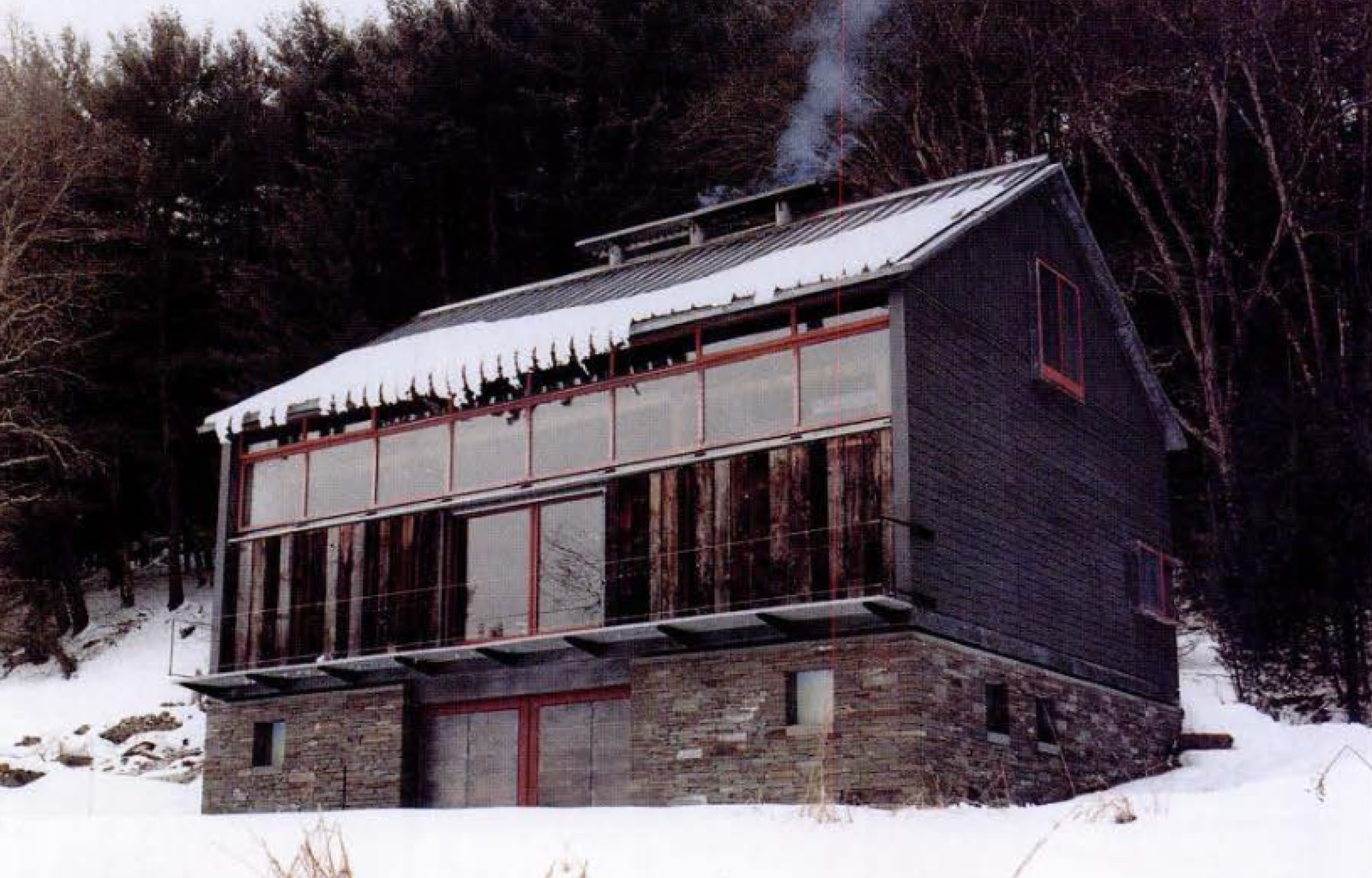
For weary urbanites, nothing signals a respite from the city like an honest-to-goodness barn. Its spare, simple silhouette is shorthand for the clean living and country air that sent Eddie Albert and Eva Gabor in search of bucolic bliss in Green Acres. New York architect Joe Levine and his wife, Jane Cyphers, were looking for a piece of that same restful country life when they bought a dilapidated 1850s barn in a quiet corner of Pennsylvania. They planned to turn the barn into a weekend retreat, but Levine had a slightly different idea of what shape peace and quiet might take. “I didn’t want a little red barn,” says Levine. “I wanted a reincarnation of the barn—into a house.”
Levine and Cyphers bought the neglected structure, which is said to have once been a station on the Underground Railroad, five years ago. The barn was part of a larger property overlooking the Delaware River in Milanville, Pennsylvania, about 100 miles northwest of New York but as far from the grit and grime of Manhattan as you can get in a two-hour drive. The barn’s previous owners, friends of Levine and Cyphers’s who still live just up the hill, sold it to the couple along with 11 acres of land. Levine vividly remembers their first impression: “Jane and I went up to take a look at it, and we were just floored. It had all the romantic characteristics of a barn, and the space was astounding. It was the archetypal barn, with light streaming in through the slots and a great smell of hay. Jane said, ‘Whatever you do, don’t lose this.’”
Even though the barn’s wooden boards were falling off and the roof was visibly bowed, Levine knew he had to preserve the post-and-beam structure. At first, he was afraid that if he took the barn apart he wouldn’t be able to reassemble it with the same timbers. Luckily, he had a strong background in salvaging old structures: The core work of his Manhattan firm, Bone/Levine Architects, is consulting on historic restoration projects. Levine has taken apart and reassembled hundreds of landmark buildings in New York City. Still, this particular job had a big learning curve. The architect and his engineers lifted the structure up 12 inches from the ground and propped it on wooden cribbing while digging and pouring new foundation walls. (While the excavation was happening below it, the structure ended up being suspended 12 feet above the new, lower ground level.)
Inside, there was no obvious way to straighten out the wayward beams and columns. The rafters were sagging and the frame was hopelessly out of plumb. But, necessity being the mother of invention, Levine and his team solved the problem by attaching a pair of Y-shaped steel braces to columns at the center of the barn, which support a new aluminum I-beam slipped underneath the ceiling rafters. Every day for a month, the work crew cranked the braces, pushing the sagging structure up and outward, an inch a day. Eventually things were straightened out, so to speak. You can still see the inventive bracing mechanism spreading out from the interior columns like the silvery branches of a tree.
Being a hands-on guy, Levine would have done the construction work himself, but he figured it would take 10 years of weekends to do it. So Levine’s next-door neighbor, Larry Braverman, a cabinetmaker and woodworker, stepped in. Braverman took charge of overseeing the construction staff and became the primary builder. “I treated it like one big piece of furniture,” explains Braverman, who was the ideal onsite stand-in for Levine. “A perfectionist meets another perfectionist,” he jokes, and it’s a good thing that such a detail-oriented craftsman was in charge: Except for the appliances, everything is custom-made, from the roof purlins and sliding glass doors to the hardware on the kitchen cabinets. “The house is based on perfection, precision, and small feats of engineering,” adds Braverman.
To keep the reengineered structure in evidence, Levine put the barn’s new skin outside the structure. He clad the north and south walls in stained cedar and covered the west-facing wall in corrugated-fiberglass panels. A pair of glass barn doors in the center of the fiberglass wall is the de facto front door. On the eastern wall, Levine let loose with a giant expanse of windows along the entire length of the barn. The top layer of windows is fixed; the bottom layer has eight sliding doors that roll away to open the entire facade to the river below. The old barn boards were salvaged and transformed into sliding shutters that control daylight and create a modicum of privacy from the road below. Thanks to these rolling shutters, the house becomes a giant porch—and recreates that sensation of light filtering in through the barn boards that so charmed Cyphers at first sight.
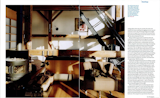
With so much effort spent on preserving the barn’s soaring interior expanse, Levine and his family didn’t want to carve up the 1,200-square-foot floor plan into separate rooms. They kept the inside free and clear, except for a freestanding box of translucent fiberglass panels and lacquered-plywood closets enclosing the bathroom. The compact but open kitchen floats atop a patch of galvanized steel. The rest of the main floor is an undivided living and dining space where Levine and Cyphers’s two teenage daughters, Raye and Emma, both serious figure skaters, have been known to practice dance and skating routines.
There are no bedrooms, just two 200-square-foot sleeping lofts where the barn’s long-vanished haylofts used to be. Levine and Cyphers share one and the girls share the other. Sheets draped over the lofts’ cable handrails provide the only visual privacy in the sleeping quarters; acoustic privacy is nonexistent. (Translucent sliding enclosures are in the works.) “Privacy has definitely been a challenge. It yielded to the space,” Levine admits. “Even at home in Brooklyn, we’ve always given up certain aspects of privacy for space. It’s just not that important for us. The kids are now 15 and 17, so they need more privacy than they did five or six years ago when we started on the project. Now they bring friends up for the weekend and expect Jane and me to go to a bed and breakfast so they can have the run of the house.” Sometimes Levine and Cyphers do camp out, bequeathing the barn to their guests while they retire to tents pitched outside.
Levine and Cyphers are counting on an increased supply of visitors in the years to come: This summer, Levine hopes to start building a little guest house atop the foundations of an old chicken coop next to the barn. He plans to construct a bathroom and sauna and to make a small guest room from an authentic New York City water tank salvaged from one of his firm’s restoration jobs. “It’ll be the perfect silo to the barn,” he says.