
Thanks for reading the Her Hoop Stats newsletter. We’re excited to announce a new partnership with Hudl. Hudl’s industry-leading tools – Sportscode, Instat, and Fastmodel – elevate the preparation, performance, and player development of WNBA and NCAA teams. We appreciate their support and look forward to working with them to help bring more insight about the women’s game to you.
You can find me on Bluesky and HHS on Bluesky, Twitter, YouTube, Facebook, and Instagram.
Haven’t subscribed to the Her Hoop Stats Newsletter yet?
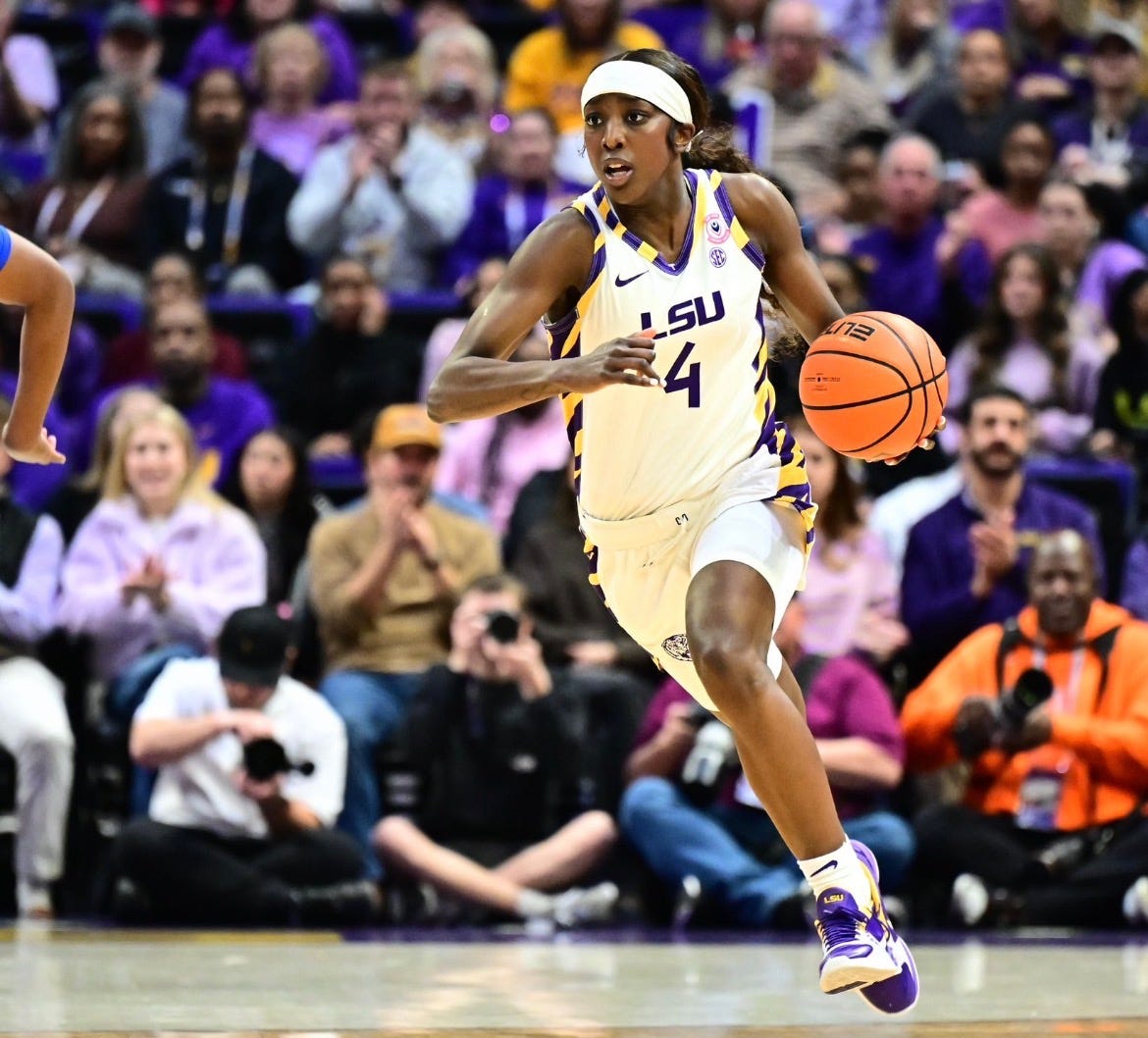 Photo courtesy of Louisiana State University Athletics
For off-ball guards, transitioning to the WNBA is a lot about handling the increased physicality while executing more quickly with fewer mistakes. Offensively, they need to persevere against the league’s most ruthless defenders, who close out faster, cover gaps better, and impede player movement almost non-stop. On the defensive end, they’re expected to hound ball-handlers, fight through screens, disrupt entry passes, and switch across positions without conceding a mismatch. Meeting these requirements is a tall task, and only a small group of prospects possess the rare combination of skill, grit, and basketball IQ demanded. Come draft night, it’s likely they’ll be jockeying for the order in which their names are called early in the first round.
As one of the few college players to average a near 50-50-100 (48.9-47.0-100) shooting split while scoring over 17 points per game, Fudd’s appeal as one of the top WNBA prospects is anchored by an almost unparalleled skill: she’s arguably the most gifted pure shooter to enter the draft in years. And coming into a league that increasingly values spacing, the 5-foot-11 guard’s ability to preoccupy defensive attention makes her an immediate asset. Her impeccable off-ball movement combined with flawless shot mechanics and footwork allow her to create separation, square up, and release her shot within fractions of a second. In addition to her shooting prowess, the 2025 national champion and Final Four Most Outstanding Player possesses a coveted feel for the game, has a deceptively tight handle, and boasts a top-tier defensive motor that enables her to hold her own against some of the most talented guards.
To solidify her position as the No. 1 overall pick, the next step in Fudd’s evolution lies in expanding her on-ball creation and finishing package. Demonstrating she can break down defenders in isolation, generate paint touches, and produce scoring opportunities for others would silence any lingering “specialist” labels. If she can pair her world-class shot-making with increased downhill assertiveness, a higher free-throw rate, and more frequent offensive initiation, Fudd could project as a complete, franchise-level guard whose combination of efficiency, gravity, and two-way impact would be impossible to pass on.
The 6-foot guard is in the midst of a true breakout campaign, posting career bests in scoring (13.8 ppg), rebounding (6.0 rpg), steals (0.8 spg), and — most notably—3-point field-goal percentage (45.2% on 3.6 3PA per game). Equally impressive, her production has translated against some of the toughest matchups. She’s reached double figures against six top-25 ranked opponents, including a season-high 29 points against then-No. 14 Tennessee. Beyond the box score, Jaquez plays with an infectious energy and consistently impacts games with a long list of intangibles, from battling for rebounds and diving on loose balls to making the extra pass and executing back-door cuts to perfection. Her high basketball IQ also shows up in several meaningful ways. Her astute court vision, savvy off-ball movement, and knack for reading passing lanes all help elevate her team’s play and have fueled UCLA’s 16-1 start.
Becoming a lottery pick may be just out of reach given the depth of talent at the top of the 2026 draft class, but Jaquez’s momentum makes her a compelling candidate to come off the board early, particularly for one of the expansion teams. She is a high-level athlete, can effectively defend multiple positions, thrives in pressure situations, and consistently makes winning plays. If she can sustain her efficiency from beyond the arc over the course of the season, she’ll have a strong case to be viewed as more than a great utility piece. Instead, she could profile as a true two-way threat, who provides great floor spacing, defensive versatility, and a competitive edge, and who also has several years of experience playing alongside other WNBA-caliber players and finding success on some of the biggest stages.
As a dynamic three-level scorer averaging 14.5 points per game, the 5-foot-10 guard possesses crafty footwork that allows her to weave through traffic, a polished mid-range game, and increasing efficiency from beyond the arc (44.8% on 3.2 3PA per game). On the other side of the ball, Johnson stands out as an exceptional point-of-attack defender. Her lateral quickness, anticipation, and competitive fire result in consistent stocks (2.1 steals plus blocks per game) and enable her to effectively switch across multiple positions. This two-way foundation combined with her ability to battle for rebounds (4.1 rpg) and serve as a connector who thrives as both a primary shot creator and a secondary scoring option make her an intriguing selection for several WNBA teams.
Although Johnson recently had a slightly worrisome outing in LSU’s 61-65 loss to Vanderbilt (0 points, 1 assist, and 3 rebounds in 17 minutes), she looked much more like herself in the two games that followed. But if she wants to cement her status as a lottery pick, she must continue to refine her half-court decision-making and show she can consistently produce against top competition. While her transition game is already elite, demonstrating sharper processing speed and command within half-court sets would definitely help her draft stock. Front offices will also be monitoring her ability to reliably pull up from beyond the arc, finish efficiently against teams with strong interior anchors, and impact the game even when her shot isn’t falling, especially when the Tigers face upper-echelon opponents. But if Johnson can show progress in these areas throughout the rest of her senior season, she could lock in a spot as one of the first five names called on draft night.
Unranked by ESPN coming out of high school, Kneepkens wasted little time proving the scouts wrong, putting up stellar numbers for Utah nearly right out of the gates and earning herself Pac-12 Freshman of the Year. And although a foot injury sidelined her for most of her junior year, her development never stalled. Instead, she continued to refine her game, ultimately transferring to UCLA for her final college season with a clear focus on becoming more pro-ready. At 6-foot, Kneepkens possesses great positional size for a modern WNBA wing or off-ball guard, and her ability to knock down 3-pointers off the catch, coming around screens, or after relocation (45.8 3P% on 5.6 3PA per game) makes her an immediate plug-and-play asset for almost any team. Now averaging 13.8 points, 3.8 rebounds and 3.5 assists, Kneepkens has not only proven her value as an offensive weapon, but also that she can seamlessly integrate into a talent-rich lineup and provide a significant impact.
To move into lottery pick territory, Kneepkens will need to continue investing in her athletic development, while dialing up her aggressiveness and hustle factor. While she’s an intelligent, high-effort team defender, proving she can reliably contain explosive WNBA guards at the point of attack remains a critical evaluation point. Additionally, although she’s shown she can be a proficient secondary creator, showcasing more advanced pick-and-roll reads could significantly strengthen her projection. If Kneepkens can evolve from being an elite off-ball weapon into a guard who can generate high-percentage looks for both herself and others, she’d fit much better into the archetype of a versatile, high-IQ cornerstone player that’s selected near the top of the draft.