
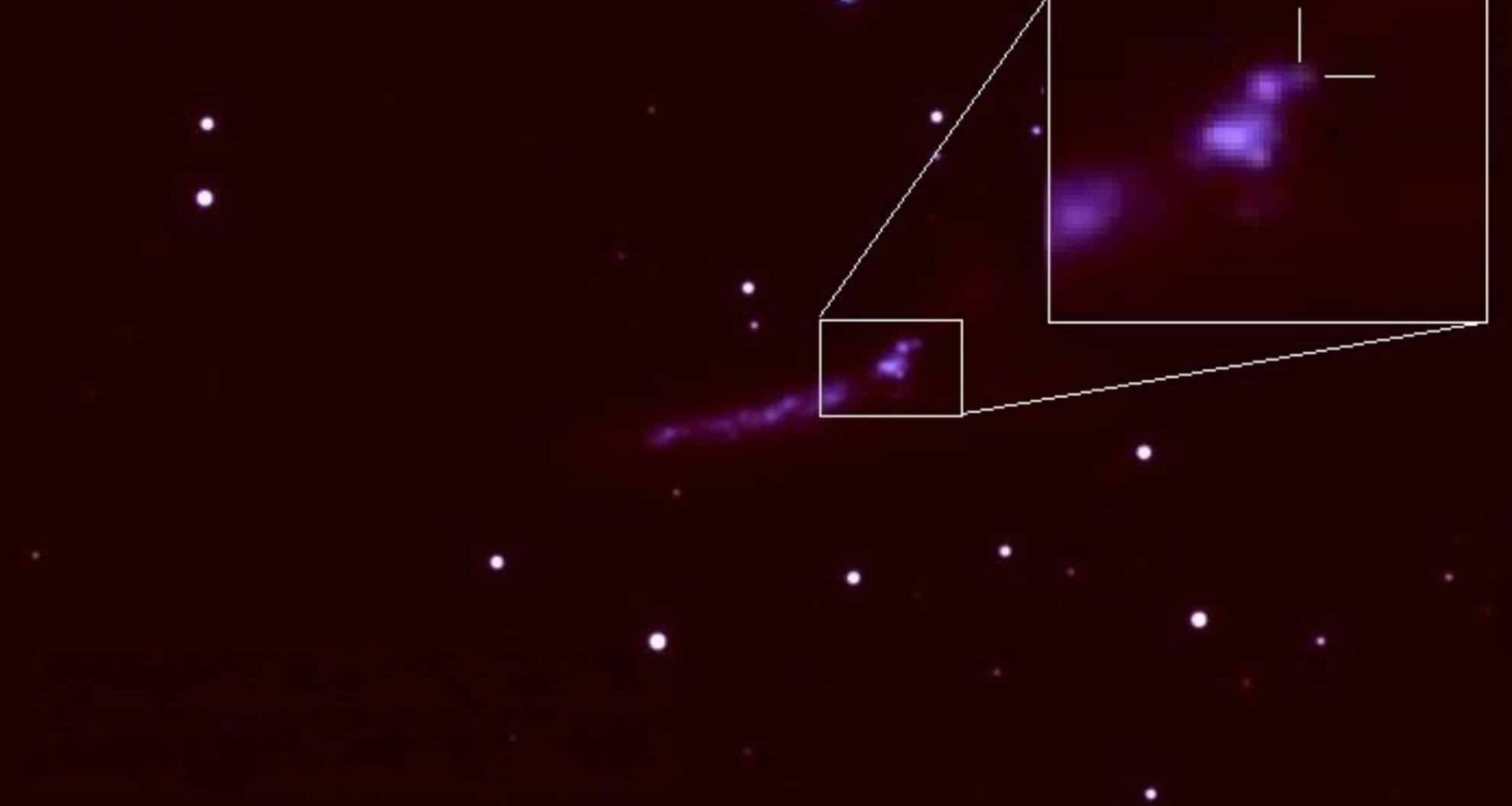
A supernova in a distant galaxy has shaken up what astronomers thought they knew about the birth of black holes. SN 2022esa, discovered in UGC 5460 in Ursa Major, didn’t go quietly into the cosmic night, it exploded with dazzling force, despite originating from a star believed to be too massive to die in such a visible way.
Instead of collapsing silently, as scientists expected from stars over 30 times the mass of the Sun, this star burst with brightness. The result is a new window into how black holes (and possibly black hole binaries) form in some of the universe’s most extreme stellar systems.
SN 2022esa stood out early on. The research team from Kyoto University classified it as a rare type Ic-CSM supernova, an explosive class linked to massive Wolf–Rayet stars. These stars are known for shedding their outer hydrogen and helium layers, and in this case, the explosion revealed a strong interaction between the supernova ejecta and a dense, oxygen-rich shell of circumstellar material. What followed was unexpected: a stable, month-long periodicity in the light curve, indicating a binary origin and challenging long-standing assumptions about massive stellar deaths.
The Explosion That Broke the Rules
When astronomers spotted SN 2022esa on March 12, 2022, they quickly realized it didn’t behave like other massive-star collapses. According to Kyoto University researchers, this supernova emitted electromagnetic signals throughout its evolution, a clear sign that its collapse wasn’t silent. That observation alone was enough to upend the prevailing theory that ultra-massive stars simply implode into black holes with little fanfare.
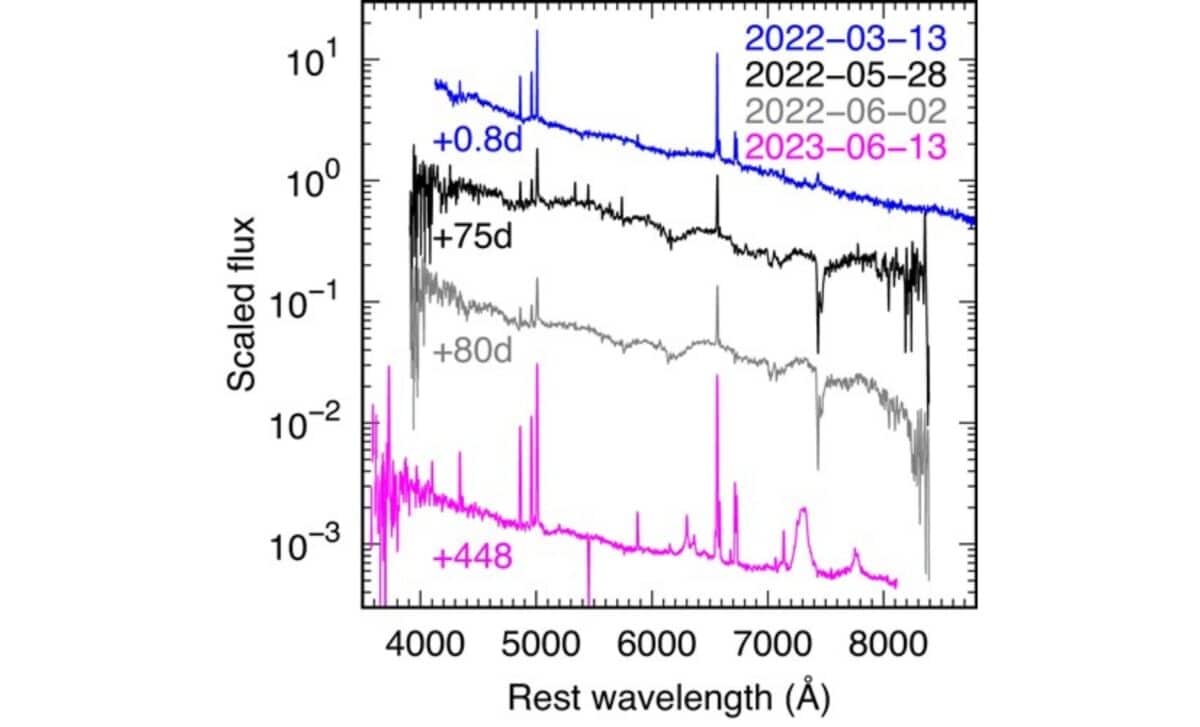 Spectral evolution of SN 2022esa from day 0.8 to day 448. ©Publications of the Astronomical Society of Japan
The explosion was tracked using the Seimei Telescope in Japan and the Subaru Telescope in Hawaii. These complementary tools allowed astronomers to classify the supernova and trace its evolution over more than 400 days. The late-stage spectrum captured by Subaru showed narrow emission lines from oxygen and other intermediate-mass elements, firmly identifying the event as a type Ic-CSM supernova.
Lead author Keiichi Maeda of Kyoto University explained that these results offer a “new direction to understand the whole evolutional history of massive stars toward the formation of black hole binaries,” The rarity of SN 2022esa’s light profile, combined with its unique emission patterns, suggests a broader and more complex diversity in stellar death outcomes than previously believed.
A Binary System behind the Cosmic Rhythm
One of the most intriguing features of SN 2022esa was its steady light-curve modulation, pulsing every 32 days. According to the Kyoto University team, this regularity points to stable mass-loss episodes prior to the explosion, a phenomenon only possible in a binary star system. Their interpretation: the progenitor star orbited another massive object, perhaps a second Wolf–Rayet star or even a black hole.
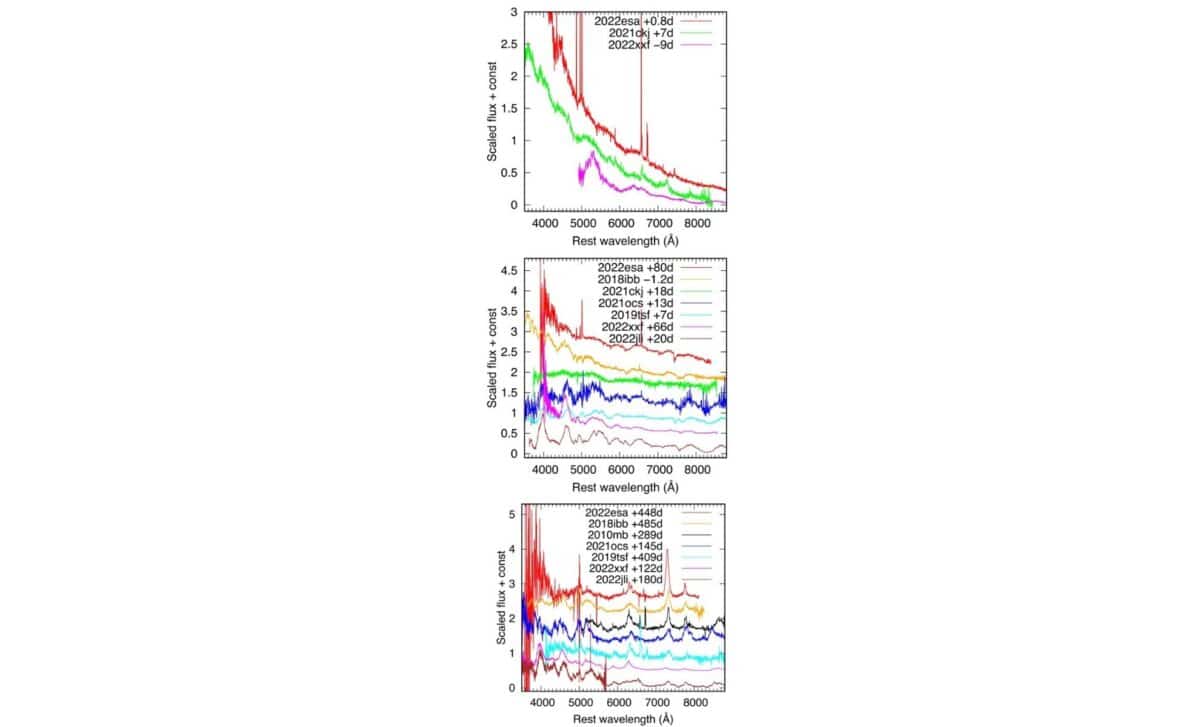 Spectral comparison of SN 2022esa and other SNe Ic-CSM at early, peak, and late phases (H II region subtracted). ©Publications of the Astronomical Society of Japan
The light-curve bumps were confirmed through detailed periodogram analyses using ATLAS and ZTF observations. The recurring signals remained consistent over hundreds of days and hinted at a slowly increasing period, a behavior consistent with a shockwave moving through layered shells of circumstellar material.
Such periodic eruptions are thought to occur when a star’s orbit brings it close to its companion, triggering gravitational interactions and mass ejections. This process is likely to have continued for years before the explosion, steadily shaping the surrounding environment with layers of dense gas. This scenario points toward an eccentric binary system that, according to the Kyoto researchers, will eventually result in a black hole binary, a powerful source of gravitational waves.
Opening the Door to New Black Hole Formation Models
SN 2022esa offers fresh clues into the physical processes at work in black hole formation. Its massive luminosity, blue optical color, and prolonged brightness (ustained for over 150 days) suggest that the main energy source wasn’t radioactive decay, but rather interaction between the supernova’s ejecta and an oxygen-rich circumstellar medium.
In their analysis, the Kyoto team compared SN 2022esa with other rare cases like SN 2022jli and SN 2018ibb. While some of these events shared features like periodic light-curve modulation or extended luminosity, none matched the consistency and strength of SN 2022esa’s emissions. These comparisons led to the conclusion that type Ic-CSM supernovae may not be a single group but rather a collection of events with diverse origins, including different binary setups, progenitor masses, and evolutionary tracks.
The implications of this case are far-reaching. By linking SN 2022esa to a Wolf–Rayet–black hole or Wolf–Rayet–Wolf–Rayet binary, the study provides a clearer picture of how certain binary systems may evolve into black hole pairs. Such systems are of particular interest because they eventually merge and release gravitational waves, as detected by observatories like LIGO. This case doesn’t just revise a theory, it reshapes a chapter of stellar evolution. Astronomers will be watching closely to see if other supernovae follow this bright path to darkness.