
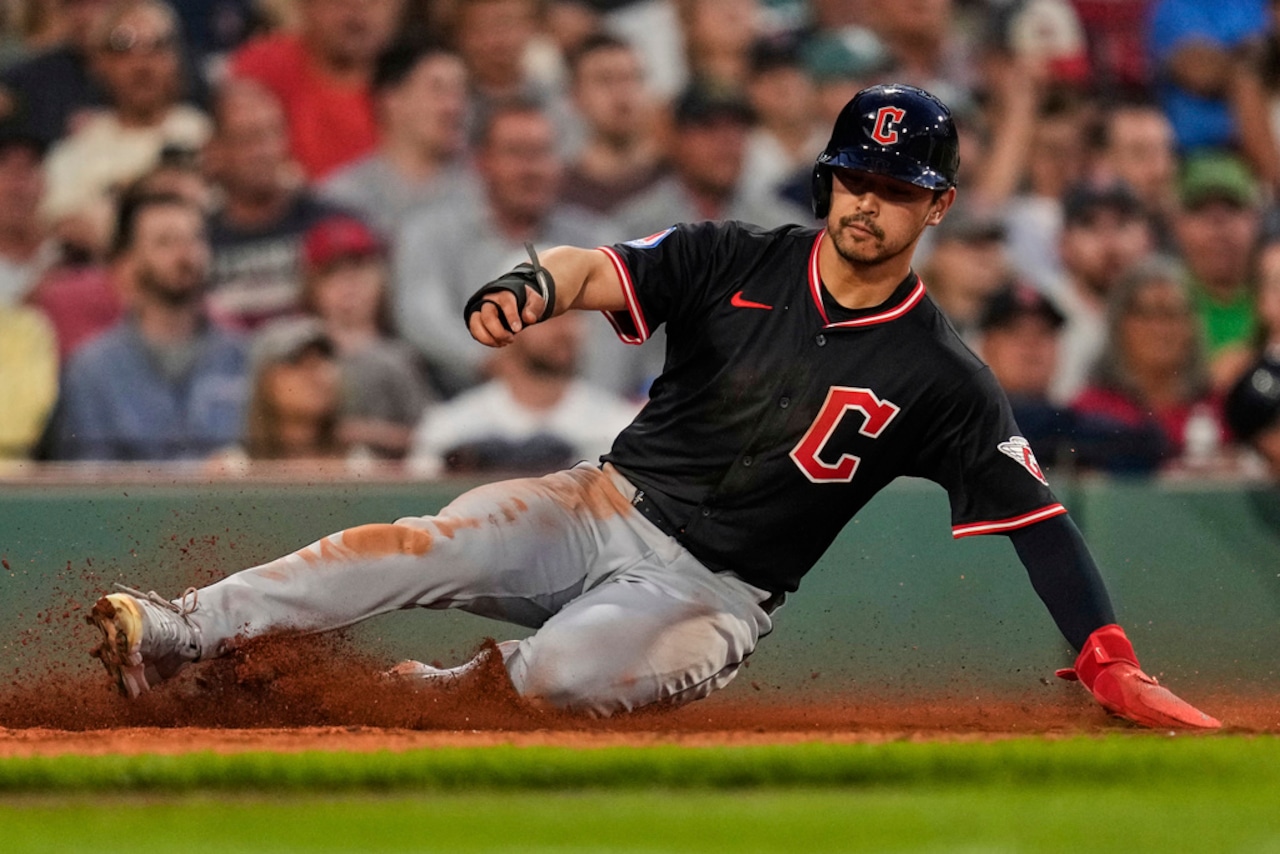
CLEVELAND, Ohio — The Guardians may be preparing for life without their offensive catalyst. Despite being labeled the “engine” of Cleveland’s offense, Steven Kwan’s future with the team suddenly appears uncertain following manager Stephen Vogt’s surprisingly non-committal comments during recent media availability.
When directly asked if Kwan would be Cleveland’s opening day left fielder, Vogt’s response raised eyebrows among reporters covering the team. According to Paul Hoynes, Vogt was “kind of non-committal” despite obviously wanting Kwan in the lineup.
“He obviously he wants Kwan to play… He said, speculation is speculation the roster is the roster and as of right now on January 16th, he’s still on the ball club. So not exactly a ringing endorsement,” Hoynes explained on the Cleveland Baseball Talk Podcast.
This tepid response from Vogt stands in stark contrast to his previous enthusiastic endorsements of Kwan as the team’s offensive spark plug. The manager has consistently praised Kwan as the catalyst who gets the offense moving, making his sudden ambiguity all the more concerning for fans who’ve embraced the outfielder’s elite contact skills and defensive prowess.
Joe Noga, co-host of the podcast, interpreted Vogt’s comments as a potential signal that trade discussions involving Kwan may still be active. “There’s a possibility, I guess just from listening to the way that he answered and responded to that question, there’s a possibility that Stephen Kwan gets traded before the season starts or early on,” Noga suggested.
Even more alarming for fans hoping to see Kwan remain in Cleveland long-term was Noga’s prediction about what might happen if no resolution is reached by spring training’s end: “If they haven’t signed him to an extension or traded him by then, he’s definitely getting dealt before the trade deadline at the end of July.”
The situation creates a fascinating dilemma for Cleveland’s front office. Kwan is undeniably valuable — a Gold Glove-caliber defender with elite on-base skills who sets the table for José Ramírez and the middle of the order. Yet with two years of team control remaining, his trade value may never be higher than it is now.
Hoynes believes the team’s lack of offensive additions this offseason makes trading Kwan unlikely, at least in the immediate future. “After what they haven’t done to improve this offense, how do you take your second-best hitter off the team?” he questioned.
The emergence of outfield prospects further complicates matters. During the same media session, Vogt indicated Chase DeLauter would focus on center and right field — positions that could shift if Kwan were moved. This potential outfield reconfiguration, with DeLauter in center and prospects like George Valera possibly getting opportunities, provides a glimpse of what a post-Kwan outfield might look like.
For Cleveland fans, the uncertainty surrounding Kwan creates an uneasy feeling as spring training approaches. The left fielder’s consistent production, defensive excellence, and fan-friendly style have made him a favorite. His presence at the top of the order has been crucial to the team’s competitive renaissance.
The coming weeks will be telling. Will the Guardians commit to Kwan long-term with an extension? Will they shock fans with a pre-season trade? Or will they enter the season with the situation unresolved, creating the potential for a deadline deal if they fall from contention?
To hear the complete discussion about Kwan’s future and other insights from Guardians insiders, be sure to listen to the full episode of the Cleveland Baseball Talk Podcast with Joe Noga and Paul Hoynes, where they break down all the latest developments as spring training approaches.
Read the automated transcript of today’s podcast below. Because it’s an AI-generated transcript, it may contain errors and misspellings.
Podcast Transcript
Joe Noga: Welcome back to the Cleveland Baseball Talk Podcast. I’m Joe Noga joined by Paul Hoynes. Hoynsie, we had a chance yesterday to talk to do a couple of zooms with Stephen Vogt, Austin Hedges and Hunter Gaddis. First time since the, the end of the season that we’ve really had a chance to really sit down and chat with these guys, see how their off season’s going and you know, sounds like everybody’s ready to just sort of press fast forward and get to spring training right now. Austin Hedges sounded like he was ready to, to, to get out there and start hitting.
Paul Hoynes: Yeah, I mean, once it gets to January 1st, these guys, you know, are creatures of habit and they, you know, they’re, they’re, they’re looking toward the desert. You know, they want to get out of the cold and get to the desert and warm up and start playing baseball.
Joe Noga: Yeah, I, I asked Hunter Gaddis about this off season and all of the, the, the diamond mind that I guess the, to be sitting on all these players, these young 20 something year old guys proposing to their girlfriends and their fiancée. Now I think, you know, five, six different guys got engaged over the, the offseason. Kyle Manzardo Gaddis himself got engaged and the most recent one, Parker Messick, we, we saw him, you know, propose to his fiancée. So lots going on. I, I think a lot of these guardians players might want to get into their routines and leave the wedding planning to their, their fiancée. But you know, Hunter Gaddis sounded like he was, you know, at least eager to, to get out there and keep throwing. He said he took about, took about a month off this year, which was unusual for him.
Paul Hoynes: Yeah, it’s, I just look at his numbers, Joe. Him and Cade Smith’s numbers the last couple years. They’ve each thrown over, made of, made over 150 appearances. And that doesn’t even include the postseason where, you know, those guys pitch in every game no matter how long the postseason run goes. And he says he’s feeling great, he takes a month off, doesn’t touch a baseball, then starts, you know, gradually working back into it, you know, throwing and, and getting in the gym. It’s amazing to me. I mean, I know the guy’s huge. You know what he’s 6, 6, you know, 240, 250. But still that’s a lot of, that’s a lot of wear and tear on your arm, you know. But he said, he, he said, what do you say? Tell us, Joe. He’s, he was saying you know, they, they don’t pitch guys more than three days in a row and, but he said he, he, he could almost pitch every day.
Joe Noga: Yeah, that’s what it sounded like. And you know, he’s got the background as a starter. He’s been a starter in the big leagues early in his career before he sort of fell into the setup role that really suits him. So, you know, he’s got the ability to go out there and pitch multiple times, multiple innings. And I just think he’s, he’s sort of in a situation now where he knows that he’s a high volume guy and he’s got his mind and his body set to where it needs to be. It’s, you know, and he’s going to be a vital part of this bullpen. We asked about all the, the new arms and, and the additions of all these, these pitchers in the offseason to sort of bolster that bullpen in front of guys like Cade Smith and Gaddis and, and now Sean, Sean Armstrong, the veteran that they signed. And you know, Gaddis said, this is, it’s good to have this competition. It’s good to have these guys. They, they understand that, you know, they need more than just eight guys in that bullpen for the season. You’re going to need probably twice that many for the year. Austin Hedges said. You need, you don’t need, you know, 26 guys. You need 46 guys during the year to sort of get through and be a championship contender. So, yeah, it just sounds like they’re ready to go. They’re, they’re getting to where they need to be. They’re, they’re all sort of just like us. They’re, they’re eager for spring training to arrive as quickly as possible.
Paul Hoynes: Joe, I’m really anxious or, you know, I’m curious to see how the pitching, the pitching coaches really kind of slice and dice this bullpen with so many new arm shows. Armstrong, Brogdon, Holderman, Peyton Pallette. And you know, they’ve got, they bring back Pedro Avila, they’ve got Cody Hewer, you know, on minor league deals and just, you know, who does what. And you know, and that’s on top of, you know, the, the incumbent guys like Hunter Gaddis, you know, would vote. I thought it was interest votes said it kind of starts at the back end like most good bullpens do with the closer. You said Cade Smith is going to have the ninth inning and then you work out from there on matchups. But, you know, there’s got to be a Little more definition to, to the roles than that, don’t you think?
Joe Noga: Yeah, and, and I think that’s on Vote. And now that you, you’ve got the one thing that, that Stephen Vogt said, the one thing that Austin Hedges said, that having Carl Willis back as the pitching coach this year is, is, is a tremendous thing. It, it’s again, something that they’re excited about, but it also helps sort of stabilize things because there’s been a lot of turnover on that coaching staff since the end of the year. Kai Correa, Craig Albert as both leaving Stephen Vogt’s staff. So having Carl Willis there and, you know, being able to map things out and bounce ideas off of Willis is going to help vote tremendously again this year. I’m not really going to worry about the, the way the matchups are going to go or how they’re going to sort things out when they get to that point during the season. Just because you’ve got that institutional knowledge there that’s been there for, for so long and done it in so many different ways. Anything else stand out? You know, from our zoom calls with Vote and with Hedges and Gaddis, you know, I thought there were a couple of quick hits. We got an update on Carlos Hernandez, who was involved in a car accident in Venezuela over the weekend. He said, Vogt said that Hernandez is recovering and they don’t know a lot of what’s going on, but he would expect that he’s going to be slowed by the injuries that he sustained there and they’re going to get a better idea of what’s going on with him as they get closer to camp.
Paul Hoynes: Yeah, Joe. I mean, you break your left arm and what, you know, at least the reported injuries involved a broken left arm and a, and a fractured right tibia. I mean, you’re going to be down. I mean, you’re cross spring training off the list. You know, maybe, maybe you come back by the All Star break. I mean, you know, you just, you just can’t. You know, it takes time for bones to heal. So, you know, that that’s, you know, that’s a setback for Hernandez and he was on a minor league deal anyways. It was a make good contract anyway. So, you know, tough break, literally for Carlos Hernandez.
Joe Noga: Yeah. Speaking of recovering, we asked about David Fry and whether or not he would be able to move around the diamond like he was prior to his elbow surgery and his, the facial fracture that ended his season last year. And Vogt said that catching is going to be the primary focus for David Fry, at least early on, yeah, he’s.
Paul Hoynes: Going to come to camp, concentrate on catching for the first month of spring training, and then toward the end of the Cactus League season, if everything goes well, he’ll start moving around to different positions. But the fact that he’s going to concentrate on catching, you got to throw to be a catcher. Obviously, that, that shows you that they’re pretty confident that he’s, you know, he’s recovered from that Tommy John surgery on his right elbow and can be, you know, really kind of, you know, be that, that kind of utility, that super utility guy that he was, you know, in 2024, you know, just an evaluable right handed hitter that can, you know, do a bunch of different things, play first base, play the outfield, and then you can, you know, you can use him as a third catcher. So, you know, if, if he’s, if he’s healthy, that’s going to help the guardian.
Joe Noga: Yeah, being able to make multiple positional moves late in games was something that Stephen Vogt was really good at, was, really got him off to the start that he did in 2024 was in a lot of ways because David Frye was so versatile and was able to make moves late and they were able to get to, you know, the batter versus pitcher matchups that they wanted to. Maybe that didn’t even involve Fry. But, you know, Fry was able to move from behind the plate out into the field and then even back behind the plate some games. He played three different positions early in that 2024 season, if you’ll recall. So having Fry back to his full versatility is, is sort of the magic formula for Stephen Vogt, and we’ll see if that continues in 2026 now with a healthy David Frye. Speaking of healthy, Chase DeLauter, they’re, they’re talking about ways to try and keep him healthy and keep him on the field. So, you know, his, his exposure there maybe in spring training and, and early on is, is going to be monitored. You know, we, we might not see him for a guy who’s a rookie trying to win a spot on the roster. You know, normally you would see a guy out there as much as possible. That might not be the case with Chase DeLauter in spring training.
Paul Hoynes: You know, with his injury history, with what they know and what the, how they’ve worked with the Lauder over the last couple years, I’m sure they are not going to run him out there on, what, February 21st for the first game and let him play nine innings. He’s they’re going to be really careful with him and just kind of nurse him along and see what he can tolerate. The thing I thought was interesting, Joe, it’s to me Volt was saying that he’s going to, that DeLauter is going to probably concentrate on center field and right field, you know, obviously with Kwan in left field. So. But you know, you, we were talking before the podcast. You think he’s probably going to end up in just one of those spots?
Joe Noga: Yeah, I think, I think center field is where they, they envision him and they really want to see him sort of excel and grow. You know, think about that’s where he played in the two playoff games, the two postseason games that he was able to, to appear in. At the end of the year when he made his debut, he was in center field. And, and that’s, I think that’s where they want him to, to sort of grab the reins and go with it. I, I picture him getting the, the majority of his, his innings defensively out there. And as long as Kwan is on the roster, left field is kind of spoken for. So people have to, to make adjustments accordingly. But if Kwan’s not there, then you got to wonder if a guy like a George Valera gets an opportunity in left or you know, do they, do they focus Valera in right field? You know, defensively? I don’t know what his, his range is and what his, his abilities are going to be because you’re talking about another guy who’s, who’s very injury prone. Yeah, definitely.
Paul Hoynes: And you know, I thought, what I thought said about Kwan was interesting. He was asked if he expects him to be the opening day left fielder. He’s kind of non committal. I mean, he wants, obviously he wants Kwan to play. He wants Kwan on the roster. He wants him to be hit and lead off. He said we all love Stephen Kwan, we all hope he’s there leadoff in our lineup. He said, you know, speculation is speculation the roster is the roster and as of right now on what, January 16th, he’s still on the ball club. So not a ringing endorsement, but I still believe he’s going to be open the season with the Guardians. Joe, after what they haven’t done offensive, you know, to improve this offense. How do you take your best, your second best hitter off the team?
Joe Noga: Yeah, there’s, there’s no offense. If Stephen Kwan is not leading off, at least at the start of the season, you need somebody to get on base and somebody, somebody to be there for Jose Ramirez to drive in. And we’ve heard Stephen Vogt say so many times, Stephen Kwan is the engine. He’s who, who sparks the offense. He’s who gets things going for them. And it’s absolutely true. Yeah, yeah. I, it did not sound like a ringing endorsement. It did not sound like a firm, you know, hey, yeah, he’s on the club and he’s, he’s who we’re going to open with. There’s a possibility, I guess just from, just from listening to the way that he answered and responded to that question, there’s a possibility that Stephen Kwan gets maybe traded before the season starts or early on, but who knows? We know one thing, if, if it hasn’t happened before, you know, spring training is over, if they haven’t signed him to an extension or traded him by then, then he’s definitely getting dealt before the, the trade deadline at the end of July. So end of July is shaping up to be a, a crazy time. Hoynsie, I’m just saying, I’m just going to put it out there right now.
Paul Hoynes: Yeah. You know, Joe, and it depends, you know, if they’re in a race and you still got Kwant for 20, 27, you know, do you, you know, at the deadline this coming season, do you really trade them if you’re in the race? I don’t know. I mean, that’s, that’s, that is a Kwandary. I mean, and they face, well, they didn’t really face the same problem this past season because they were so far behind the Tigers.
Joe Noga: Yeah. And they, and they wouldn’t have made up that 15 game deficit had it not been for Steven Kwan’s presence and contributions, obviously, throughout the, the entire race there. All right. Guardian’s not the only team making news on Thursday. Kyle Tucker, one of the top free agents out there this offseason, finally made his decision. I think a lot of people were expecting him to wind up with the Mets. I think a lot of people with the Mets were expecting Kyle Tucker to end up in New York. That was not the case. The Mets made a, a very generous offer to Kyle Tucker, included deferrals. It included a $75 million bonus. But he turned down the Mets offer and instead Moyncy, he’s going to be a Dodger. And boy, you want to talk about building the evil empire. It is back in full force. The Dodgers get everybody. I guess now is the theme of the year. Four years, $240 million. Kyle Tucker’s average annual salary, $60 million. Hoynsey, Jose Ramirez, only makes $21 million. Is Kyle Tucker three times more valuable than Jose Ramirez? The answer to that is no, by the way. The answer to that is no.
Paul Hoynes: And Joe, timing is everything. You know, Timing is everything. Jose, you know, when he signed that contract with Cleveland, he knew he left millions on the table. There’s no doubt about it. But he was looking for peace. He got that in Cleveland. And Kyle Tucker yesterday got the big bucks. It’s, you know, this is, this is a guy that, I mean, I guess if you’re the Dodgers, you can do whatever you want. If you make a mistake, you can just, you know, you can just over, you know, you can just spend your way past it. You know, Kyle Tucker, you know, when he was with Houston, looked like one of the best players in baseball, but the last two years, this is a guy that only played 78 games for Houston in 2024. And he played 136 games for the Cubs last year, but he hit.266 with 22 home runs and 73 RBIs. I mean, okay, you know, that’s all right. 841 OPS. That’s okay. Is it a 60? Is he the $60 million man? I don’t know. But, you know, when you, when you have the Dodgers money, you can play in this, in this, in that ballpark. You can take chances. I don’t know where they going to play this guy. They, they’ve got like All Stars at every position.
Joe Noga: Yeah, I’m looking at their lineup and Kyle Tucker maybe slotting in, batting second behind Ohtani and playing right field. You’ve got bets at shortstop. You got Tommy Edmond at second base, and that’s, you know, maybe one of your, your weaker spots. Teoscar Hernandez in that lineup. There’s there Freddie Freeman at first base. You’ve got all stars basically all over the field and, and multiple MVPs. Uh, I just go back to Kyle Tucker million a year. And, you know, there’s the contract has 30 million deferred payments there. That’s, you know, something that the Dodgers are, are really fond of, a $64 million signing bonus. Aaron Judge is only making $40 million a year or $40 million in 2026. Kyle Tucker is going to make $20 million more than Aaron Judge in the first year of that contract. That’s, that’s insanity to me. Again, you’re talking about injuries. You’re talking about a guy who statistically is not even at that same level. I mean, I could see Judge or Ohtani making $60 million in a year, easily. But this guy, you know, it’s, it’s the Scott Boris effect. It’s gotta be.
Paul Hoynes: Yeah. And you know, he’s 28 years old, which is, you know, really fairly young to be a free agent. He has, he has a track record and I think Joe, he’s going to the Dodgers. He doesn’t have to be the hero. They have plenty of heroes on that team. They have Ohtani, they have Freeman, they have Mookie, like you were. You go to the Mets, you know you’ve lost. They haven’t had a great off season. You lose what you lose to the Dodgers, right? Yeah. And then you lose who, you know.
Joe Noga: The, the first baseman, he goes to Baltimore.
Paul Hoynes: He goes to Baltimore. If you’re Tucker, you go into the Mets and everybody’s looking at you, you know, and also the, the Mets had that, you know, have had a reputation, I guess. You know, there’s been a lot of rumors at the clubhouse. Culture is not the greatest. You go to the Dodgers, everything is Hollywood bright lights, you know, it seems like, you know, they can do no wrong. So, you know, maybe that played into it as well.
Joe Noga: Yeah, if you’re Tucker, you’re right. You don’t have to go there and be the man for $60 million, which is crazy. Anybody making that much should, should have to be the man somewhere. You don’t have to be the man on that roster, but you better be available and you better play and you better be out there every game. And he hasn’t necessarily played, you know, 150 games in a season for, for a few years here. You know, if, if he’s two years into this contract, if he hasn’t played 150 games each year, people are going to be talking about that. And that’s a contract that they’re not going to be able to get rid of or trade. They’re going to have to eat $240 million a guy who, who doesn’t get on the field. So in my mind, that’s what I’m going to be watching is how much is he going to play in in order to live up to that deal, how much is he going to be available and be on the field? That thing the Guardians making not necessarily the biggest news of the day there with their trade with the Mets, actually they trade international bonus pool money which can be traded in increments of what, up to $250,000 at a time. They sent that international bonus pool money to the Mets for minor league left hander Franklin Gomez coming Over he’ll go directly to minor league camp.
Paul Hoynes: Yeah, left hander Joe, he’s 20 years old, pitched at A and high A last year, Port St. Lucie and, and then he moved up to high A their high A club, the Mets high A clubs. You know, you know he’s, he’s been in the minors for, you know he signed with the Mets when he was 16. You know he’s pitched 69 games in the big in the minors, most of them as a starter. So you know, we’ll have to see. But just kind of, I don’t know. The Guardians usually don’t make trades like that unless they, you know, think they can work with a pitcher. Maybe this was, maybe one of their scouts has followed this guy and thinks they could turn him around or make him give him another pitch. Who knows. It certainly wasn’t a trade that moved the needle.
Joe Noga: The Guardians were one of what, seven teams that had up to $8 million at the top end of the, the international bonus pool funds. The Mets were one of the teams that were sort of lower down on that scale. So they were sort of trying to cobble together as much international bonus pool money I think you can, you can trade for up to what, 60% of what you, you have in that, in that bonus pool. So they were trying to put together a package to sign Wandy Asigen who is the number two overall international prospect. So they got their guy as a shortstop from the Dominican, 16 years old, $3.9 million signing bonus or signing for the Mets to get this Wandy Asigen the number two international prospect. So you know, we can see why the Mets made the trade. They were trying to call in all their, their chips to, to try and get as much money together to make a deal with this Dominican shortstops. We’ll see where that goes. We, we covered the trade, we covered the uh, we did mention the 22 international free agents that were signed by the Guardians. They came out with that list at 8.8 what $4 million can spread out over 22 guys that can make some, some make for some very happy shortstops. I think in the international bonus pool market. Svirt Reynoso, the top guy the Guardians got, you know what were some of the patterns that developed out of who they signed in this international bonus in this international signing period?
Paul Hoynes: Yeah. Reynoso was the 38th ranked prospect with MLB pipelines top 50 international prospects. Switch hitting shortstop Joe 17 from the Dominican Republic. He’s close to 6 foot 200 pounds. He’s got some power, probably it sounds like he might be, you know, a candidate to move to third base or, you know, he might outgrow the shortstop position, but he’s got a strong arm and he signed for 800. $820,000. 820 grand. It was his signing bonus. You know, the guardians always, you know, take a lot. They always really dive into the, the international free agent signing period position. Players, you know, they, and they. So they drafted players from the Dominican Venezuela and two players from Cuba. So it’d be interesting to watch. You know, what these guys do. This is, you know, a long process. These kids are 16 and 17 years old, so it takes a while, but this is where Jose Ramirez came from. Angel Martinez, you know, this is, you know, where a lot of players that eventually get to the big leagues with Cleveland, this is how they get them.
Joe Noga: And like Junior Caminero, right?
Paul Hoynes: Yeah, Junior Caminero, the franchise changer right there. Wow.
Joe Noga: Still shake your head about that, but we won’t, we won’t dwell on it. Hoynsie, we’re not going to do that. All right. Anything else from the, the free agents? I think that was 22 guys. A lot of those guys will be going to the, The Dominican, the Dominic.
Paul Hoynes: Yeah, they’ll. They’ll play. They’ll all go to the academy. The signing bonus, I mean, the signing period lasts from. It started yesterday, January 15th, and runs through December 15th. That, you know, they’ll. They’ll pick up some other players, too, as well. The, the. This. They won’t stop at these 22, but it just depends how much money they spend out of the bonus points.
Joe Noga: Cool. Yeah. And. And, you know, today was sort of the day where they had them all with their parents at the, at the table with the hats, like it was, you know, college football signing day. And, and that. Yeah, things, you know, it’s a, It’s a nice sort of jumping off point for their careers. You know, bookmark some of these, these tweets with the, the photos because, you know, in, in five, six years, these could be the guys who are on the roster. And you can look back and say, oh, look at that. That skinny kid signing, uh, his, his life away right there. You know that.
Paul Hoynes: Yeah. This is where John Kenzie Noel came from. Too.
Joe Noga: Yeah, exactly.
Paul Hoynes: So it’s an interesting thing. It’s. It’s a good thing. They start scouting these kids when they’re 12 years old. The Dominican system is different than, you know, the United States. The kids, sometimes they drop out of school or they’re still going to school. They work they work with trainers and there’s not really that many games being played in the Dominican, you know, a couple of leagues, you know, you know, have, have amateurs playing, but they’re showcases. It’s all about showcases. Test seeing how a player hits how, how hard he can run, his power, his speed, where, you know, his arm strength. So it’s, it’s a different, it’s a different, you know, kind of a grading system. And the, and the guardian scouts usually do a good job with these guys.
Joe Noga: Yeah. And, and they’ll be at that Dominican Academy and they get their, you know, they can finish school through the academy as well. A lot of them get diplomas and graduate while they’re still playing ball down there and working out in that program as well. All right, Hoynsie, that’s going to wrap up today’s edition of the Cleveland Baseball Talk Podcast. We will be back on Monday to break down what happens over the weekend, and we’ll talk to you then.
Paul Hoynes: Deal.