
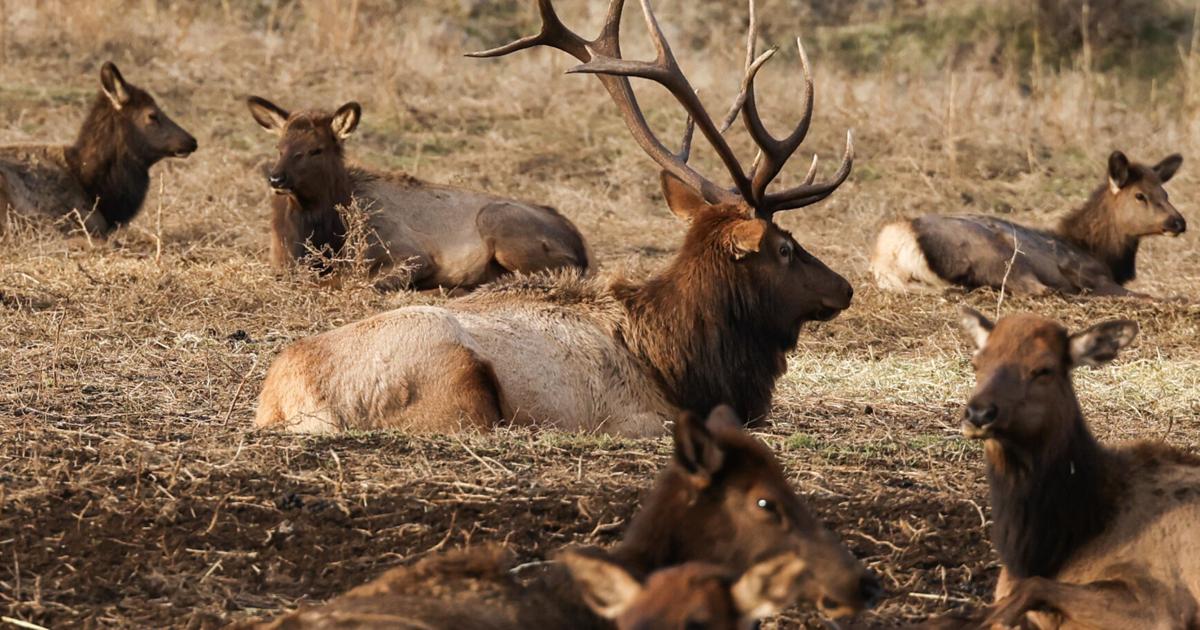
Visiting hours for most of the Yakima elk herd appear to be a little shorter so far this winter thanks to warm weather and significant December rainfall.
A handful of animals could still be seen wandering down from the ridge last Thursday after Washington Department of Fish and Wildlife employees Matt Floyd and Trinity Peterson slowly dropped off hay at Oak Creek’s daily 1:30 p.m. feeding off of U.S. Highway 12 west of Naches.
Oak Creek Wildlife Area manager Greg Mackey said the elk continue to spend most of their time at higher elevations and generally leave the feed site before sunset following their afternoon meal, thanks to conditions created by the atmospheric river that caused a lot of problems throughout Washington state.

Hundreds of elk are pictured during feeding time at Oak Creek Wildlife Area Thursday, Jan. 8, 2026, near Naches, Wash.
Evan Abell / Yakima Herald-Republic
“But it was really a benefit to the elk because it provided a lot of late green-up, so what that means is the elk are going to winter in an above-average condition, which is good,” Mackey said. “We should be seeing decreased winter mortality this year because of the condition the elk should winter in.”
He noted that should translate to a larger population and more opportunities for hunters next fall, although it’s still too early to tell for sure. The wildlife department typically conducts its annual population surveys and analyzes calf ratios in February, Mackey said.
Nearly 450 elk showed up at Oak Creek, and Peterson said around 1,300 appear daily at the Cowiche feed site, which isn’t open to the public. Even though the elk won’t be as desperate to forage for food this winter, Mackey said it’s still important to put out hay to ensure they won’t find their way around the fence and down the river corridor.
Elk make their way down the hill to the feeding area at Oak Creek Wildlife Area Thursday, Jan. 8, 2026, near Naches, Wash.
Evan Abell / Yakima Herald-Republic
“I don’t want them to get through somehow and get in the orchards,” Mackey said. “Because once they get by you, it’s hard to get them back.”
Feeding began at both sites on Dec. 22 and the numbers slowly grew a little slower than usual, with elk remaining somewhat skittish every time the trucks go out in the afternoons. Mackey said 40-50 volunteers provide education from the viewing area or inside the visitors center, and truck tours will begin this Saturday.
Despite a 30% annual cut to the hay budget this biennium, Mackey said enough surplus remains in storage to reach the end of this winter and possibly part of the next without needing to take money out of the donations fund. Visitors give around $8,000 per year that can be used for equipment needs as well as hay, and that account sits at about $100,000, according to Mackey.
A grant from the state’s Recreation and Conservation Office will allow for some improvements at the feed site with work expected to begin later this year. Mackey said that will include replacing the vault toilets with new CXT concrete toilets, extending the viewing deck, building a better truck loading tour system and repaving the viewing area, walkway and parking spots.