
From The Plant Press, Vol. 29, No. 1, January 2026.
Another grape escape in western United States and Jalisco, Mexico
By Jun Wen and Carol Kelloff
The two of us went on another great Grape Escape in late summer 2025 in the western United States (August 16-25, 2025), and then Jun Wen went to Jalisco, Mexico for an additional week (August 25-September 1). We primarily collected the grape family Vitaceae as well as the associated plants. We targeted the Vitis arizonica (canyon grape) species complex in the western U.S., covering Nevada, Utah, Arizona, New Mexico, and Texas. Wen’s trip to Jalisco was primarily focused on Cissus, Vitis, Ampelocissus, and Parthenocissus. She was joined by botanical colleagues, especially Professor Antonio Vázquez-García and his associates from the Departamento de Botánica y Zoología, Universidad de Guadalajara, Mexico.
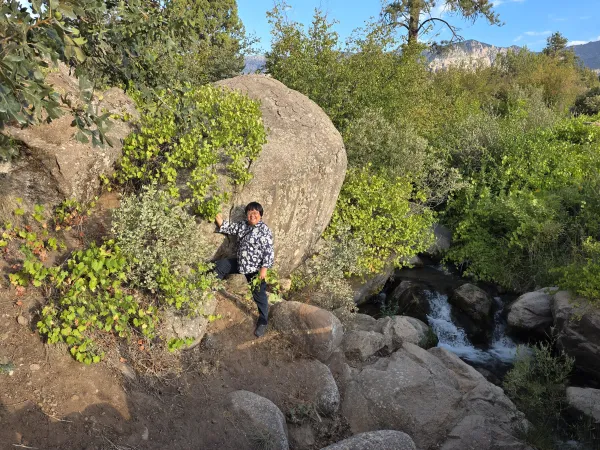
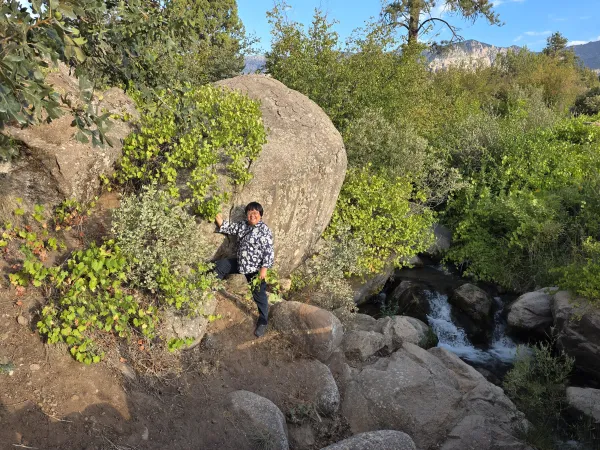
Jun Wen in the middle of a patch of Vitis arizonica by the Reeds Creek in Utah. (photo by C. Kelloff)
The expedition started in the Las Vegas area of Nevada focusing on the Vitis arizonica species complex, first in the Red Rocks Canyon with permission from the Red Rock/Sloan Field Office of the Bureau of Land Management (BLM), and then in the Lake Mead National Recreation Area with permission from the National Park Service (NPS). Wen was in the Las Vegas region in 2018 but did not have the permits to collect wild grapes in protected areas at that time. With the pandemic over, we were finally able to make this grape expedition to Nevada, with generous assistance from colleagues in the Red Rocks Canyon and the Lake Mead National Recreation Area, focusing regionally on the Grapevine Canyon as well as Rogers Spring in Lake Mead. We are especially grateful to Riley Rackliffe, the research permit coordinator at Lake Mead. Rackliffe generously provided detailed information about the wild grapevines in the Lake Mead National Recreation area and arranged the logistics of our visit.
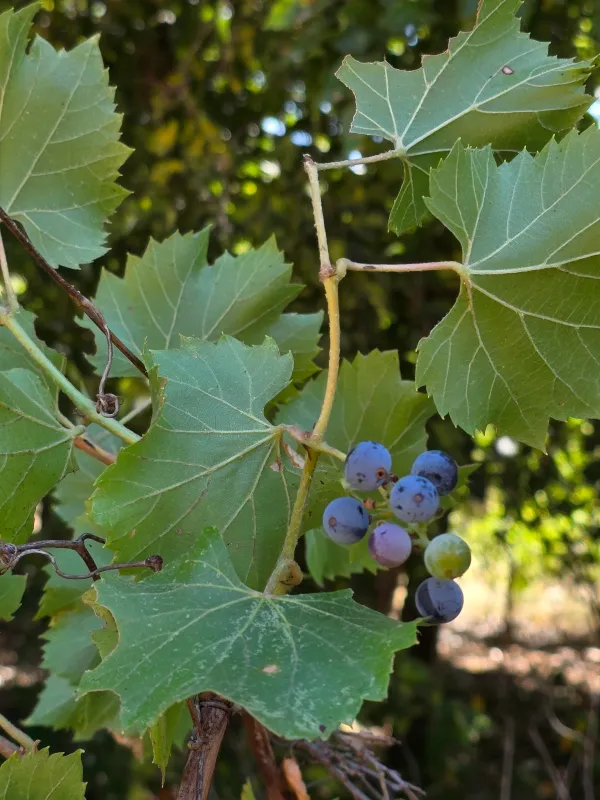
Vitis acerifolia in fruit in Potter Co., Texas (Wen 11625). (photo by J. Wen)
After the Nevada grape hunting, we drove north to Utah and visited Washington County to collect in St. George, Washington, Rockville, and Leeds, targeting the northern populations of Vitis arizonica. We then collected in Coconino County, Arizona, and the counties of Rio Arriba, Santa Fe, and San Miguel in New Mexico to target more populations of Vitis arizonica.
Texas is one of the diversity centers of North American grapes. Wen had explored Texas many times with various colleagues in the last 20 years. This time we first visited the Texas panhandle (Amarillo and vicinities in Potter County) and collected a few populations of Vitis acerifolia, a Great Plains species in the High Plains region. We then headed south to the Lubbock area to collect Doan’s grape, Vitis × doaniana, a hybrid grape species resulting from the natural hybridization of V. mustangensis and V. acerifolia. We also collected a yet to be named grape species, Vitis gerrathiana J. Wen ined., in Del Rio of Val Verde County near the border with Acuña, Coahuila, Mexico. Wen was collecting in Coahuila, Mexico in 2024 and she encountered several populations of this unusual grape species along the Rio Grande. We found more populations of this grape species in Kinney County, Texas, which is just east of Val Verde County. On the way to Fort Worth, we made a few collections of Vitis linsecomii (post oak grape) and V. mustangensis (Mustang grape). We also ran into and collected the easternmost population of Vitis arizonica during the Texas portion of the trip.
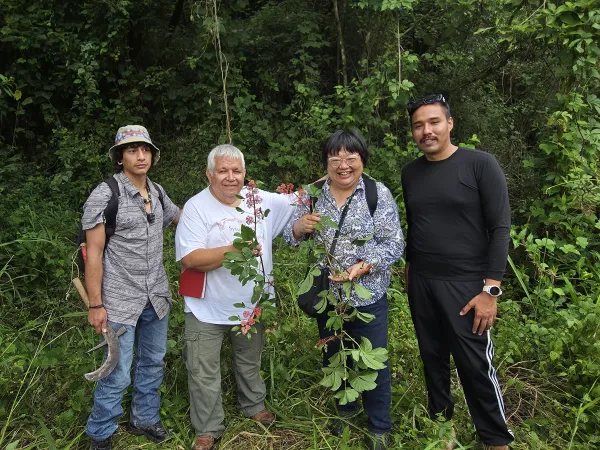
Collecting an unusual Cissus in Puerto Vallarta (left to right): Juan Luis Lomeli Hernández, Antonio Vázquez-García, Jun Wen, and Byron Gullermo Gutierrez. (photo by Jesús Padilla-Lepe)
Wen’s trip to Mexico allowed her to explore several unusual species of Vitaceae in Jalisco. Upon arrival Wen first worked in the Universidad de Guadalajara Herbarium (IBUG) and gave a seminar titled, “Advances in Plant Systematics in the New Age of Big Data.” It was great to meet the many plant systematists and a large number of students in systematics in Universidad de Guadalajara, and it was good to collect Vitis blancoi in Guadalajara, its type locality.
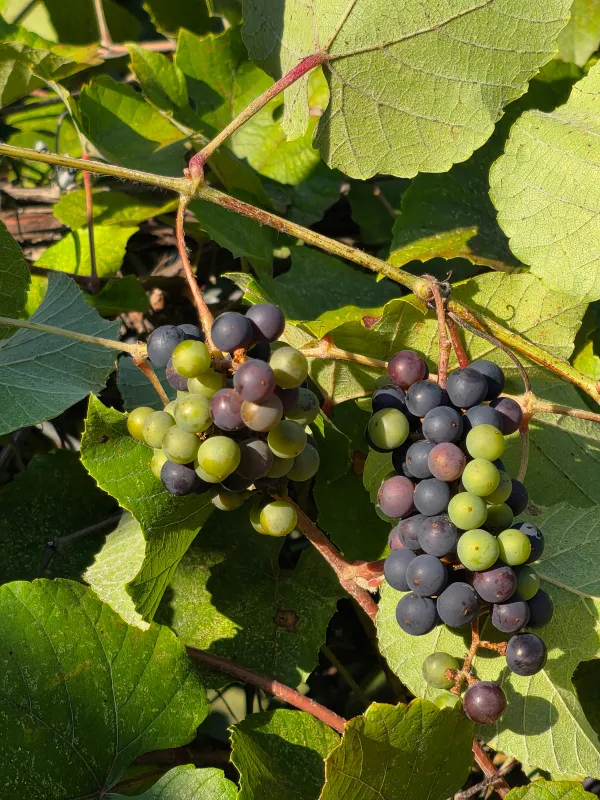
Vitis gerrathiana J. Wen ined., in Kinney Co., Texas (Wen 18638). (photo by J. Wen)
Wen, Antonio Vázquez-García, and three of his students made a road trip to Puerto Vallarta and Chamela in western Jalisco. Even though Wen briefly collected in both areas during her prior trips to Mexico, this visit was fruitful to target several unusual and poorly understood species. It was productive to work with Vázquez-García’s team. Vázquez-García is a very experienced systematist and an ecologist, and he helped design the field routes and often found great specimens with his ecological expertise. We also visited the Vallarta Botanical Gardens in Puerto Vallarta and was warmly hosted by Robert Price, the founder of the Vallarta Botanical Gardens. Price accompanied us to collect in areas near the botanical garden and shared his great efforts on conserving native biodiversity in Mexico through the Vallarta Botanical Gardens.
It was a highly productive field trip, collecting the most extensive set of specimens of the Vitis arizonica species complex as well as several poorly known species and a few taxonomic novelties from western US and Jalisco, Mexico. Furthermore, the additional connections we made in Jalisco will greatly benefit our research on the grape family and other plant groups.
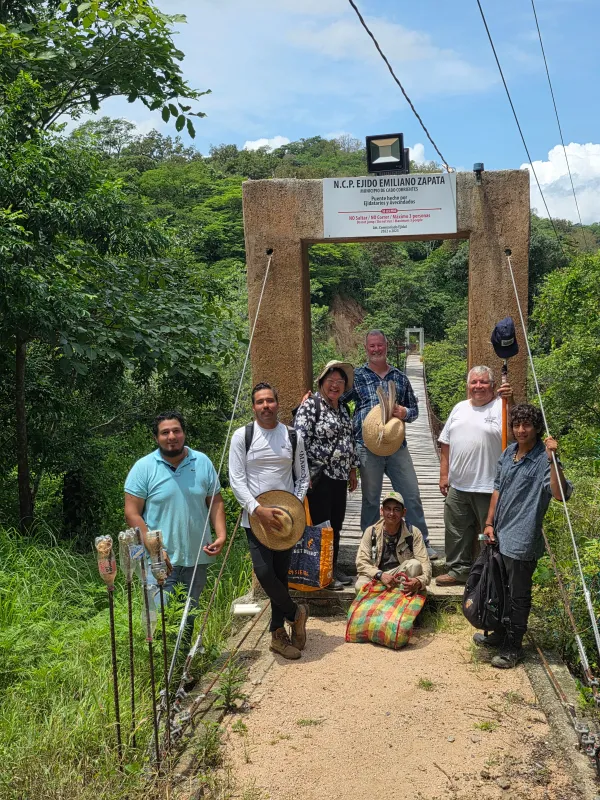
At N.C.P. Ejido Emiliano Zapata, Municipio de Cabo Corrientes, Jalisco (left to right): a local villager with unknown name, Byron Gullermo Gutierrez, Jun Wen, Bob Price, Antonio Vázquez-García, Juan Luis Lomeli Hernández, front sitting Jesús Padilla-Lepe. (photo by anonymous)