
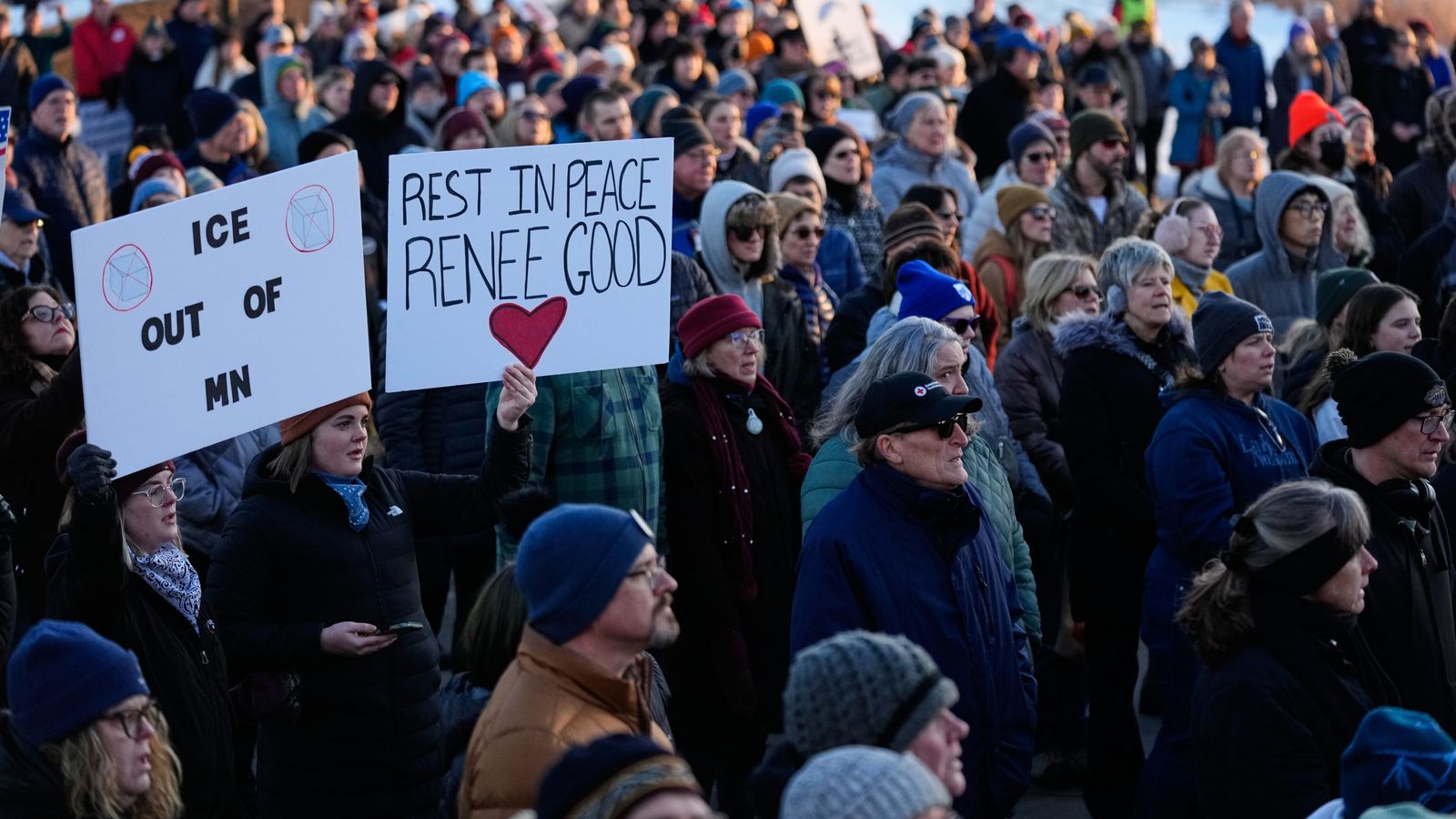
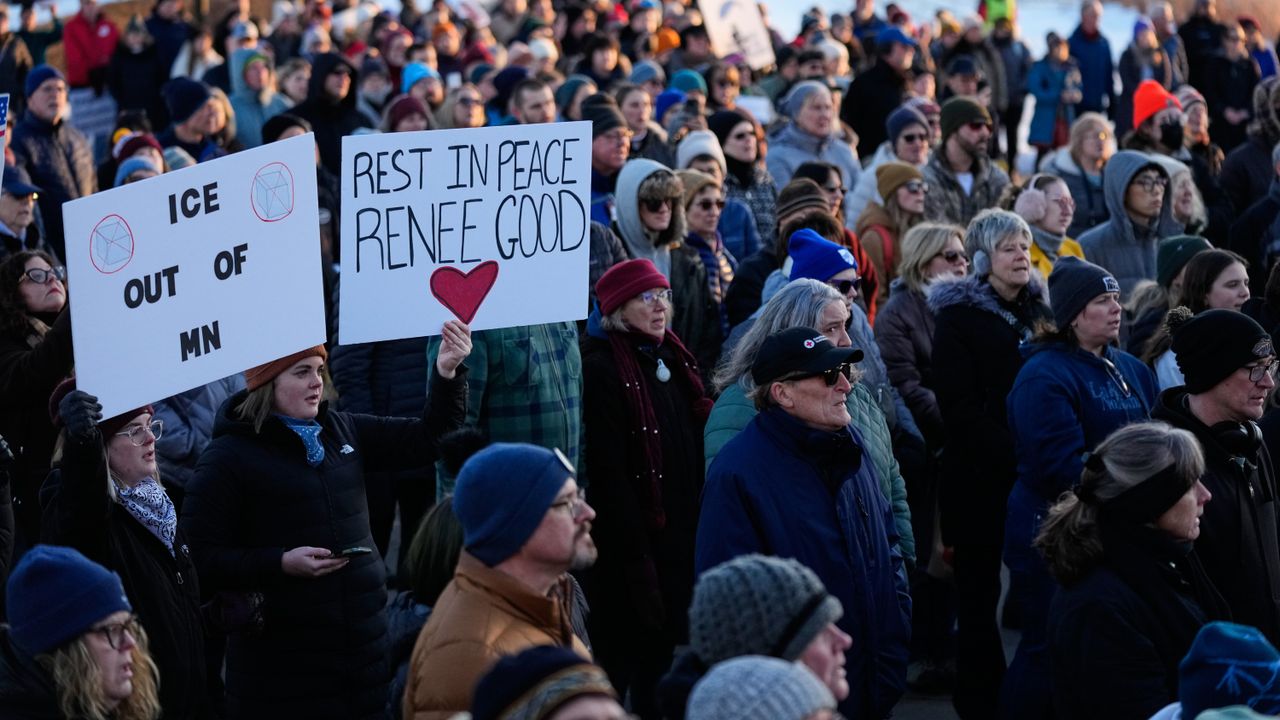
 People gather for a vigil honoring Renee Good, who was murdered by an ICE officer in Minneapolis earlier in the week, at the Minnesota State Capitol in St. Paul, Friday, Jan. 9, 2026. [AP Photo/John Locher]
On January 8, the day after the ICE murder of Renée Nicole Good in Minneapolis, the World Socialist Web Site posted a statement explaining that “the logic of events is moving inexorably toward a general strike against the Trump regime: a mass, coordinated intervention by workers across every industry to bring the machinery of repression and exploitation to a halt.”
One week later, in response to growing pressure from working people outraged over the daily brutality inflicted by Trump’s paramilitary forces, a coalition of local trade unions and community organizations in Minneapolis has called a general strike for January 23.
The Minnesota AFL‑CIO has so far failed to endorse the action, and its official webpage—under the slogan “A Day of Truth and Freedom”—carefully avoids the word “strike,” instead urging workers to call in sick, consumers not to purchase anything and businesses to close voluntarily. The union apparatus, closely tied to the Democratic Party, is attempting to counteract a growing sympathy for a general strike that is taking hold among broad layers of the population.
However, the very fact that the general strike has entered political discussion is itself an expression of a new stage in the class struggle and the social and political polarization of the United States. It reflects a growing sense within the working class that traditional political channels—court challenges, appeals to politicians, electoral maneuvers and pressure campaigns—are incapable of halting the rapid turn toward dictatorship.
At the immediate level, the call for a general strike in Minnesota is a response to the dramatic escalation of repression by the Trump administration and ICE in Minneapolis and other cities. What began as mass raids and sweeps targeting immigrant workers has developed into paramilitary deployments and the occupation of a major US city. This assault has stripped away all democratic pretenses, signaled Trump’s threat to invoke extraordinary powers, including the Insurrection Act, and deploy the military against the population.
Trump’s response to opposition is to escalate. The murder of Renée Good has been followed by a wave of repression, further deployments and threats against protesters for engaging in “insurrection” and “terrorism.” On Friday, the Department of Justice opened a criminal investigation into Minnesota Governor Tim Walz and Minneapolis Mayor Jacob Frey, issuing subpoenas on the fraudulent charge that they “impeded” federal immigration enforcement, an extraordinary use of the justice system against elected officials.
There are, however, broader issues involved. The United States has reached a point where the scale of political breakdown and the ferocity of class tensions are generating profound shifts in consciousness. The Trump administration, speaking and acting for the capitalist oligarchy, is dismantling democratic rights and tearing up what remains of public education, healthcare and other social services. Workers face an AI-driven jobs bloodbath, soaring inflation and deepening debt, while US billionaires increased their collective wealth by 18 percent last year alone, to nearly $7 trillion.


There is a mood of resistance that reflects a growing sense that things cannot continue “in the old way.” Polls, which invariably understate oppositional sentiment, show deep hostility to the Trump administration’s repression, with a majority of Americans disapproving of ICE’s tactics and the way immigration is being handled, and many opposing military action abroad, including the invasion of Venezuela and war threats against Iran.
The strike of 15,000 nurses in New York City, the largest in the city’s history, is an early sign of opposition that will grow in 2026, as is, in a different form, the fact that the Detroit autoworker, who was suspended for calling out Trump earlier this week, raised more than $800,000 via GoFundMe in a few days from tens of thousands of people.
This growing opposition must be transformed into a conscious, organized movement. There exists a long and powerful tradition of class struggle in the United States, including of the general strike. From Philadelphia in 1835, to St. Louis in 1877, to Seattle in 1919 and San Francisco and Toledo in 1934, the decisive factor has never been the militancy of the call alone, but whether the working class entered the struggle consciously and independently, in opposition to the institutions seeking to contain it.
Minneapolis itself has a long history of class conflict. The 1934 Minneapolis truck drivers’ strike, led by Trotskyist workers in Teamsters Local 574, transformed a local organizing drive into a citywide general strike that paralyzed commerce and confronted the combined forces of the employers, police, National Guard, Farmer–Labor Party and Roosevelt administration. Its victory helped spark the mass industrial unionization of the 1930s and remains a powerful demonstration of what the working class can achieve when it fights under its own leadership and with a clear political perspective.
Trump’s brazen impunity is the product of a prolonged absence of organized working class resistance in the US. Over decades, the labor bureaucracy dismantled the workers’ movement while the ruling class enriched itself through imperialist war and a massive transfer of wealth. In this vacuum, the most ruthless sections of the bourgeoisie have come to believe they can act without constraint.
The assault on the working class was reinforced by an ideological campaign to deny its very existence as a social force. In a country once defined by frequent strikes and mass confrontations between labor and capital, the Democratic Party, official academia and the political pseudo-left advanced ideologies—above all, racial and gender identity politics—that rejected Marxism, denied the reality of class struggle and dismissed the role of the working class as a revolutionary force.
The re-election of Trump marked a violent realignment of the state to reflect the reality of oligarchic rule in the United States. Moreover, the extreme character of its actions, both on the domestic and international levels, reflects the intensity of the crisis confronting American capitalism—expressed in the devaluation of the dollar, the staggering buildup of debt and the rampant speculation that underlies the wealth of the oligarchy.
This is the backdrop to the realignment from below that is beginning to take shape, through the growing resurgence of open class conflict as the central axis of social and political life. Moreover, the development of the class struggle in the United States will have immense international repercussions, shattering the myth that American workers are uniquely reactionary or incapable of collective struggle.


The events in Minneapolis mark the opening of a new stage of departure. Though still in its initial stages, it can be confidently predicted that the class struggle within the Twin Cities and throughout the country will develop at a speed driven by the intensity of the capitalist crisis. The anger provoked by the actions of the Trump administration will make ever clearer the connection between what is unfolding in Minnesota and the broader crisis of the capitalist system.
But there are political lessons to be drawn from these events. For those seeking a way to stop these atrocities, it is essential to understand the deep and entrenched opposition to any mass movement against fascism, not only from Trump, but also from the Democratic Party. As a party of Wall Street and imperialist war, the Democrats seek at every point to contain opposition, to block the emergence of an independent struggle against Trump and to prevent it from developing into a broader fight against the oligarchy and capitalism.
Moreover, even as the Trump administration attacks leading Democrats, he can count on their support in the defense of the global interests of American imperialism.
The fight against Trump requires the construction of new organizations in the working class that can unify the defense of democratic rights and opposition to dictatorship with the growing social struggles of workers. It is necessary to impart to the emerging class movement a clear political strategy, connecting the fight against fascism to the fight against exploitation, war and the capitalist system itself, in the US and internationally. This depends, above all, on the conscious intervention of the Marxist movement in the working class.
The perspective of the Socialist Equality Party and the International Committee of the Fourth International has always emphasized the revolutionary role of the American working class as a decisive component of the international working class.
The SEP has fought consistently against all efforts to subordinate workers to the Democratic Party and its affiliated organizations. Through the initiation of the International Workers Alliance of Rank-and-File Committees (IWA-RFC), the ICFI has developed the organizational form for a rebellion against the pro-corporate trade union apparatus. And most recently, the ICFI and WSWS has launched Socialism AI as a vital tool for the political education of workers and youth in the great lessons of the 20th and 21st centuries, above all, the strategic experiences of the Marxist movement.
In the actions of the Trump regime, the American oligarchy is crossing a Rubicon, from which there is no turning back. The issue confronting millions of workers and young people is the most fundamental: socialism or barbarism.
The World Socialist Web Site urges all working people who want to stop the descent into fascism and war, who want to fight for a future based on equality, democracy and peace, to draw the necessary conclusions and join the SEP.
I would like to join the Socialist Equality Party
We will follow up with you about how to start the process of joining the SEP.