
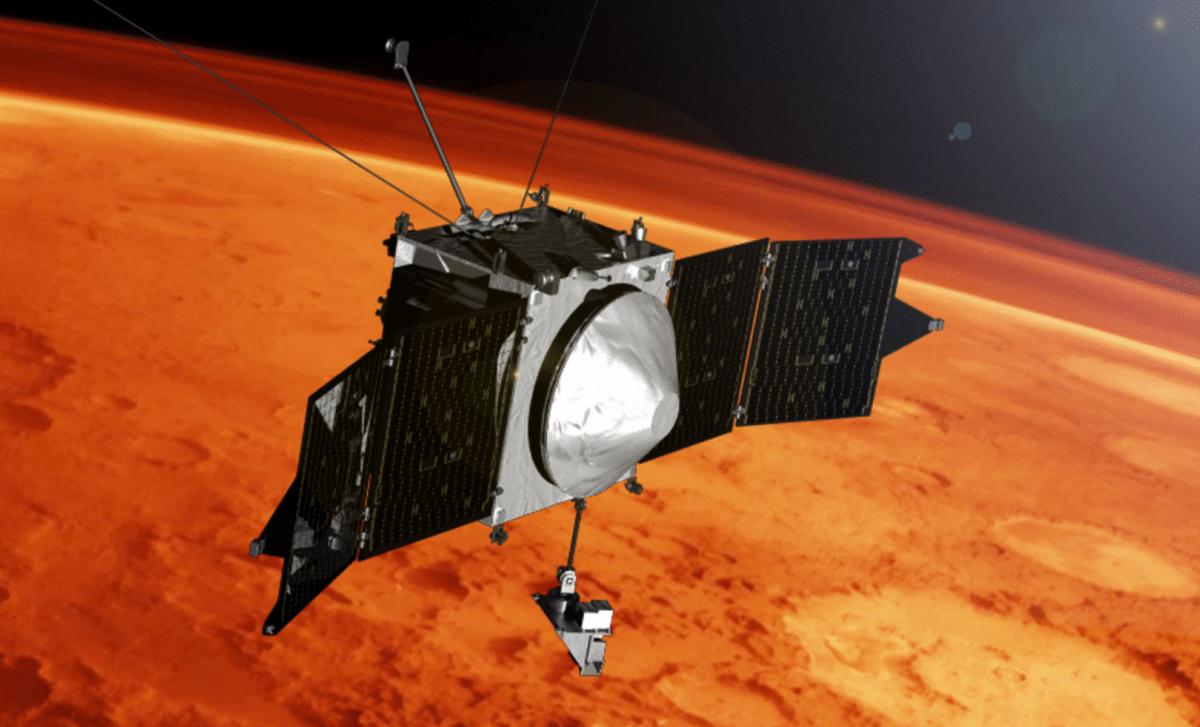
NASA’s MAVEN (Mars Atmosphere and Volatile Evolution) orbiter has been a cornerstone of Mars exploration for over a decade. However, after an unexpected communication blackout that lasted for more than a month, the space agency has faced the uncertainty of whether it will ever hear from the spacecraft again.
As the mission pushes into its critical recovery phase, NASA is carefully assessing the challenges of reconnecting with MAVEN after it fell silent in December 2025. With a recent solar conjunction period behind them, NASA is once again making attempts to reestablish contact, though experts acknowledge that the situation is becoming increasingly grim.
NASA’s MAVEN: Silent for Over a Month
MAVEN, which has been orbiting Mars since 2014, has provided invaluable data about the planet’s atmosphere and its interactions with solar wind. This orbiter has also served as a crucial relay for surface missions such as Curiosity and Perseverance. However, communication with MAVEN was abruptly lost on December 6, 2025, after the spacecraft passed behind Mars, a routine event that temporarily blocks communication. Yet, when MAVEN emerged from the other side, NASA’s Deep Space Network was unable to regain contact, leaving the agency in a state of uncertainty.
“NASA will not have contact with any Mars missions until Friday, Jan. 16,” the agency said in a Dec. 23 statement.
The cause of the communications failure is still unclear, but one possibility is that MAVEN was rotating in an unexpected manner after passing behind Mars. This unexpected behavior likely shifted the spacecraft out of its planned orbit, complicating recovery efforts. Despite several attempts by NASA to reconnect with the spacecraft, MAVEN remained silent, sparking concern among the mission team.
The Solar Conjunction and Communication Blackout
The solar conjunction period between Earth and Mars, a regular astronomical event that occurs roughly every two years, further complicated NASA’s efforts. During this time, the sun sits directly between the two planets, and solar particles can interfere with radio signals.
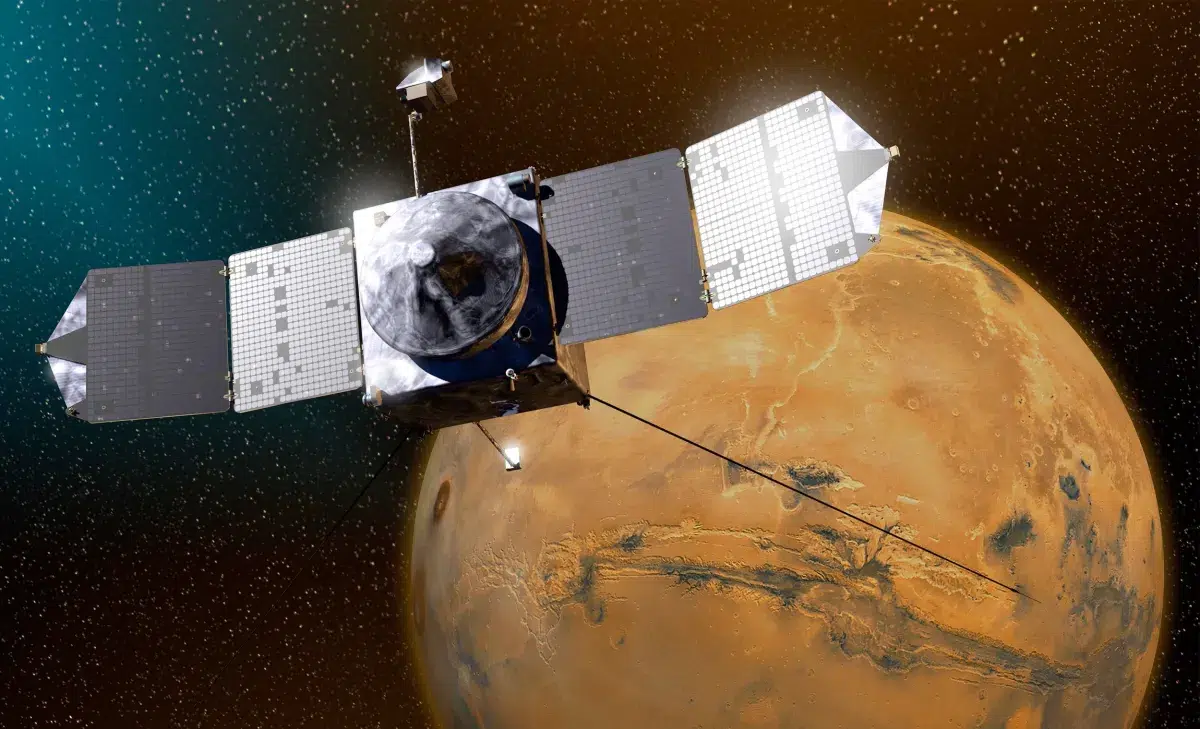 NASA’s MAVEN spacecraft has been orbiting Mars since September 2014. Credit: NASA/GSFC
As a result, NASA temporarily halts communications with all Mars missions to avoid sending corrupted commands or receiving incomplete data that could potentially damage the spacecraft.
“We will start looking again, but at this point it’s looking very unlikely that we are going to be able to recover the spacecraft,” said Louise Prockter, the director of NASA’s planetary science division, on January 13, according to Space News.
Her statement reflects the growing pessimism surrounding the recovery of MAVEN. While the team was hopeful that the end of the solar conjunction might provide a window to restore communication, the extended silence and lack of progress indicate that MAVEN’s return to normal operations may no longer be feasible.
Challenges in Reconnecting: MAVEN’s Aging Systems
One of the key challenges NASA faces in recovering MAVEN is the aging hardware on board the spacecraft. MAVEN has encountered several technical difficulties over the years, including issues with its onboard inertial measurement units (IMUs), which are essential for its orientation in space. In 2022, MAVEN spent about three months in “safe mode” due to problems with the IMUs. This forced the mission team to rely on a backup system that had accelerated wear and tear. To mitigate the risks associated with these aging components, the team accelerated the development of an alternative “all-stellar” navigation mode, which uses stars for orientation instead of relying on the IMUs.
Despite these efforts, MAVEN’s aging technology has been a persistent vulnerability. The spacecraft’s inability to fully recover from its previous outages in 2022 led to missed observations of significant solar flares, which also disrupted its role as a communications relay for other Mars missions. While MAVEN still has enough fuel to remain in orbit until at least 2030, its operational capabilities may be limited, further complicating NASA’s ability to restore full functionality.
The Impact of MAVEN’s Silence on Mars Exploration
MAVEN’s silence has far-reaching implications for the Mars exploration community. As a key communications relay, MAVEN played a significant role in supporting NASA’s surface missions, including the Curiosity and Perseverance rovers. With MAVEN offline, NASA has had to adjust the operations of these rovers to rely more heavily on other orbiters, such as Mars Reconnaissance Orbiter and Mars Odyssey. This shift in operations has increased the pressure on the remaining orbiters to maintain communication and support surface science activities.
The potential loss of MAVEN is particularly concerning given its scientific contributions. MAVEN’s work has significantly advanced our understanding of Mars’ atmospheric history, including how it lost its once-thick atmosphere and why it is now a cold, dry world. The data MAVEN collected on Martian weather patterns, dust storms, and auroras provided valuable insights into the planet’s climate system and its potential habitability. Without MAVEN, critical gaps in the ongoing study of Mars’ atmosphere could emerge.