
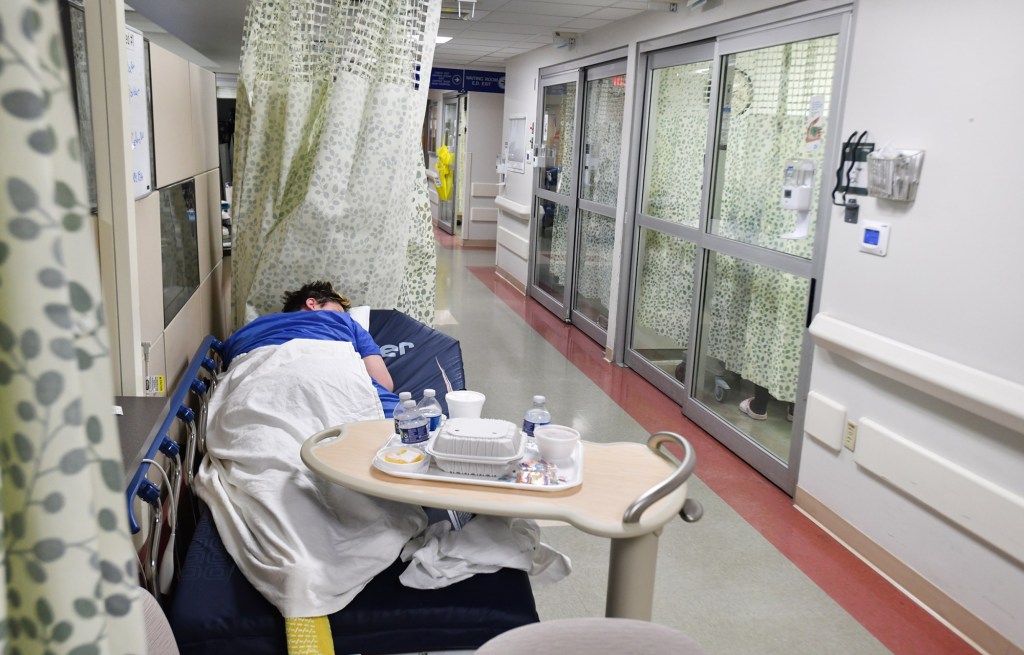
Geisinger officials grappling with packed emergency departments and inpatient units are imploring the public to consider the most appropriate points of care as the health system’s hospitals in Lackawanna and Luzerne counties operate above capacity at historic levels not seen even during the heights of the COVID-19 pandemic.
It’s a plea prompted by a recent surge in respiratory virus cases and an inrush of local patients picking Geisinger as their health care provider, including some switching health systems as Commonwealth Health’s hospitals, particularly those in Scranton, face uncertain futures amid a pending ownership change.
Against that backdrop, Geisinger Community Medical Center in Scranton, Geisinger South Wilkes-Barre in the Diamond City and Geisinger Wyoming Valley Medical Center in Plains Twp. are caring for more patients now than during the pandemic’s peak, Geisinger officials said this week.
“And one of the reasons why we are having this surge … is the respiratory virus, and at the same time we have more people choosing Geisinger because of the situation, the ground situation, in the other hospitals,” said Ujwal Tuladhar, M.D., a board-certified hospital medicine specialist who serves as associate chief medical officer of Geisinger Community Medical Center. “It’s a combination of both, but at the current moment it’s more of the respiratory virus, though more patients coming to Geisinger because of the Commonwealth situation has exacerbated it further.”
“We thought COVID times were high, but this is way, way above what we had at that time,” he said.
The respiratory virus activity Tuladhar referenced includes influenza, RSV and COVID-19, with a mutated strain of flu called subclade K driving a surge in flu cases health officials here and elsewhere have highlighted in recent weeks. And while the Pennsylvania Department of Health’s respiratory virus dashboard showed statewide flu activity “decreasing rapidly” during its most recent weekly update — the next update is Tuesday — it also cautioned that flu activity may increase again.
Statewide RSV and COVID-19 activity was “decreasing slightly” and “stable,” respectively, according to the online dashboard.
All three of the aforementioned Geisinger hospitals — GCMC, GWV and South Wilkes-Barre — were operating above 100% capacity when Tuladhar outlined the situations there in a Wednesday interview. That was still the case at GCMC and South Wilkes-Barre as of Friday morning, when GWV was at about 95% capacity, Geisinger spokesman Matt Mattei said.
“But our clinical leaders think that is an outlier,” Mattei said of the dip at GWV. “This trend has been pretty consistent since the beginning of the year, so we don’t know what tomorrow brings. I don’t think there’s any way to tell that that’s a good sign yet.”
Kali Gargone, a registered nurse who works in the surgical department at GCMC and serves as membership chair of the Northeast Pennsylvania Nurses Association, the local union representing nurses there, also spoke to the capacity challenges.
“We’ve been operating at high capacities since COVID,” she said. “Recently, I mean you go into the ER and there’s patients lining the hallway. Every open space has turned into a patient-care area. We are very overwhelmed. Not only is it flu season for the community, it’s also flu season for the staff that live in the community.”
The pressures Gargone and Geisinger officials described aren’t limited to emergency care.
“Not only just for our regular (medical-surgical) beds, but particularly for our higher level of care beds, our ICU and our stepdown beds, are at 100% capacity almost every day if not every day, so there’s always a patient shuffle,” she said.
The capacity crunch underscores the importance of seeking care in the proper settings, be it via telehealth or at a primary care provider’s office, walk-in clinic or hospital emergency department, to avoid adding unnecessary strain to a system already bursting at the seams.
“We really need our community … to go to the most appropriate location for their care, and within Geisinger there are different levels of care that are available,” Tuladhar said. “If you have, say, mild to moderate respiratory virus symptoms and you think you can be treated at home with rest and hydration and over-the-counter medication, please stay home. Now, we request that you only come to the emergency (department) if you feel this is really severe and it’s life threatening.”
Geisinger provided information on where and under what circumstances patients should pursue care depending on the severity of their symptoms and conditions. While those with mild symptoms from flu or other viruses can generally treat them at home with rest, fluids and medicine like acetaminophen and ibuprofen to manage pain and fever, people who need to see a clinician because of flu symptoms should start with their primary care provider.
“Geisinger PCPs sometimes have same-day appointments available by calling primary care offices early in the day,” the system noted. “Geisinger patients can call 800-275-6401 and say ‘schedule an appointment for primary care’ or use MyChart to find the direct line for their primary care clinic in their appointment reminders.”
Urgent care locations can also treat less-serious illnesses and injuries “faster than providers can in the hospital setting,” per Geisinger, whose ConvenientCare clinics accept walk-in and scheduled patients. They’re “ideal for urgent treatment of respiratory viruses and other seasonal illnesses, allergies, skin rashes, sprains and strains, tick removal and ear, throat and urinary infections.”
Patients can reserve spots and check wait times at ConvenientCare clinics by visiting geisinger.org and clicking the “ConvenientCare” link under the “Find Care” tab at the top of the website.
Geisinger also operates ConvenientCare+ locations at the Geisinger South Wilkes-Barre hospital campus and at its Geisinger Tunkhannock facility in Wyoming County, offering “more advanced treatment for non-life-threatening emergencies, such as nebulizer treatment for breathing issues, IV fluids and IV medications.” Those more advanced treatments complement the same services provided at traditional ConvenientCare clinics.
A virtual urgent care option is also available.
Presenting at the wrong point of care — a hospital emergency department for mild flu symptoms, for example — when another, more-suitable location would suffice can compound strain on the system and make for a frustrating visit, with longer wait times likely for patients with less-serious conditions.
It can also create “a delay in taking care of those patients that actually need it, especially patients with strokes, heart attacks or acute respiratory illnesses that need to be addressed immediately,” Tuladhar said. “We do a pretty good job of trying to triage and trying to address the serious ones first, but when you have so many of those patients out there having to triage it does take away a lot of time addressing those patients that need more intense therapy and immediate care.”
“Getting care in the right setting can help the people in our community, and of course it can relieve some pressure on our over-stressed local hospitals,” he said in closing. “I cannot stress this enough.”
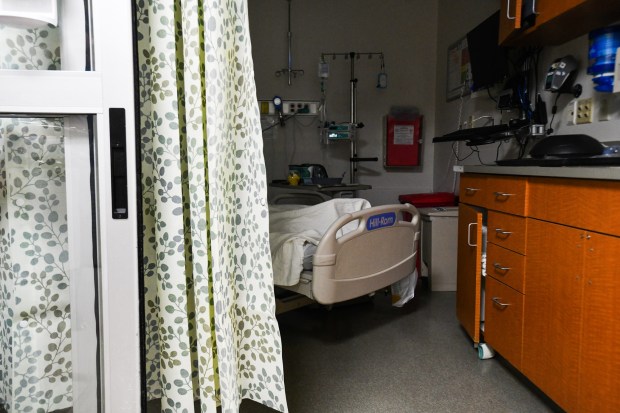 A patient occupies a room in the ER of Geisinger Community Medical Center in Scranton Friday, January 16, 2026. (SEAN MCKEAG / STAFF PHOTOGRAPHER)
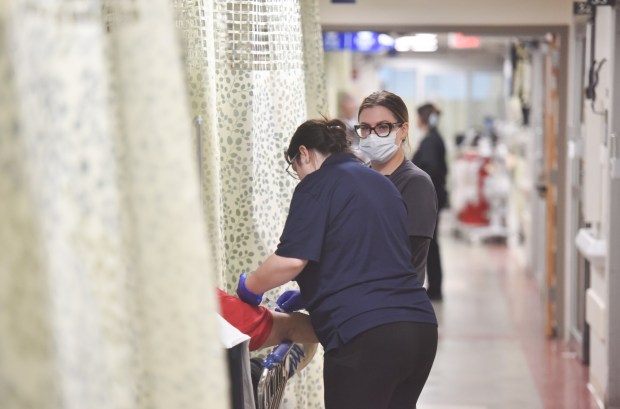 Registered nurse Donna Stobodzian and AEMT (Advanced Emergency Medical Technician) student Alyssa Quinn work in the emergency room at Geisinger Community Medical Center in Scranton Friday, January 16, 2026. (SEAN MCKEAG / STAFF PHOTOGRAPHER)
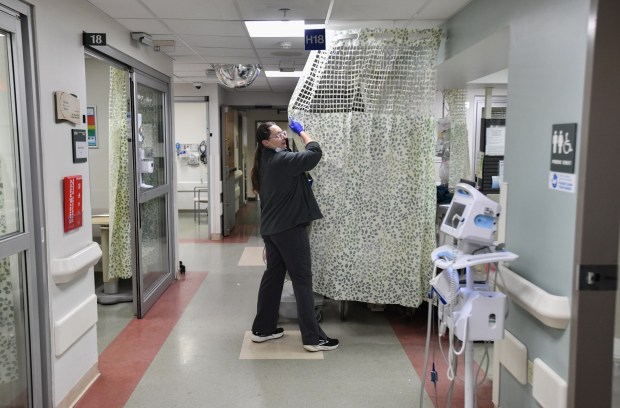 Registered nurse Natalie Wojtak closes the curtain to create privacy for a patient in the emergency room at Geisinger Community Medical Center in Scranton Friday, January 16, 2026. (SEAN MCKEAG / STAFF PHOTOGRAPHER)
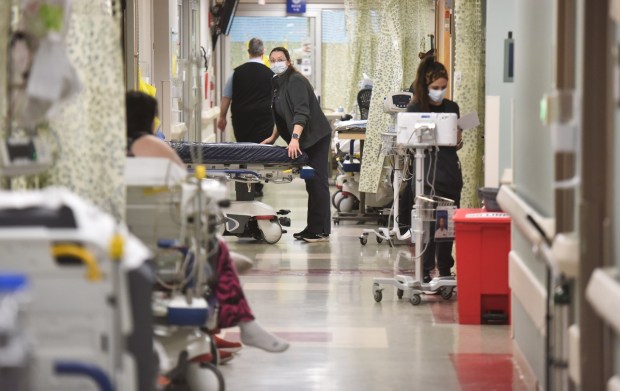 Registered nurses work in the emergency room hallway at Geisinger Community Medical Center in Scranton Friday, January 16, 2026. (SEAN MCKEAG / STAFF PHOTOGRAPHER)