
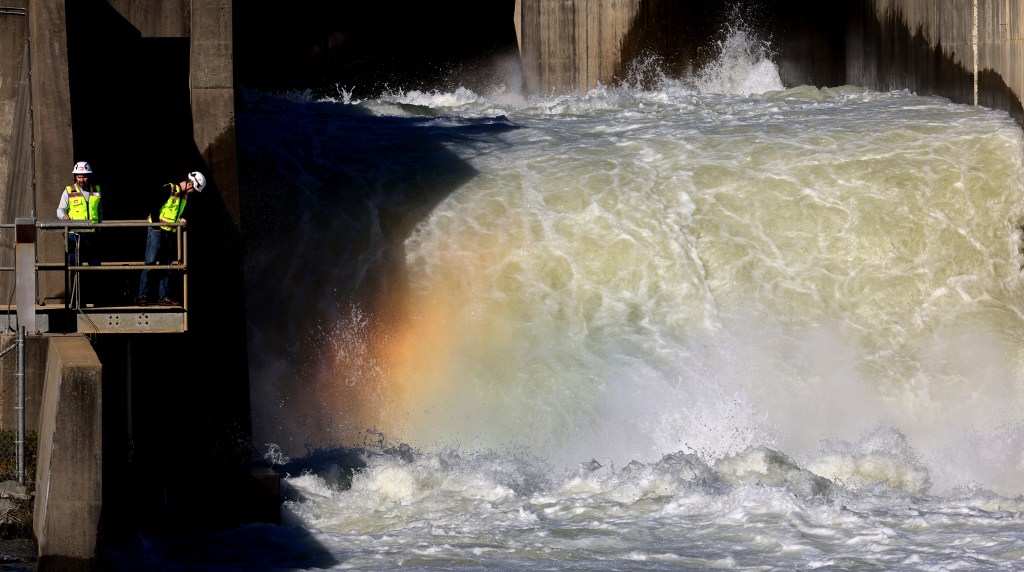
The surge of water, more than 22,400 gallons a second, plunged from the foot of Warm Springs Dam, launching a fine mist above.
That was the spectacle of abundance last week at Lake Sonoma, the North Bay’s largest reservoir, where the U.S. Army Corps was releasing what dam managers call an “oversupply” — the welcome product of heavy runoff from recent storms.
The back-to-back atmospheric rivers that drenched the region beginning before Christmas and extending through the start of the new year have bolstered water reserves across the region, raising reservoirs many feet — to the seasonal brim for Lakes Sonoma and Mendocino, within the Russian River watershed.
The inflow made for happy water engineers — steady early-season rains are a holiday gift in their world. As for the longer-term outlook, they struck a tone of cautious optimism just as the region entered a streak of warmer, dry days this week.
“It’s a great start. We are full now and the watershed is saturated,” said Don Seymour, deputy director of engineering with Sonoma Water, the region’s dominant drinking water supplier.
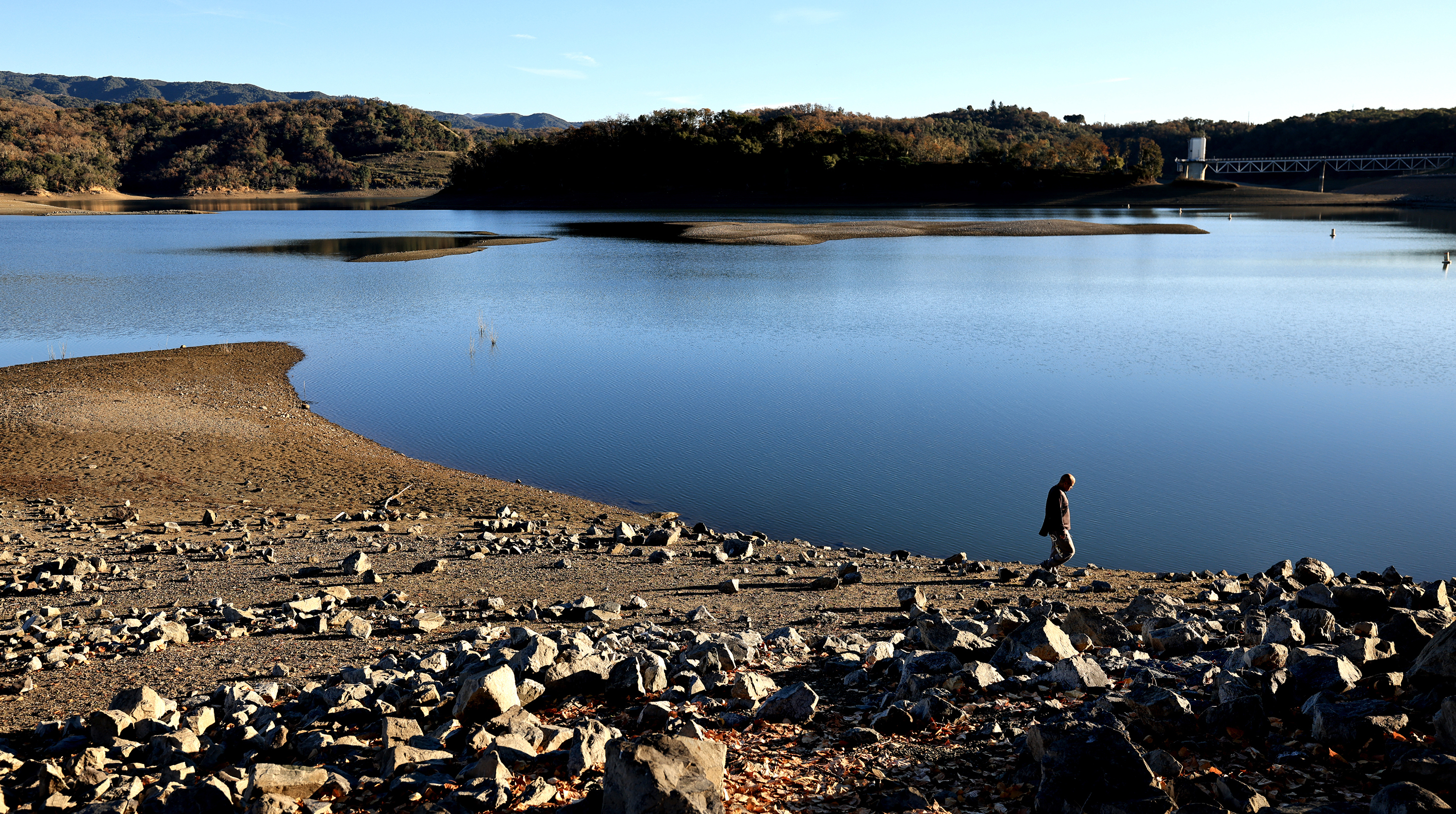
Javier Soberanis of Ukiah, takes a stroll on the exposed shoreline of southern arm of Lake Mendocino, Friday, Dec. 5, 2025. The north boat ramp has been closed because of the low water level. (Kent Porter / The Press Democrat)
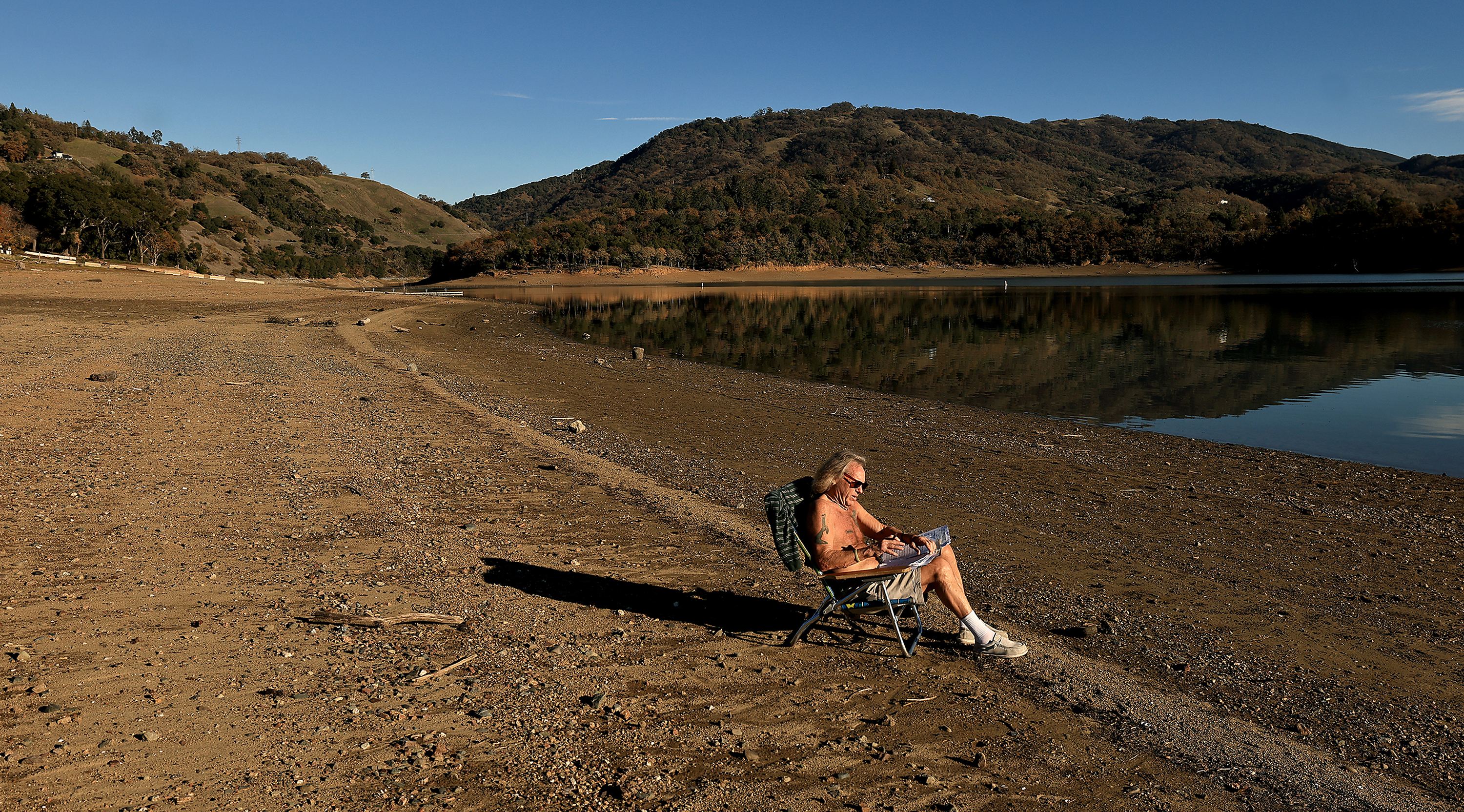
Patrick Nunes of Ukiah, takes advantage of a cloud free day as he reads sheet music on the receding shoreline of Lake Mendocino, Friday, Dec. 5, 2025. The north boat ramp has been closed because of the low water level. (Kent Porter / The Press Democrat)
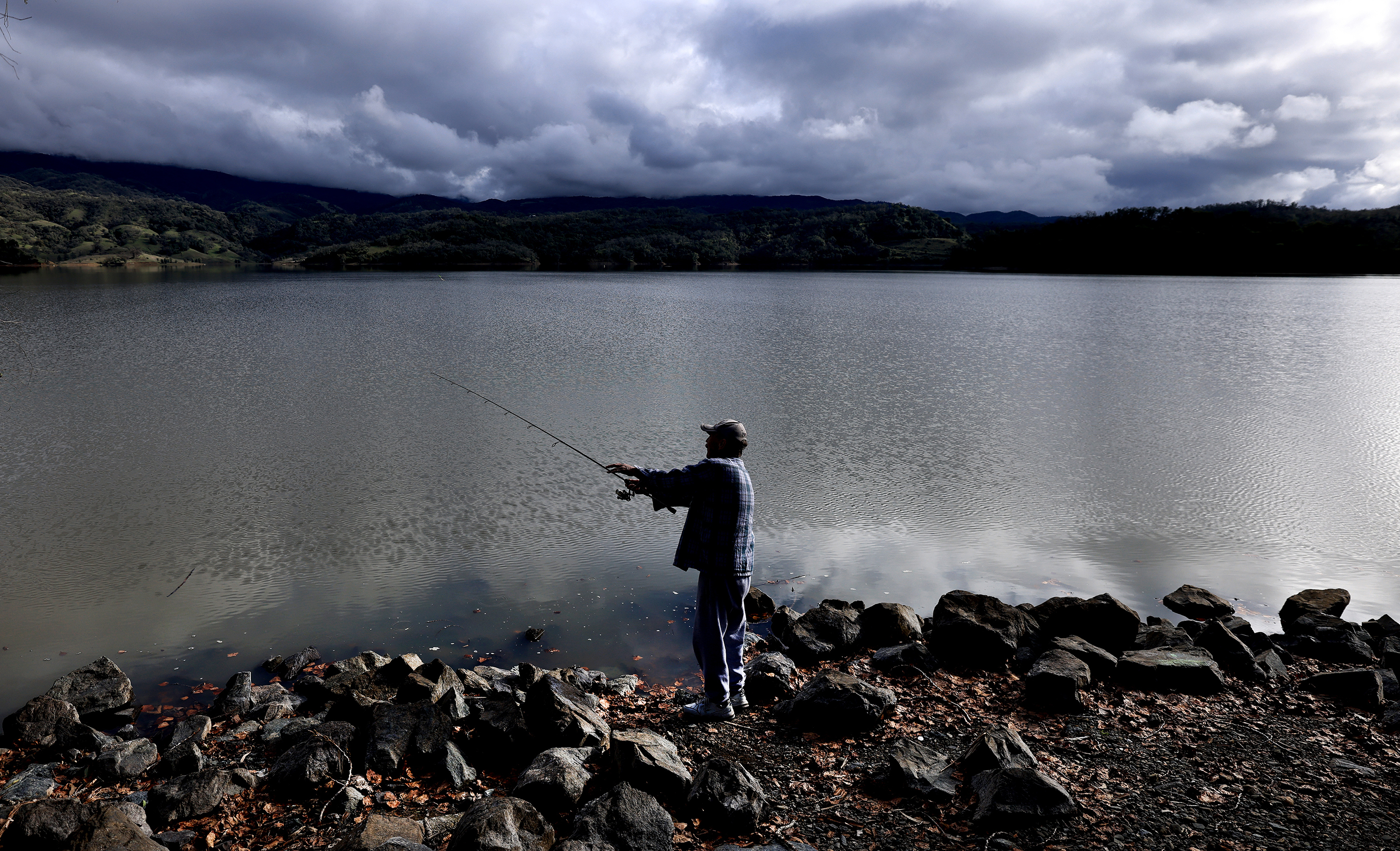
Warren Koors of Ukiah attempts to add to his take of bass, as he casts in to the nearly full Lake Mendocino, Tuesday, Jan. 6, 2026m North of Ukiah. (Kent Porter / The Press Democrat)

Gonzolo Garcia and Annabelle Rousseau enjoy their first day of vacation at Lake Mendocino. Tuesday, Jan. 6, 2026, north of Ukiah. (Kent Porter / The Press Democrat)
Show Caption
1 of 4
Javier Soberanis of Ukiah, takes a stroll on the exposed shoreline of southern arm of Lake Mendocino, Friday, Dec. 5, 2025. The north boat ramp has been closed because of the low water level. (Kent Porter / The Press Democrat)
Going north to south, the storms worked wonders for reservoir shorelines that had been receding, even in the wake of early fall storms that greened up the hills.
Lake Pillsbury, which is in the Eel River watershed but helps feed Lake Mendocino through a diversion that links the two basins, has more than doubled in volume since mid-December. It now sits at nearly 200% of its target for this time of year. Unlike the other two reservoirs, Pillsbury is more dependent on snowfall, with a storage curve that ramps up through May.
Lake Mendocino, supplied by headwaters at the top of the Russian River watershed, has gained about 35% of its volume in recent weeks, rising to about 103% of its capacity for this time of year.
Lake Sonoma, the largest of the three, gained about 11% of its volume, and sits at more than 103% of its current capacity.
The storms inundated Lake Sonoma’s recreational areas, flooding the Yorty Creek picnic area and the visitor’s parking lot, and felling trees in the dog park.
“A full lake means a successful recreation season,” said Jan Young, executive director of the Friends of Lake Sonoma, the nonprofit that provides educational activities at the lake.
She said the crew at the marina are looking forward to a fun-filled summer of “swimming, boating and fishing and all of it.”
The early January release at Lake Sonoma, required by regulators, was meant to preserve some of the reservoir space needed to hold back additional water and prevent downstream flooding should the region get another heavy bout of rain.
Enough water is now in the reservoir, however, to ensure adequate water supply for the region for the remainder of the year should the storm door close and rains not return, Seymour said.
“We can’t store anymore right now,” he added.
The Jan. 7 release, which equated to 3,000 cubic feet per second, or a total of 6,000 acre feet, seemed like a lot of water to let go. But Seymour said the Army Corps released just enough so that if the rainy pattern shuts down and the watershed dries out, they’ll still have enough to meet drinking and irrigation water demands, as well as flow rates for wildlife and recreation downstream of the Dry Creek confluence. An acre-foot is equivalent to the amount of water needed to flood most of a football field one foot deep, and can supply the needs of three water-efficient households for a year.
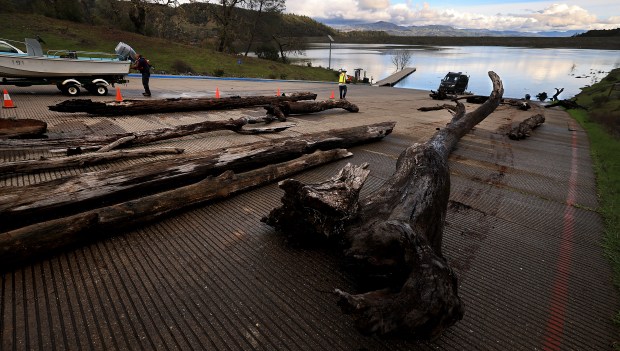 Juilan Navarro, left, and Rudy Aguilar with Army Corps of Engineers finish up pulling dead oak and pine trees ashore after copious flash flooding dislodged timber from tributaries which drain in to Lake Sonoma, Tuesday, Jan. 6, 2025. (Kent Porter / The Press Democrat)
The regional water supply system involving the three reservoirs serves about 700,000 customers from Mendocino County through Sonoma County to northern Marin County.
The past three winters have delivered average to above-average precipitation across Northern California, equipped with most of the state’s big reservoirs, the bulk fed by snowmelt in the interior ranges — the lifeblood of the mammoth state and federal water projects that supply farms and cities stretching down the Central Valley to Southern California.
Many of those reservoirs are in good shape for this time of year. Lake Shasta, the state’s largest reservoir near Redding, was at 77% capacity CK for any change, at 129% of its historical average for this time of year and still rising. Lake Oroville, in Butte County, was at 73% capacity, and 134% of seasonal average Monday.
From the Oct. 1 the start of the official rain year through Jan. 4, Santa Rosa had received 15.7 inches of rain, about 126% of its historical average — in a moderate La Niña year, when the pattern can result in colder and drier weather for the region.
“I was a bit surprised,” Seymour said of the rainfall.
Spring rains, he stressed, will decide just how plentiful overall supplies will be going into the remainder of the year. Lake Sonoma holds enough now to assure its downstream deliveries for the year even if the rains vanish for the rest of the winter, like they did in 2013, the driest year on record in Sonoma County.
“If we were to have another season like 2013, Lake Sonoma is big. It’s full,” he said. “It would be in really good shape.”
Seymour is less optimistic about Lake Mendocino should that kind of scenario play out.
Although full now, he said, “dry weather would really bring it down.”
Amie Windsor is the Community Journalism Team Lead with The Press Democrat. She can be reached at amie.windsor@pressdemocrat.com or 707-521-5218.