
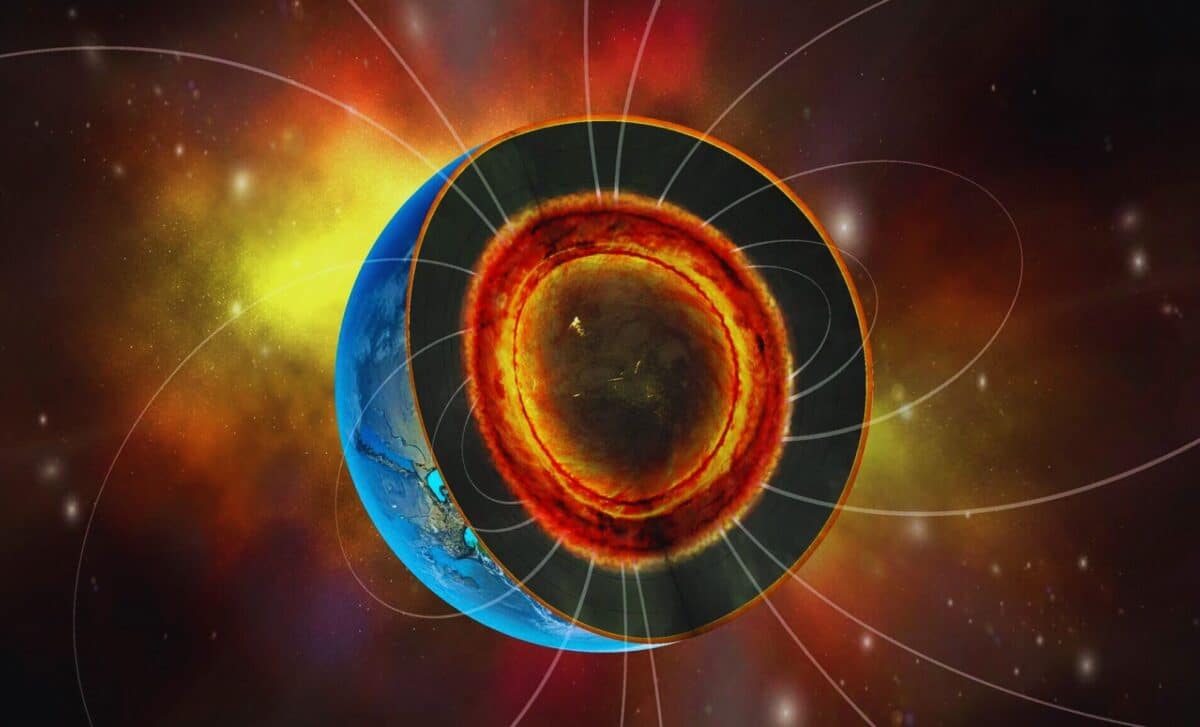
Beneath the surfaces of rocky super-Earths, vast underground oceans of molten rock may be quietly doing the work of life’s first line of defense: generating magnetic fields powerful enough to block harmful radiation. A recent study suggests these hidden magma layers could serve as long-term shields for alien worlds.
Published in Nature Astronomy, the research led by Miki Nakajima from the University of Rochester proposes an alternative magnetic field source: the basal magma ocean (BMO). Unlike Earth’s magnetic field, which is generated by movement in its liquid iron outer core, BMOs deep inside massive rocky exoplanets may themselves become electrically conductive under extreme pressure. This has major implications for the habitability of planets orbiting other stars.
Lava Seas as Dynamos
On Earth, the liquid iron core spins and churns to generate a magnetic field. On larger rocky planets, the core may be fully solid or entirely liquid, both of which may not support a dynamo. According to lead researcher Miki Nakajima:
“Super-Earths can produce dynamos in their core and/or magma, which can increase their planetary habitability.”
In the study, the team proposes that BMOs, deep layers of molten rock located at the bottom of the mantle, can sustain magnetic fields if they are electrically conductive. While Earth’s BMO likely existed only briefly after formation, super-Earths with greater mass and higher internal pressure might retain these molten regions much longer, potentially for billions of years.
According to findings reported in Nature Astronomy, this conductivity could allow molten rock to act like metal in generating a planetary magnetic field. If correct, this process could serve as an enduring protective shield against solar wind and cosmic radiation, even in planets with inactive or unsuitable cores.
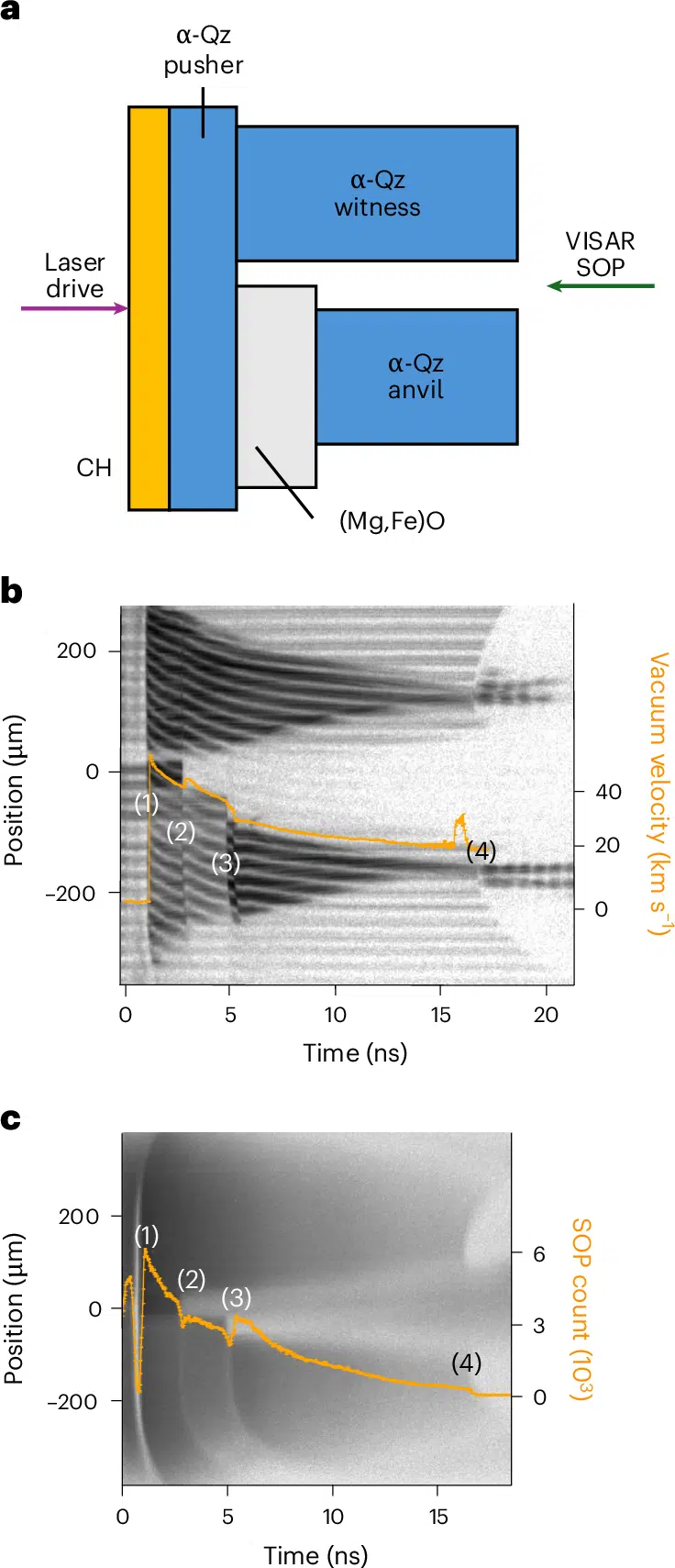 Experimental setup and diagnostics used to study (Mg,Fe)O under extreme pressure. Credit: Nature Astronomy
Simulating Exoplanet Conditions on Earth
To explore whether molten rock under such conditions can conduct electricity, Nakajima and her colleagues ran a series of laser shock experiments at the Laboratory for Laser Energetics at the University of Rochester. These experiments recreated the extreme pressures thought to exist deep inside super-Earths. The lab work was combined with quantum mechanical simulations and planetary evolution models to test how molten mantle minerals behave under such conditions.
Their target was (Mg,Fe)O, a mineral common in planetary mantles. The results showed that, when subjected to super-Earth-like pressure, this molten rock becomes conductive enough to support a magnetic dynamo.
“This work was exciting and challenging, given that my background is primarily computational and this was my first experimental work.” said Nakajima, who usually works in computational modeling. She credits the interdisciplinary team’s collaboration as key to the project’s success.
According to the researchers, if a planet’s BMO is sufficiently large and long-lived, it could rival or even surpass Earth’s magnetic protection in both strength and duration. This could be the decisive factor in determining whether certain planets can retain their atmospheres over cosmic timescales.
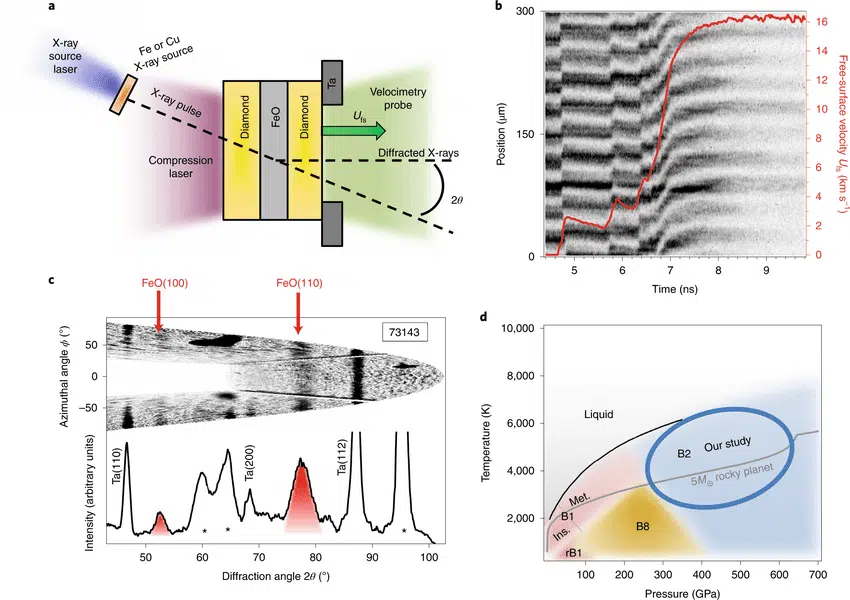 Simulating planetary interiors in the lab using FeO. Creditl: Researchgate
A New Lens on Alien Worlds
The presence of a magnetic field is often overlooked in early habitability assessments, yet it plays a crucial role in preserving a planet’s atmosphere and protecting it from energetic particles. According to the University of Rochester team, the BMO-driven dynamo opens up new possibilities for habitability in planets that might otherwise have been dismissed due to non-metallic or static cores.
Super-Earths with active BMOs could now be seen as strong candidates in the ongoing search for life beyond our solar system. As Nakajima noted:
“I cannot wait for future magnetic field observations of exoplanets to test our hypothesis.”
Such measurements, once available, could confirm whether deep molten rock is the silent force shaping life’s potential across the galaxy.