
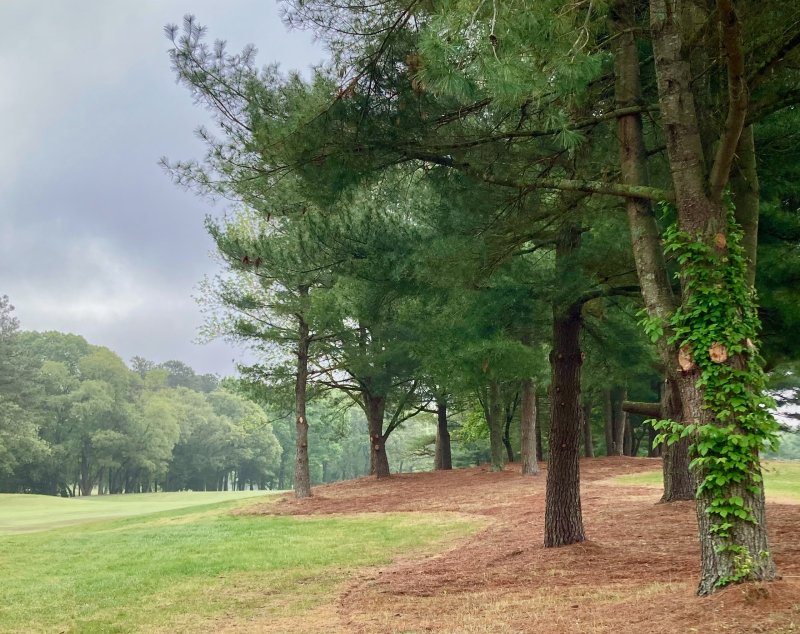
Trees are nice to see on a golf course, but there is a limit.
Golfers play golf on grass. Grass competes but always loses to trees for the sunlight and air critical to turf’s survival. Therefore, trees must be trimmed or cut down when conditions warrant.
Cape Region golf course operators agree. I have done stories on tree management or removal about most of the area’s courses, including Southern Delaware GC, Kings Creek Country Club, The Rookery, and even Old Landing Golf Course before it became a housing development.
I asked course Superintendent Bill Leedom about tree management at Seaview Resort, home of the ShopRite LPGA Classic presented by Acer. He focused on its Pines course.
The heavily treed layout is used for ShopRite’s huge pro-am event. Thousands of other rounds are played there from April to November, when it closes for the off-season.
“I’ve done a lot of tree removal at the Pines course. You couldn’t see from hole to hole, and there was lots of underbrush,” he said. “I rented a forestry mulcher. Everything that was cut down, I left it to mulch down, to mat it down to keep weeds and grass from coming up. Now, if your ball goes in there, you can find it, you can play it.”
Leedom continued, “Then I went in there with a pole saw and limbed up as high as I could, 30 feet. That’s my fall project in late October, November and December. I just start at a corner, just work my way down a line and go back, then take a look.”
“You don’t want to make it too easy,” he said. “If you go in there, you shouldn’t have an easy shot, but you should be able to at least play a shot. Hit a knock-down three-iron or something.”
He also uses the SunSeeker app on his smartphone to help save his tee box turf.
“The tees at the Pines have been an issue for year after year, where they just die. The lack of light and air, blocked by nearby trees, is a quick grass killer,” he said.
“In my mind, what does the grass need? It needs water, it needs sunlight, it needs air movement. If you take two or three of those out, you’re not going to grow grass anyway, so forget fertilizer, forget nutrients, forget all that stuff. If I don’t have good sunlight, I don’t have good air movement, I can’t irrigate, you’re losing.”
“With the SunSeeker app, you can track the sun location any day of the year. It gives me a line, a map where the sun is. So, I can see these trees are not a big deal, but this one, this one, this one, if I take these out, I get better sunlight.”
Over the course of a year, that sun line forms a curved, banana-like shape. Knowing that sun area leads to smarter and therefore cheaper tree-removal decisions.
Leedom said, “When you’re tight on money and you have a tree company coming in, I can go, ‘I want this tee to get some sunlight. I want afternoon shade and morning light.’ If I take these out, I’m getting beautiful morning sun and as the sun goes highest in the day, these in the back give it a little bit of shade, boom. We’re done.
“Instead of aimlessly cutting stuff down and wasting money, I can selectively spend it,” he said. “I put a little white dot [on a tree] and then my tree guy comes in, boom, boom, boom, and then we see how it goes. Because once a tree’s gone, it’s gone. You can always come back the next year and do some more.”
Alan Fitzgerald, the course superintendent at Rehoboth Beach CC, recently discussed the tree issues addressed at his club. He also likes the SunSeeker app. “This app has been huge for [tree management]. You can literally check any time of year.”
Fitzgerald said his predecessor dealt with most of RBCC’s major tree issues. “We have a few left, small little odds and ends.”
Last year the club did significant reconstruction at the par 3 15th hole, which included tree work that opened up some areas, Fitzgerald said. “If you can just get some windows [for light and air], that helps.”
Bringing in experts also helps. “We hired an arborist out of Philadelphia. He did an entire tree inventory for us on the west side of the club property. He’s supposed to come out this winter and do the rest. It’ll give us a true tree inventory of what’s there, what’s healthy, what’s not healthy. We can build on that,” he said.
The club is also planning to replace trees where warranted. Fitzgerald said, “We have to be prepared for trees dying and whatnot. We’re working with a golf course architect and landscapers to find areas to [plant] trees just in case in the future, say, a big one comes down and you have a big hole.”
Note: This is the second of a continuing series on golf course maintenance.