
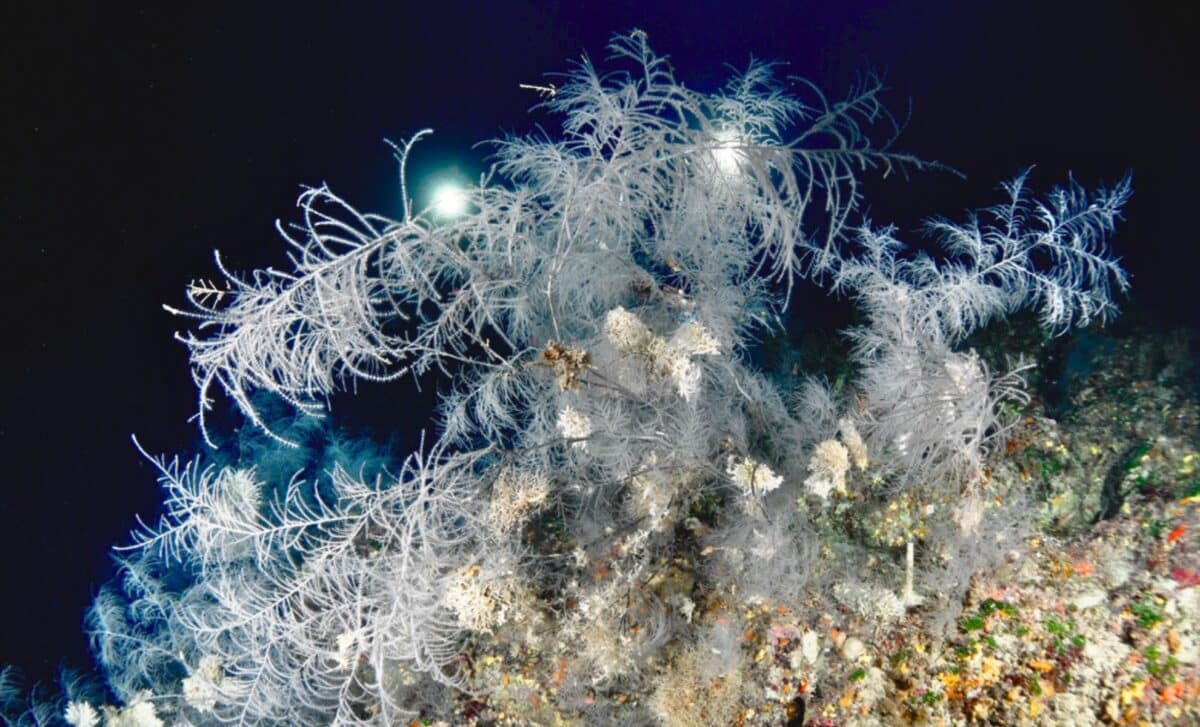
Deep below the surface of New Zealand’s southern fjords, in waters rarely disturbed and even less understood, a discovery has surfaced that may shift the parameters of deep-sea biology. It wasn’t marked by movement or sound. Just silence, and size.
The object in question is not new. It has been growing slowly, possibly for centuries, in one of the planet’s most isolated marine environments. In a region where scientific access is limited and biodiversity often goes unrecorded, the scale of what researchers found is prompting fresh scrutiny of conservation efforts and data blind spots.
The structure stands over four metres tall, its branches extending across nearly five. Its age is estimated in centuries, not decades. It is not a reef, not a tree, but a black coral, long overlooked in policy and research, now newly relevant.
What researchers encountered in Fiordland is likely the largest black coral ever documented in New Zealand’s territorial waters. Its scale, age, and location pose questions about how much of the deep ocean remains unaccounted for, and how much more may still be hidden.
Largest Recorded Black Coral in New Zealand Waters
The coral was discovered by a dive team led by scientists from Te Herenga Waka–Victoria University of Wellington, during a survey in Fiordland’s deep channels. Marine biologist Professor James Bell, who has conducted coral research for over two decades, confirmed the specimen as the largest he has encountered in New Zealand’s territorial waters.
“Most black corals we come across when we’re diving are small,” Bell said in a university statement. “With the bigger ones usually less than two to three metres tall, so finding this one was really cool.”
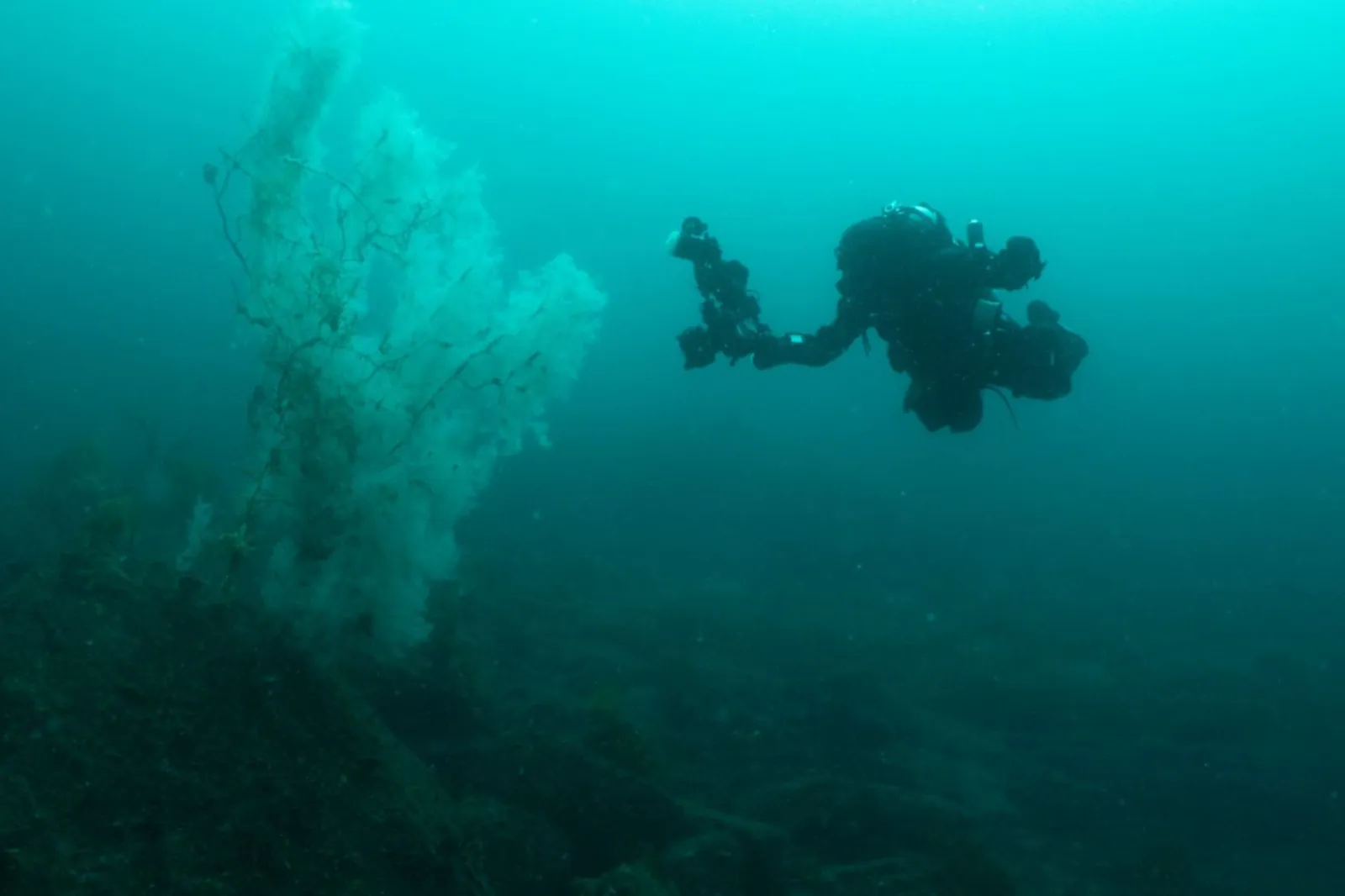 A picture shared by Te Herenga Waka—Victoria University of Wellington, shows a 4 metre tall black coral found in Fiordland. | James Bell
The finding was first reported by Newsweek, based on fieldwork led by the university’s marine research team. The coral’s size significantly exceeds previously documented black corals in the region, many of which do not surpass two metres in height. Bell emphasised the ecological importance of identifying large colonies, which can function as breeding stock in populations with extremely low growth and reproduction rates.
Accompanying the dive was Richard Kinsey, a senior biodiversity ranger with the New Zealand Department of Conservation, who characterised the sighting as exceptional. “I’ve been a marine ranger in Fiordland for nearly 20 years and it’s rare to see a coral so big. It’s easily the largest one I can remember seeing,” Kinsey stated, according to the university.
Habitat Protection and Mapping Efforts Underway
Black corals, known scientifically as members of the order Antipatharia, are sessile invertebrates typically found at depths of 30 metres or more. They grow slowly, often just millimetres per year, and can live for several centuries. Their dense, branching skeletons offer habitat to invertebrates and juvenile fish, contributing to deep-sea ecological networks.
The region where the coral was found is part of the Fiordland Marine Area, which is covered by several layers of conservation protection. New Zealand’s Marine Protected Areas Policy aims to safeguard biodiversity across a representative range of ecosystems, though its implementation has faced calls for stronger enforcement and expanded habitat mapping.
To support that, researchers from Victoria University, working with the Department of Conservation and the Fiordland Marine Guardians, have launched targeted surveys to identify zones of ecological significance. Their goal is to reduce the risk of damage from marine activities by developing informed guidance for vessel operators and fishers.
Anchoring and gear deployment are known threats. According to the New Zealand Threat Classification System, physical disturbance is among the leading pressures on vulnerable marine invertebrates, including corals. To limit these impacts, the team has asked local divers and mariners to report any sightings of black corals over four metres tall.
Bell said the team would like to receive “reports from anyone who knows of particularly large black corals” to help improve the data on their distribution and assess how frequently these large colonies occur throughout the fiords.
Identification Challenges and Legal Protections
Although commonly referred to as black corals, the term describes the colour of their internal skeleton, not their outward appearance. Living tissue covers the coral in pale or white hues, which can lead to misidentification in the field. Accurate classification may require microscopic analysis or DNA sequencing, especially in habitats where multiple coral species coexist.
In New Zealand, black corals are listed as protected species under the Wildlife Act 1953. It is an offence to intentionally collect, damage, or possess specimens of any protected marine wildlife. Despite this, enforcement relies heavily on public reporting and proactive monitoring by conservation agencies.
Black coral has been historically valued in traditional medicine and jewellery in parts of the Pacific and Mediterranean. A study published in Frontiers in Marine Science notes that many species within the Antipatharia order are long-lived and function as biological archives, storing environmental data within their skeletons. This makes them useful for palaeoclimate research, but also particularly sensitive to habitat degradation.