
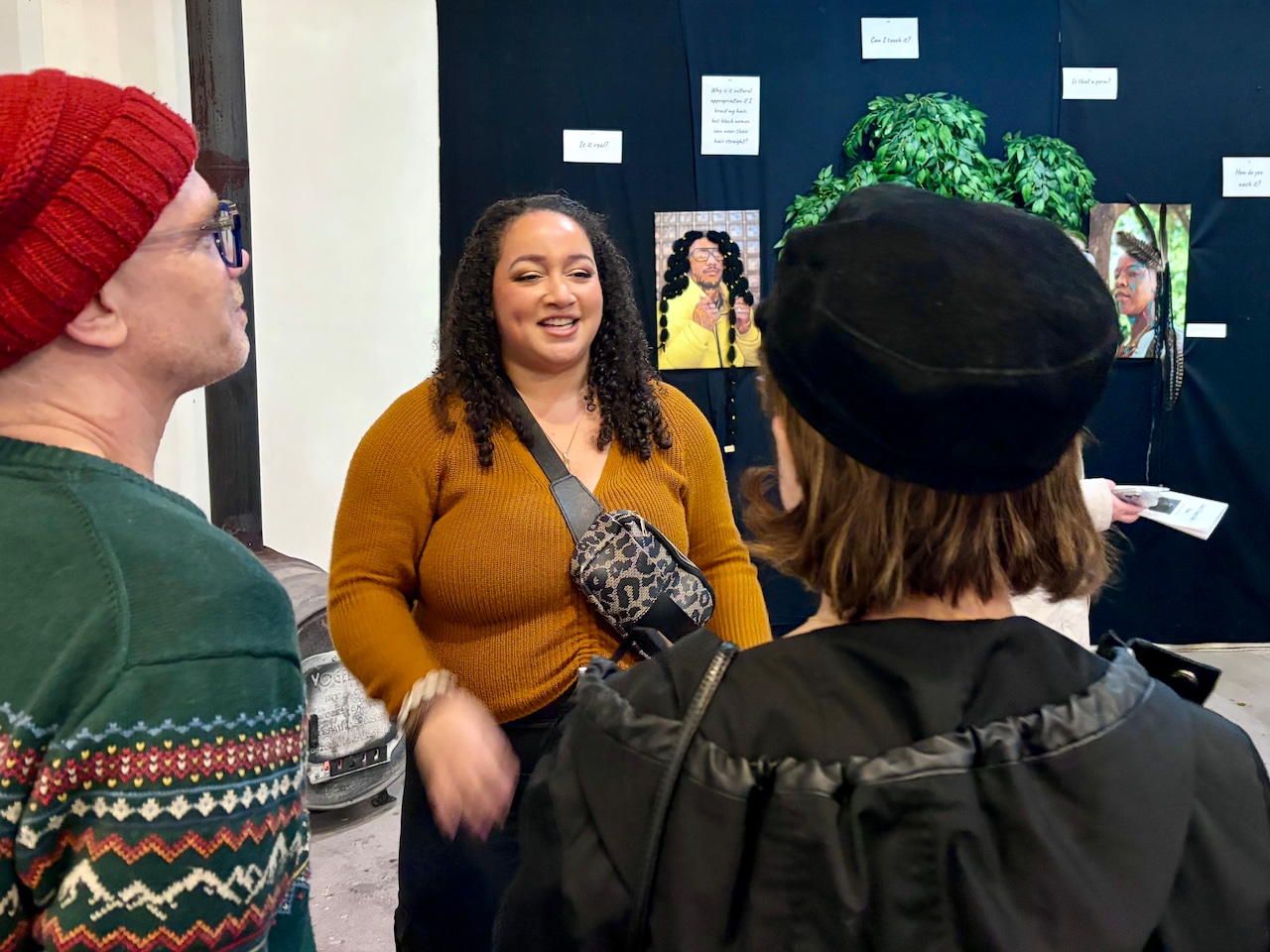
Ashland artist Crystal Proffitt’s poignant installation “Don’t Touch My Hair: An Interactive Crowned Experience” at southern Oregon’s Langford Art Gallery invites viewers to stop playing by the rules.
People are encouraged to do what the title tells them not to do: touch the carefully arranged strands of hair attached to portraits of local Black models.
While handling the braids and locs, gallery visitors listen to voice recordings of the models speaking of styling hair as ancestral acts of cultural identity, healing and resilience. One model called hair “my soul signature.”
The models also speak of uncomfortable experiences of strangers scrutinizing, questioning and reaching for their hair.
Proffitt said her multi-sensory installation was created to allow for critical reflection on the beauty of often-maligned textured hair and how histories of exclusion continue to shape contemporary experiences of identity, bodily autonomy and cultural visibility.
Hair is a personal crown, not a public curiosity, said Proffitt, who has full, curly hair that strangers often try to stroke.
She has found some people and businesses see textured, kinky or coiled hair as unkempt, unprofessional and a fireable offense, rather than hair that can make a person feel beautiful, important, attractive and loved.
The “Don’t Touch My Hair“ installation is supported by a grant from the Oregon Cultural Trust to the Black Alliance & Social Empowerment (BASE) Southern Oregon community organization.
Vance Beach, BASE’s founder and executive director, said Proffitt’s work welcomes people to “come with care and a willingness to grow” to deepen their knowledge and understanding.
The “Don’t Touch My Hair” installation debuted Jan. 3 at the Langford Art Gallery in the Rogue Valley city of Phoenix, with support by the Phoenix Art & Culture Council, and continues through Jan. 24.
The installation will then join BASE’s third annual Black Cultural Legacy Series, which celebrates Black History Month and runs Jan. 17-Feb. 27 at the Rogue Gallery & Art Center in Medford.
The hair will gradually show wear from viewers’ touching, yet Proffitt intentionally will not rebraid or repair the art.
“This erosion is part of the meaning,” Proffitt said. “It’s a quiet reminder of what happens to things that are meant to be treated with care, yet are not always handled as such.”
The movement behind the art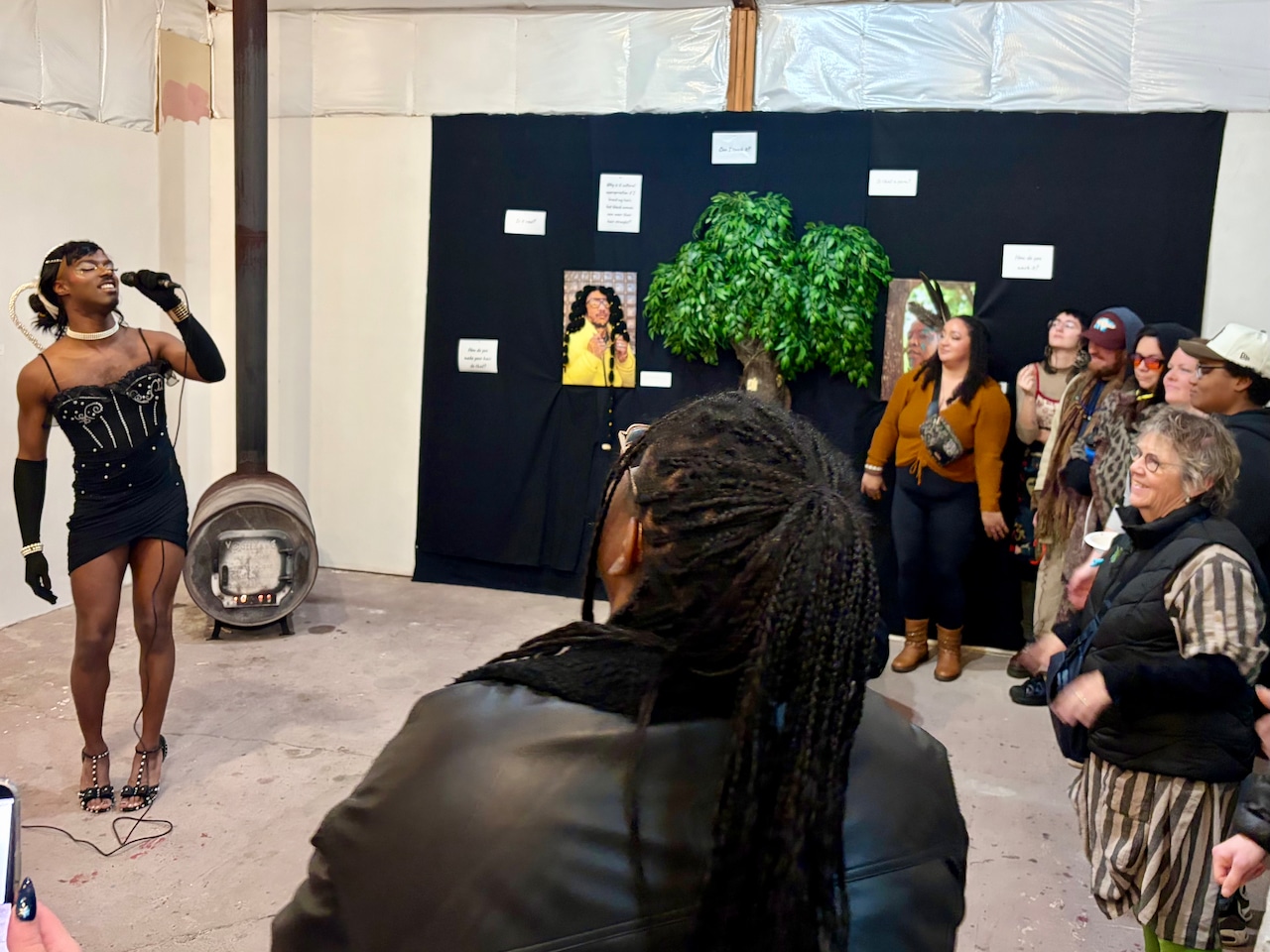 Performer Devyn-Michelle LaVicious sings Solange Knowles’ ”Don’t Touch My Hair” Jan. 3 at the opening of artist Crystal Proffitt’s installation “Don’t Touch My Hair: An Interactive Crowned Experience” at the Langford Art Gallery in Phoenix, Oregon.Janet Eastman/The Oregonian/OregonLive
Proffitt’s installation is ambitious. She sees her affirming project as an artistic experience, an educational tool and a platform to elevate the Don’t Touch My Hair movement, which is widely championed in art, literature and music.
Nina Simone’s song “Four Women,” India.Arie’s “I Am Not My Hair” and Solange Knowles’ “Don’t Touch My Hair” all address the preservation of Black stories and the policing of Black hair in modern society.
In 2021, Oregon passed the CROWN Act (Creating a Respectful and Open World for Natural Hair) to protect the wearing of race-based hairstyles in the workplace and public schools.
Although 28 states have legislation against biased hair policies, people in 22 states still face potential discrimination. They can be disciplined or denied opportunities for wearing an afro, crown braid, Bantu knots or locs.
Two-thirds of Black women change their hairstyle for a job interview, mostly by straightening naturally curly hair, according to a 2023 Workplace Research Study of almost 3,000 Black, Hispanic and white women by the nonprofit CROWN Coalition.
Ongoing hair bias makes Proffitt’s art an urgent and relevant form of activism.
The installation’s centerpiece is an Ancestor Tree that lights up when viewers tap it with braids tethered to nearby portraits. Here, Proffitt said hair becomes the conduit through which identity, sovereignty and resilience are illuminated.
“The illumination isn’t created magic,” said the multiracial artist, “but rather referencing truths our ancestors knew and a return to nature and Indigenous ways.”
She said beliefs held by the South Sudanese and other people who recognize hair as possessing significant cultural and spiritual power will seem familiar to those who have seen “Avatar” movies. The fictional Na’vi connect their braids to sacred trees.
By researching worldwide faiths and traditions and drawing on her own beliefs, Proffitt sees the crown of the head as a sacred focal point for spiritual experience, energy flow and divine connection.
“Hair is an antenna,” she said, “that holds cultural memory and connection to something far greater than the individual.”
‘Taming’ natural waves and curls
Proffitt, 36, grew up in California’s Bay Area in a blended family and was not raised by her biological parents, who are people of color.
She taught herself how to care for her curly hair and practiced braiding on her Barbie doll. She noticed early on that her hairstyle affected the way strangers treated her.
“When I wore cornrows I was followed in grocery stores; when I wore my natural hair, I was teased at school,” she said.
For years, she used chemicals or a flat iron to relax her hair “to fit into a world that equated professionalism with straight, ‘tamed’ hair,” she said.
Even with straightened hair, she still faced unwanted touching in casual and professional settings, including when she worked at a law office.
She wondered, how do I get people to just not touch me?
“As someone who is highly sensitive and easily overstimulated by touch, moments like feeling fingers on my scalp while working made it clear that something was deeply wrong,” she said.
Later, when she was a dancer, dance manager and a hair and makeup artist at a San Francisco talent agency, she witnessed a young Latina performer being disciplined for wearing her natural waves and curls.
A team leader told the performer that her hair was “unprofessional” and “nasty,” recalled Proffitt.
Proffitt confronted the woman who made the remarks, and the woman cried and said she was “a good person.” Too often, Proffitt said, people dismiss conversations to protect someone’s feelings.
She sought another way to talk about hair bias.
An enticing interactive installation
Proffitt moved to Ashland in 2021 to be near her sister and said the touching of her hair intensified. In addition, she couldn’t find a hair braider near her home to protect her hair from Rogue Valley’s dry climate.
“A great hairstylist will take their time — almost like a shaman, really honoring and caring for you,” she said. “Prayers go into creating each and every single braid.”
Out of necessity, Proffitt cares for her hair as well as her friends’ textured hair.
During long braiding sessions, Proffitt said they shared stories of their hair being touched by strangers and spoke openly about the emotional labor required to navigate those experiences.
The discussions led Proffitt to use her artistic voice to speak plainly, as seen in “Don’t Touch My Hair.”
Her art has always depicted people of color in empowering, fantastical ways, like an afro hairstyle seen as a galaxy. This time, she wanted to create a multi-sensory experience where the message in her visual art is amplified by sound and touch, and viewers interacting with the art.
Proffitt collaborated with photographer Ally White and Afrofuturist multimedia artist Micah Blacklight to create the portraits surrounding the 6-foot-tall Ancestor Tree equipped with a light system by engineer and artist Robert Quattlebaum of Voria Labs.
Viewers notice that the models in the six portraits have an unwavering gaze that looks directly at them. Then they see painted markings on the canvas near the strands of artfully braided, twisted or poofy hair. One portrait has a touchable cowrie shell headpiece.
White, who said her work celebrates the real, unfiltered beauty of human beings, photographed the six models in downtown Ashland’s Lithia Park.
During a Jan. 9 panel discussion with the installation’s collaborating artists at the Langford Art Gallery, White said she approached the assignment softly and with care as the models “bared their souls.”
Blacklight, a respected Ashland artist known for solo shows, then told the audience that White’s photography “captured the innocence, authenticity, vulnerability and swag” of the models.
Each of the photographs was printed on a canvas and then embellished by Blacklight with painted tattoos and other markings that emphasize power.
Blacklight said his role was to reinforce Proffitt’s message, which he described as the need for people who feel “pushed, crushed, suppressed and trivialized” to stand tall.
In the interactive installation, people use headsets to hear the models’ audio recordings.
Model Jaalen Owens remembers wearing a T-shirt to school that his mother made with the words “Don’t Touch the ‘Fro.”
He said in his audio recording he “could tell when somebody’s energy came from respect rather than novelty,” and sometimes he consented to having his hair tousled.
Model CJ Thomas describes an experience of a woman calling Thomas’ braids “dreadlocks” and pushing to touch them after Thomas said no.
Thomas also speaks of the hours with her stepmother, who owned a hair salon. “Her hands gave me dignity. Her hands felt like love,” Thomas said. “And that’s the type of dignity anyone deserves.”
If you go: “Don’t Touch My Hair: An Interactive Crowned Experience” will be exhibited through Jan. 24 at the Langford Art Gallery, 4850 S. Pacific Highway in Phoenix.
The art will then be exhibited at the Rogue Gallery & Art Center at 40 S. Bartlett St. in Medford through Feb. 27. Admission is generally free and open to the public at both galleries, though some special events might have a small cover charge.