
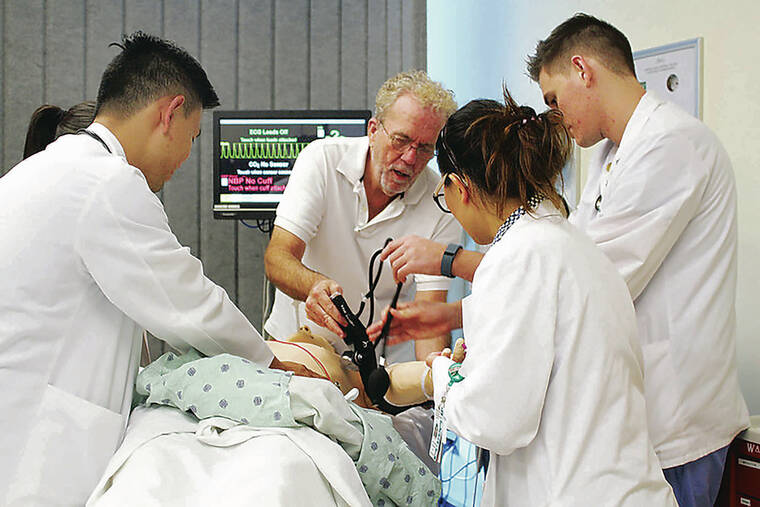
The doctor shortage in Hawaii has not only persisted, but worsened, according to the most recent report tracking the numbers.
The Hawaii Physicians Workforce Report found the state short of 833 full-time equivalent doctors in 2025 compared to 768 in 2024, with the greatest gaps continuing on neighbor isles.
Similar to national trends, doctors in Hawaii are retiring due to age and burnout from the lingering impacts of the COVID-19 pandemic. In Hawaii, many continue to leave due to lower pay compared to the U.S. continent while costs of living are higher, along with lower reimbursement rates and administrative burdens, among other challenges.
Dr. Kelley Withy, who oversees the study, said she was hopeful there would be continued recovery from the pandemic, as shown in 2023 and 2024, but that momentum did not last and “now we are losing traction.”
During the height of the pandemic in 2020, many senior doctors retired, exacerbating the situation.
“They didn’t want their health to be at risk, so some of them retired,” said Withy, a professor at the University of Hawaii’s John A. Burns School of Medicine. “And then there was a cliff for electronic heath records. Senior doctors who didn’t want to adopt the electronic health records retired.”
Don’t miss out on what’s happening!
Stay in touch with breaking news, as it happens, conveniently in your email inbox. It’s FREE!
As Hawaii doubles down on recruitment efforts, the state continues to struggle with a doctor shortage due to ongoing challenges, along with rising costs, federal cuts, and an aging population.
Short of specialists
The annual report to the state Legislature noted that of the 12,688 licensed physicians in Hawaii, only 3,647 are currently providing patient care.
Of those actively practicing, not all are full time, so the actual number of full-time equivalent physicians come out to about 3,044, which is 31 less than in 2024.
About a quarter of Hawaii’s doctors are already ages 65 and older, which means they may be approaching retirement. Last year, at least 81 doctors retired, 14 died, and more than 88 moved away.
The greatest shortage by category remains in primary care physicians — the doctors who provide routine checkups, manage flu or diabetes, and refer patients to specialists. Hawaii is short of close to 180 full-time primary care doctors.
Hawaii is also short of specialists in pediatric critical care, pediatric gastroenterology, pediatric and adult endocrinology, pediatric and adult pulmonology, and cardiothoracic and colorectal surgery.
The need is most pronounced in Hawaii County, which has a 43% gap, with 224 more doctors needed to fill it, followed by Maui County, which has a 41% shortage, with another 179 doctors to close it.
Maui County also has the highest percentage shortage of primary care physicians, at 35%. The Maui wildfires “exacerbated an already significant shortage of providers” and eliminated multiple health care facilities that have not been rebuilt, so the numbers are likely worse.
Neighbor island crisis
Dr. Scott Grosskreutz, a breast cancer specialist in Hilo and president of the Hawaii Healthcare Task Force, said on the neighbor isles, it’s actually a crisis.
“In talking to many Neighbor Island healthcare professionals, there is clearly a crisis in our ability to continue to provide patient care in Hawaii’s rural communities,” wrote Grosskreutz in an email. “This is not simply another same old, same old 40% plus shortage of doctors, that our Neighbor Islands have suffered from for years.”
He said many rural practices either have, or will soon close.
Grosskreutz co-authored a recent editorial column in the Honolulu Star-Advertiser that said the cause is straightforward — the costs of providing care is often higher than reimbursements by the federal government and local insurance companies.
Recruiting new doctors is nearly impossible, he said, while keeping them in Hawaii becomes harder every year. Without drastic change, many will simply retire or leave the state.
Many communities on Hawaii island simply cannot get the basic primary care they need, he said, with patients in Puna, Kau, and Hamakua waiting months for appointments or having to travel to get the care that they need.
The task force is supporting legislative efforts to increase primary care reimbursements to 12% of total medical expenditures, as well as a “Patient Bill of Rights” to ensure oversight over a growing number of health insurance denials.
State Rep. Terez Amato (D, Kihei-Wailea) said she is teaming up with doctors across the state to introduce the “Patient Bill of Rights” to address the crisis.
“It will reduce administrative burdens on doctors, require timely prior authorization of patient care to prevent needless deaths and also place human guardrails on Artificial Intelligence calculated insurance decisions,” said Amato in a statement.
She added that a duty to protect public health is clearly outlined in the state Constitution.
“Health care is a human right,” she said. “I will not stand by while doctors are forced out of business and patient lives are sacrificed simply to increase large corporate profits. We must support our doctors and patients.”
Bright spots
Some bright spots include a new law, which went into effect Jan. 1, exempting medical and dental practices from paying Hawaii’s general excise tax for patients covered by Medicare, Medicaid, and Tricare.
This exemption could save private practices 10% to 15% of revenue, the report noted.
Hawaii also has been awarded nearly $190 million from the federal Rural Health Transformation Program over five years to address disparities outside of Honolulu. These funds could go toward more recruitment incentives, training and residency programs on neighbor isles.
The state’s health care education loan repayment program, launched in 2023, continues to offer up to $50,000 to doctors and other health care workers, in exchange for two years of service in underserved areas.
More than 920 applicants were approved last year, according to Withy, and about 200 more are expected to be approved this year.
“I would say we’ve had success, but we aren’t yet to the point where we can draw people here with the loan program,” she said. “We’re still trying to help everybody that’s here to keep them here, which is important.”
The main setbacks for Hawaii recruitment include lower pay, paired with the higher cost of living, particularly for the largest expense, which is housing.
A recent Omnitrak survey found hundreds of doctors would consider moving to Hawaii if there was a four-day workweek, a salary 110% of their current one; a 50% tax credit for three years; and a quarter-point lower interest rate for home mortgages.
Central Pacific Bank offers a quarter-point discount for doctors via its “white coat program.” Withy is advocating for a half-point discount.
Administrative burdens
But other initiatives needed to improve recruitment include increased reimbursement rates from health insurance companies, the report noted, and further reductions in administrative burdens.
Dr. Elizabeth Ann Ignacio, chair of the Hawaii Medical Association Public Policy Committee, said administrative burdens such as prior authorizations, pharmacy benefit management requirements, insurance formularies, and extensive paperwork — continue to pull physicians away from their primary mission of caring for the people of Hawaii.
“These demands are among the leading factors driving physicians out of clinical practice,” she said in a statement. “Reducing both the intentional and unintentional growth of administrative complexity is essential to improving access to health care and addressing the moral injury that has accumulated over the past two decades.”
Withy added that the proposed partnership of Hawaii Medical Service Association, the state’s largest insurer, with Hawai‘i Pacific Health, a major health care system, also could impact doctors.
“I am afraid if this merger goes through,” she said, “we will lose a lot of private practice doctors … I fear this will make a division because you’re either in HPH or you’re out, and if you’re out, you can’t transfer patients there. You may not be able to get specialists to see your patients.”
HPH and HMSA have said, however, that the move is part of an effort to streamline the process for patients, and that its network will remain open to other participants.
Nationally, the U.S. is also short of 40,000 to 60,000 practicing physicians, with the shortage projected to grow even further in the next decade. The trend is driven by retirement, along with growing patient needs in a shifting health care landscape.
Pending cuts to Medicare and Medicaid are expected to make the situation even more dire.
The studies of Hawaii’s physician workforce began in 2010, and the counts factor in geographic barriers and time-sensitive coverage needs on different isles.
In order to keep up with demand, the report said Hawaii needs to increase its net workforce by at least 100 physicians a year.
HAWAII’S PHYSICIAN WORKFORCE
>> Shortage: 833 full-time equivalents statewide.
>> Greatest shortage by specialty: Primary care (178 FTEs needed across all islands).
>> Greatest subspecialty shortages: Pediatric gastroenterology; pediatric and adult endocrinology; pediatric and adult pulmonology; cardiothoracic and colorectal surgery; pediatric critical care.
>> Shortages by county: Honolulu (379 FTEs, a 15% gap); Hawaii (224 FTEs, a 43% gap); Maui (179 FTEs, a 41% gap); Kauai (50 FTEs, a 28% gap).
>> In 2025, at least 81 physicians retired, 14 died, and more than 88 moved away.
Source: Hawaii Physician Workforce Report 2025