
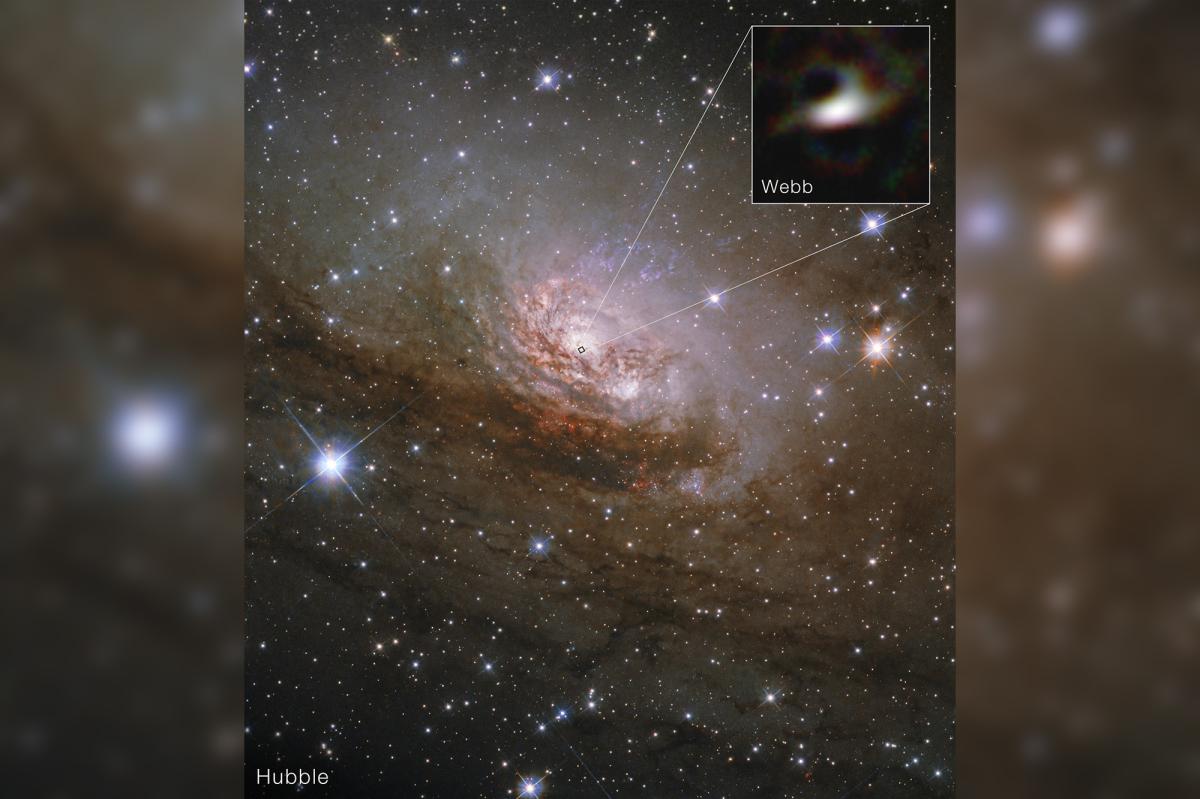
A new image from the James Webb Space Telescope by NASA gives a glimpse into a black hole within the Circinus Galaxy.
The Circinus Galaxy is 13 million light-years from Earth.
NASA said it’s long been thought that a large source of infrared light closest to the supermassive active black hole were streams of super-heated matter that fire outward called outflows.
Now, the new image from the James Webb Space Telescope, combined with a new image from NASA’s Hubble Space Telescope, suggests that the hot, dusty matter near the black hole is actually feeding the black hole, NASA said.
“Since the ‘90s, it has not been possible to explain excess infrared emissions that come from hot dust at the cores of active galaxies, meaning the models only take into account either the torus or the outflows, but cannot explain that excess,” research lead author Enrique Lopez-Rodriguez of the University of South Carolina said.
A torus is infalling gas and dust which accumulates into a donut-shaped ring around an active black hole.
As supermassive black holes gather matter from the inner walls of the torus, they form something called an accretion disk.
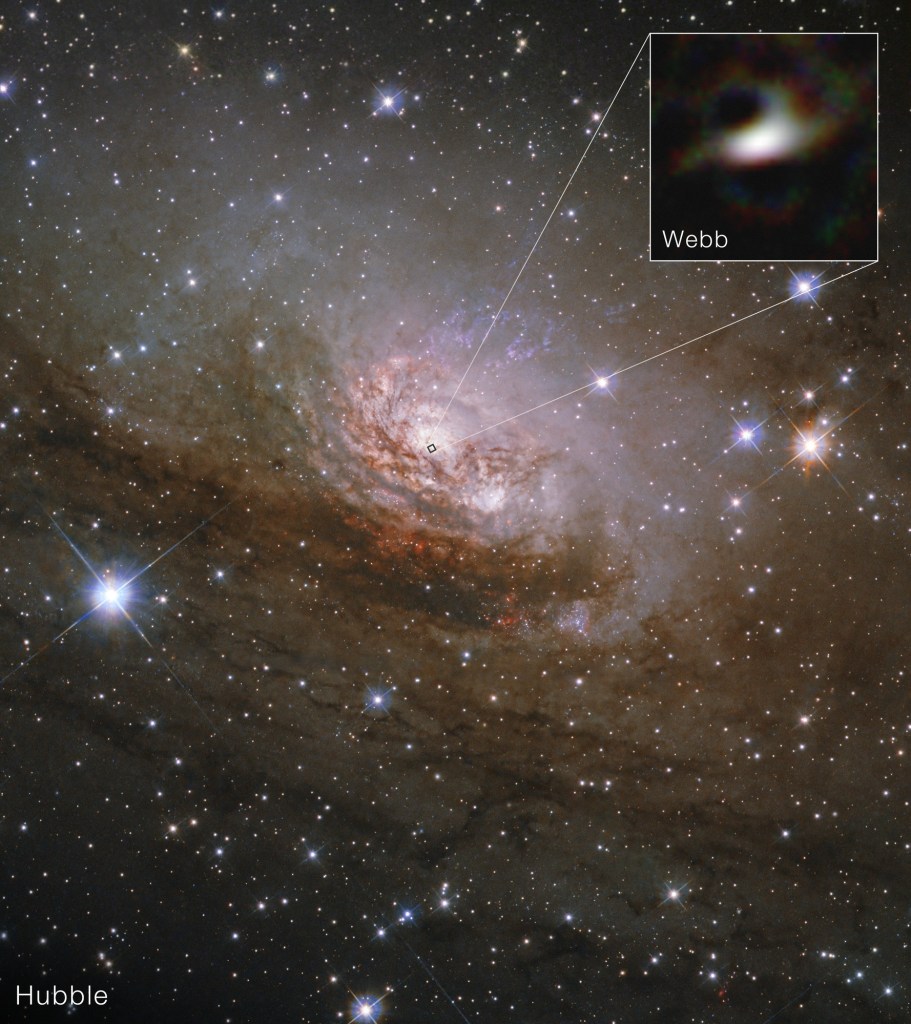 A new image from the James Webb Space Telescope paired with one from NASA’s Hubble Space Telescope shows hot, dusty matter feeding the black hole. NASA, ESA, CSA, Enrique Lopez-Rodriguez, Deepashri Thatte, Alyssa Pagan
NASA said this is similar to a whirlpool of water swirling around a drain. This disk grows hotter through friction, eventually becoming hot enough to emit light.
This glowing matter can become so bright that seeing details within the galaxy’s center with telescopes on the ground is challenging.
It’s made even harder due to the bright, concealing starlight within Circinus, NASA said.
Start your day with all you need to know
Morning Report delivers the latest news, videos, photos and more.
Thanks for signing up!
In order to see into Circinus, the Webb Space Telescope needed its Aperture Masking Interferometer tool.
NASA said the Aperture Masking Interferometer allows Webb to become an array of smaller telescopes working together as an interferometer, creating these interference patterns by itself.
It does this by utilizing a special aperture made of seven small, hexagonal holes, which, like in photography, controls the amount and direction of light that enters the telescope’s detectors, NASA said.
With new data, the research team was able to construct an image from the central region’s interference patterns.
To do this, the team referenced data from previous observations to ensure their data from Webb was free of any errors.
This resulted in the first extragalactic observation from an infrared interferometer in space and the sharpest image of a black hole’s surroundings ever taken by Webb, NASA said.
NASA said that while the mystery of the Circinus galaxy’s excess emissions has been solved, there are billions of black holes in the universe that haven’t been investigated.
Read more about the photo and this research on NASA’s website.