
In a major shift for condensed matter physics, researchers have discovered a new way to alter the properties of materials, not with ultra-powerful lasers, but by triggering internal quantum ripples called excitons. This method opens the door to reconfiguring the behavior of matter using far less energy than previously thought possible.
The breakthrough, reported in Nature Physics on January 19, 2026, stems from a collaboration between the Okinawa Institute of Science and Technology (OIST), Stanford University, and several global institutions. It marks a significant step for Floquet engineering, a field that seeks to manipulate materials using periodic external forces, traditionally achieved through high-intensity light pulses.
Floquet engineering has long held promise as a way to “dress” ordinary materials with quantum properties, like turning semiconductors into superconductors or inducing topological phases. Yet the high laser powers required have posed a major obstacle, too weak and the effect doesn’t appear, too strong and the material risks damage. According to the team at OIST, excitons offer a much more efficient route forward, and crucially, they’ve now demonstrated this in a real-world setting.
A New Driver of Quantum Hybridization
Excitons, which are electron-hole pairs that form inside semiconductors when electrons absorb energy, have become unlikely heroes in this story. These particles carry self-oscillating energy and can act as an internal driver, reshaping the electronic structure of materials without destroying them. According to Professor Keshav Dani, who leads the Femtosecond Spectroscopy Unit at OIST, “Excitons couple much more strongly to the material than photons due to the strong Coulomb interaction, particularly in 2D materials.”
 TR-ARPES setup at OIST with co-author Xing Zhu, showcasing the table-top extreme-UV source used to capture the first direct images of excitons and demonstrate excitonic Floquet engineering. Bogna Baliszewska (OIST)
This strong coupling allows them to induce what’s known as Floquet hybridization, where the energy bands of a material bend and merge into new shapes, often flattening into a distinct camelback or “Mexican-hat” profile. In the new study, scientists directly observed this effect in a monolayer semiconductor, proving that excitons alone were responsible. The hybridization was especially clear at high exciton densities, where it overshadowed the faint signal seen in conventional, optically driven systems.
Faster, Clearer, and With Far Less Energy
The experiments were conducted using a highly specialized time- and angle-resolved photoemission spectroscopy (TR-ARPES) setup at OIST, equipped with a proprietary extreme-UV light source firing at femtosecond intervals. Co-first author Xing Zhu, a PhD student in the same unit, explained that the system allowed them to isolate the excitonic effects by delaying measurement after the light source was turned off.
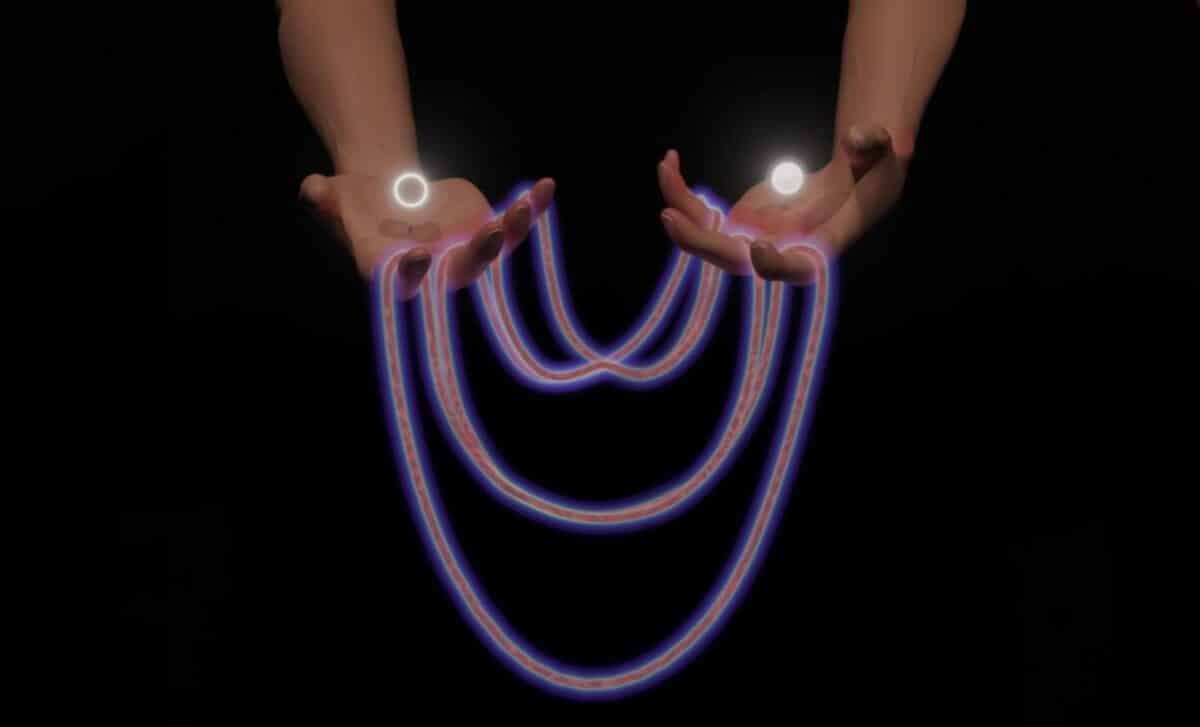 Visualizing excitonic Floquet effects: hands cradle energy bands with Mexican-hat dispersion and paired electron-hole orbs © Jack Featherstone
What they found was striking. According to Dr. Vivek Pareek, now a postdoctoral fellow at Caltech, “It took us tens of hours of data acquisition to observe Floquet replicas with light, but only around two to achieve excitonic Floquet—and with a much stronger effect.” This contrast highlights not only the greater efficiency of exciton-driven engineering, but its practicality for future quantum device development. The team dialed down the light intensity by more than an order of magnitude and still observed stronger band modification.
Toward a Broader Toolkit of Quantum Manipulation
For over a decade, the field of Floquet engineering has focused almost exclusively on light as the periodic drive, following a theoretical proposal by Oka and Aoki in 2009. That framework assumed that only photons could produce the desired effects. This latest study overturns that idea completely. As explained by co-author Gianluca Stefanucci of the University of Rome Tor Vergata, “It takes significantly less light to create a population of excitons dense enough to serve as an effective periodic drive for hybridization.”
The researchers now suggest that similar effects might be achievable using other bosonic particles, such as phonons, plasmons, or magnons, each with its own method of excitation. But for now, what’s been proven is this: excitonic Floquet engineering works, and it works well. According to the study’s co-first author Dr. David Bacon, formerly of OIST and now at University College London, “We’ve opened the gates to applied Floquet physics… We don’t have the recipe for this just yet—but we now have the spectral signature necessary for the first, practical steps.”
This shift from photon to exciton as the driver of material change not only rewrites assumptions in quantum physics, it also simplifies the path toward programmable quantum materials that don’t rely on brute-force laser manipulation.