
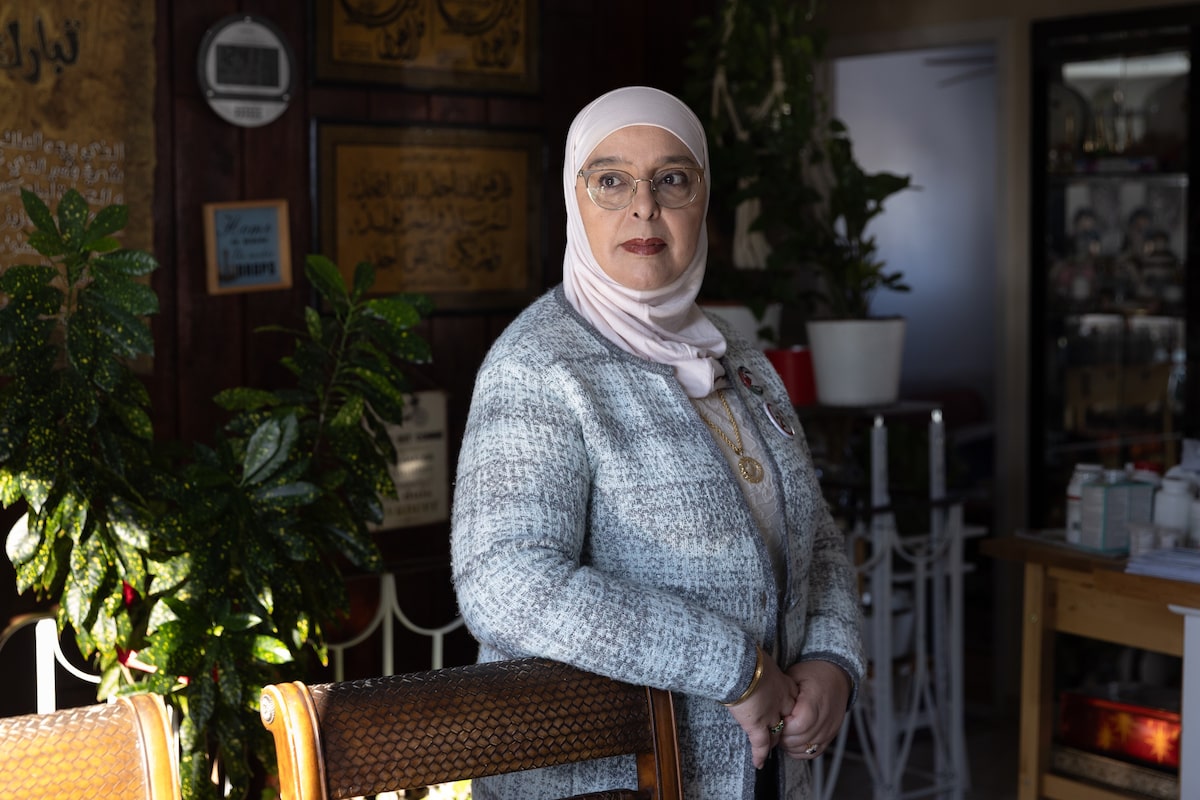
Samira Laouni at her home in Laval, Que., on Sunday. She moved to Quebec in 1998. Today, she’s contemplating leaving the province.Nasuna Stuart-Ulin/The Globe and Mail
Samira Laouni moved to Montreal in 1998, largely to escape the racism she faced in France as a Muslim woman, and to give her infant daughter a life free from such discrimination.
The Quebec consular official in Paris who processed Ms. Laouni’s immigration paperwork assured the Sorbonne marketing professor that she would be welcome in the province, and at first she was “amazed” at how much that was true.
Twenty years later, François Legault became Premier of Quebec. One of his first major pieces of legislation, known as Bill 21, made it illegal for public employees in positions of authority, such as police officers and teachers, to wear religious symbols. The main group affected were observant Muslim women such as Ms. Laouni who wore hijabs. She doesn’t work in the public sector, but the climate of opinion generated by the law has been nothing short of “hellish,” she said.
As Mr. Legault prepares to depart office after announcing his resignation last week, he leaves a province where many religious and linguistic minorities feel less welcome in Quebec. Ms. Laouni’s adult daughter, the one her mother so wanted to protect, decided to leave the province altogether and practise psychology in Ottawa.
“She can’t take the discourse here,” Ms. Laouni said. “We work like dogs to pay taxes, we contribute to society, and we end up being rejected. Emotionally it’s very, very hard.”
Eric Andrew-Gee: Legault’s ‘third way’ Quebec nationalism down but not out after resignation
In 2022, the Legault government followed up with Bill 96, a law to toughen the rules against using English in medium-sized businesses and government services, which left many anglophones feeling targeted.
This past fall, the provincial government expanded the religious symbols ban to all public-school workers who interact with students. Another proposed law would extend it further to subsidized daycare workers.
Anglophone institutions are also concerned about a proposed Quebec “constitution” that would bar public bodies such as English school boards from using their budgets to contest certain provincial laws before the courts – the only way they have staved off another Legault government initiative to eliminate English school boards altogether.
All of this legislation has been justified by Mr. Legault as a way to defend the French language and Quebec’s hard-won secularism, which is particularly precious to many in the province after decades of overweening control by the Catholic Church. Most of the laws have been popular with the province’s francophone majority. But many minorities felt their rights were being trampled and their status as Quebeckers challenged, a climate Ms. Laouni fears will outlast the departing Premier.
“Good riddance,” she said. “But we are not out of the woods yet.”
Konrad Yakabuski: François Legault set out to bridge Quebec’s divides. He ended up widening them
National rights groups have decried the Legault government’s record. In December last year, the Canadian Civil Liberties Association denounced the secularism legislation, along with recent restrictions on protesting and organizing by doctors and unions, and Quebec’s use of the notwithstanding clause to shield such laws from legal challenge.
“This quest for absolute power has a name,” the organization said in a statement. “It is the early stages of authoritarian drift.”
Montreal constitutional lawyer Julius Grey has been confronting the Legault government’s stance on minorities from both a professional and personal angle for years. Although he has been involved in the legal challenges to Bill 96 and Bill 21 – the latter is scheduled to be heard by the Supreme Court in March – the storied jurist says he understands Quebec’s desire to maintain a strong French-speaking and secular mainstream; he does not think assimilation is a dirty word.
As a child in the 1950s, he immigrated from Poland and quickly became a quintessential Montrealer: The long-time McGill University law professor married into a prominent francophone family and developed a love for 19th-century Quebec literature.
Newcomers should aspire to adapt to the values and customs of the host society, Mr. Grey believes. Once, he told a Sikh client that he was defending the man’s right to wear the ceremonial dagger known as a kirpan in the hopes that the man’s grandson would not wear one.
Campbell Clark: Legault’s inevitable resignation shuffles Quebec politics
But Mr. Legault has gone too far, Mr. Grey said, with “the idea that collective aspirations trump individual rights.” Among other things, he believes it will backfire if the goal is to make immigrants feel like Quebeckers in full standing.
“Quebec is absolutely counterproductive in alienating its minorities by trying to tear off hijabs,” Mr. Grey said. “All you’re doing is creating martyrdom.”
Even some long-standing Quebeckers feel alienated by this government’s rhetoric and legislation. Jack Jedwab, the president of the Association for Canadian Studies, has lived in Montreal all his life, and has engaged in heated debates about the province’s future throughout his career. But Mr. Jedwab has sometimes been made to feel like an outsider by virtue of being an anglophone at odds with the government’s approach to language policy.
“Am I a threat to Quebec – a threat to my home?” he said.
Others have more or less given up on Quebec. The atmosphere for Muslims in Quebec has deteriorated since the Sept. 11 terrorist attacks, said Ms. Laouni, and worsened again during the province’s debates about “reasonable accommodation” in the mid-2000s. A terrible low came with the 2017 Quebec City mosque shooting, which left six Muslim men dead.
Ms. Laouni co-founded Muslim Awareness Week in the wake of the killings, but the province’s horror at the attack did not blunt public enthusiasm for Mr. Legault’s legislation affecting Muslim women soon after.
The climate for religious minorities is gradually pushing the Laouni family out of Quebec. Ms. Laouni’s son is a biomedical student at McGill, but he is planning to leave Canada altogether once he graduates. The family thought they were model immigrants – speaking French, pursuing higher education – but even Ms. Laouni is thinking of selling her house and moving back to Morocco, the country of her birth.
“I’ve reached a saturation point,” she said.