
It’s been more than a decade since workers cleared out space for the Lafitte Greenway in New Orleans, a nearly 3-mile long multiuse path connecting Mid City with the French Quarter. Next to a city sign and signal facility, a clearing alongside the path sat empty for years.
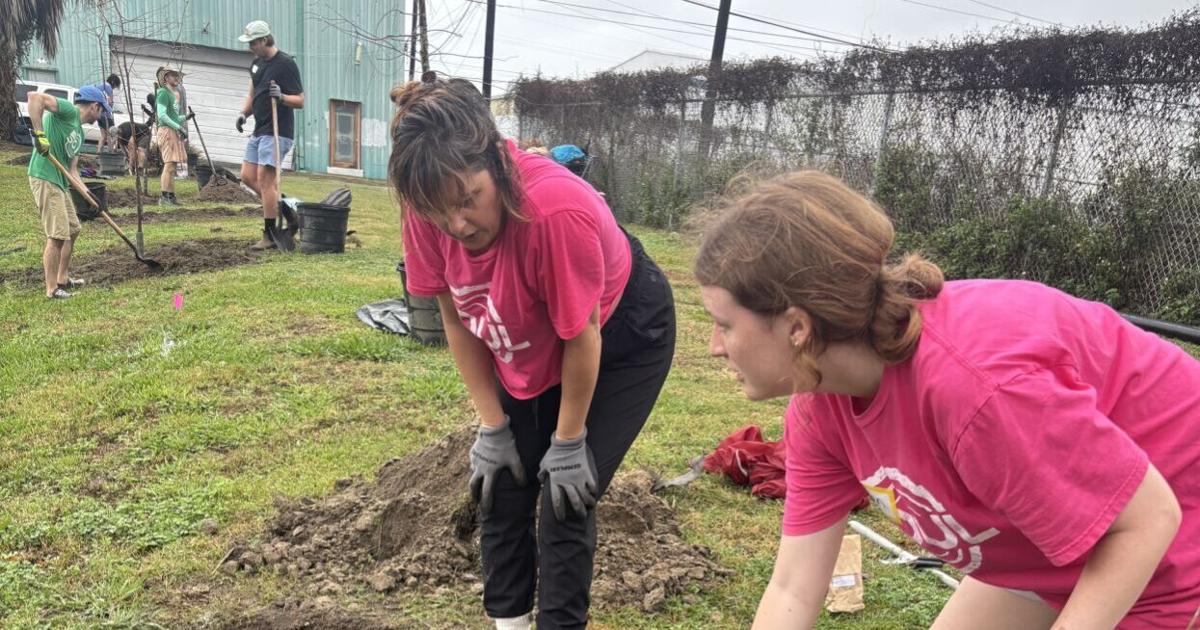
On a recent Saturday, 50 volunteers waited out torrential rain before descending on the site. They hacked through clay and rock and got to work planting 100 trees.
“We realized there was a big, beautiful bioswale here,” said Jason Neville, head of the Lafitte Greenway Partnership. “We should do something with it.”
When complete, the site will serve as a small but key example of what Neville and the nonprofit Sustaining Our Urban Landscape (SOUL) want the greenway to become.
In recent years, the group has planted a wide variety of trees, creating pockets of forest that should eventually create a canopy for parts of the path.
Susannah Burley, head of SOUL, said the group has already amassed over 800 trees along the greenway. By the end of the year, they’ll reach 1,000.
The trees provide obvious benefits for users of the greenway: shade, beauty and eventually a canopy expected to shape the greenway’s appearance. But Burley and Neville are hoping their efforts will do more. They hope rainwater that pools on nearby streets will eventually be funneled into bioswales like this one, alleviating flooding.
As New Orleans gets hotter because of climate change, the trees should cool the span. They expect ongoing experiments with many of the trees will help determine which root-manipulation techniques help trees grow stronger.
“We want to build a big canopy,” Burley said.

Volunteers plant 100 trees along the Lafitte Greenway on Jan. 10 2026.
Sam Karlin
New Orleans has few trees in several pockets of the city that are barren and blanketed in concrete, making summers especially hot. Summers in the city are getting dangerously hot due to climate change, and trees are an obvious solution — and also can help soak up ubiquitous stormwater.
Funding and difficulties coordinating who plants and cares for trees have long caused problems for the groups working on reforesting the city.
Neville and Burley see the greenway effort as a way to demonstrate how simple solutions like planting trees can help New Orleans become more livable.
SOUL’s Molly Powell, program and field coordinator, and Ellen Rogers, communications and volunteer coordinator, prepare a tree to be planted on the Lafitte Greenway on Saturday, Jan. 10, 2026.
Sam Karlin
About 50 volunteers worked for several hours planting the trees, with funding support from Entergy and Parks and Parkways through the Greater New Orleans Foundation. Among the volunteers was Mike Karam, head of the city’s Parks and Parkways department. Karam previously said the city and nonprofit partners are about halfway to a 40,000-tree goal laid out in the city’s climate action plan, though certain pockets of the city have been developed with narrow streets and concrete that makes planting difficult.
Mike Karam, director of the city’s Parks and Parkways agency, helps volunteers plant a tree as part of a project to plant 100 trees along the Lafitte Greenway on Jan. 10, 2026.
Sam Karlin
Neville, of the Lafitte Greenway Partnership, took a break from hacking through old stumps to drive his golf cart down the greenway, waving at regulars walking their dogs.
The rain had cleared up, and hundreds of trees planted at various points over the past three years soaked up the water next to the path.
Neville pointed out a burgeoning forest between the path and a playground. Further down, saplings planted a few months ago lined the greenway. Behind a new football field, cypress trees were slowly rising to form what should eventually be a barrier shielding the sprawling urban park from the interstate and its pollution.
A forested area on the Lafitte Greenway soaks up rainwater on Jan. 10, 2026. Nonprofits are working to plant 1,000 trees on the span by the end of the year.
Sam Karlin
SOUL is testing out various methods when planting the trees, including scoring and rubbing the roots to stimulate better growth, as well as enriching the soil when planting. They’re monitoring which trees had which method, and in the coming years they’ll be able to tell what works best.
A nonprofit called Louisiana Green Corps has put its students to work planting many of the trees, part of a broader effort to improve the prospects of underserved young people in the city.
With many large-scale efforts to build green infrastructure languishing with bureaucratic delays, Neville said he’s embraced smaller projects on the greenway as a way to show what can be done at a larger scale.
“The new strategy is to do smaller scale stuff that demonstrates the concept,” he said.
Editor’s note: This story has been updated to correct the name of Sustaining Our Urban Landscape.