
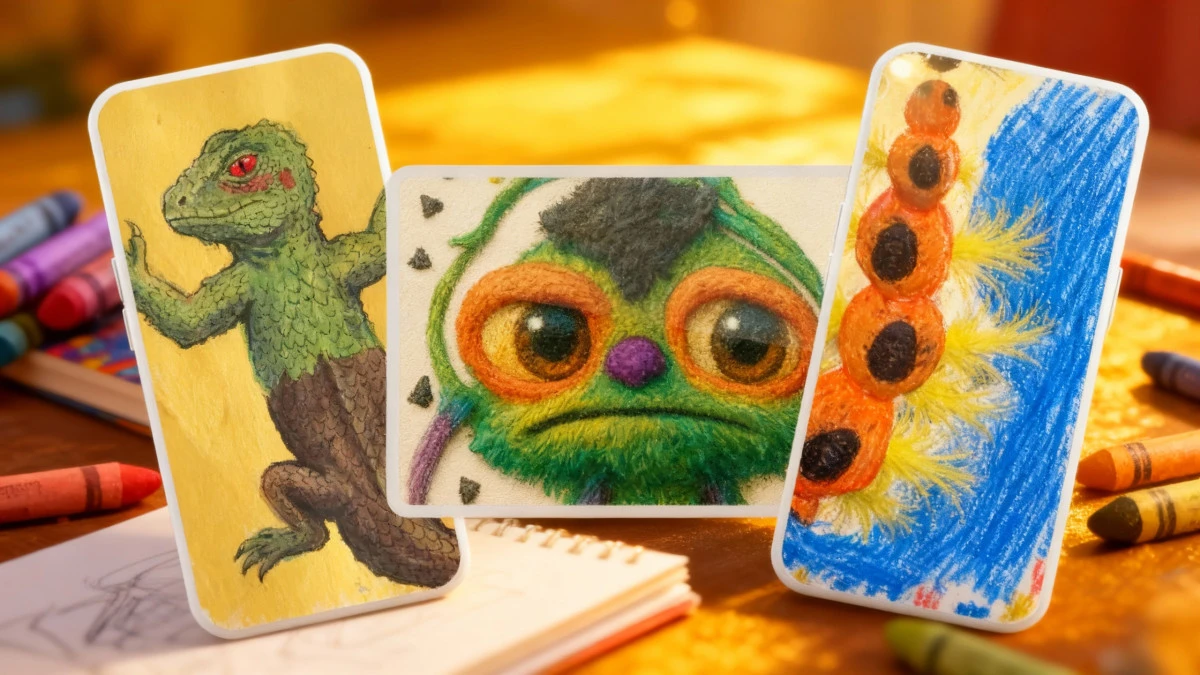
Getting a four-year-old and ChatGPT in the same room sounds like the start of a joke—but in our house, it’s a springboard for creative explosions (and plenty of giggles). If you, too, are wondering how to introduce AI to your child without making it sound like a magic box that just does stuff for you, join the club—and discover how clicking one button can turn your kid’s sketches into magical stories, without ever letting technology steal their creative thunder.
Why AI Needs an Ethical Introduction (Even for Preschoolers)
If you spend your days knee-deep in AI tools for work (guilty as charged), there’s a strong temptation to show your enthusiastic offspring that with one click, AI can make everything better, faster, more sparkly… but let’s be honest: we don’t want to raise children who think creativity is a button on a machine. As a tech journalist, I’m well aware AI is transforming the world—shaping how we live, learn, and create. Yet I also want my daughter to stay creative, spontaneous, and—dare I say it?—messy.
Take Ethan Hawke’s recent quip on CBS Sunday. The theater, he explains, ignites his excitement precisely because it’s a realm untouched by AI. “I could not be less interested in computers and artificial things. I love people. I love how they smell. I love their way of talking and imagining. I like to think of AI as a plagiarism machine, that’s all.” While I’m not about to start sniffing the local actors, I share his sentiment: tech is a tool, not the creator.
From Crayon to ChatGPT: Honoring the Artist
In our home, markers, paint, colored pencils, and copious blank canvases are a daily affair. Some days my daughter delivers whirlwind doodles; other days her details leave me genuinely awestruck.
When I use ChatGPT with her drawings, the goal isn’t to overwrite her style. It’s to animate what’s already there. For example, after she painted a delightfully odd green and purple character with orange eyes, I snapped a photo and uploaded it to ChatGPT. My prompt:
“Bring my daughter’s drawing to life as a more realistic, lively character. Keep the spirit of the original—the colors and shapes—but add texture, depth, and subtle 3D details to make it look alive and tangible, while still clearly hers.”
The end result? Still undeniably her artwork—just with more dimension and realism. She was awestruck when she saw it, and promptly asked to try again. This is where real collaboration kicks in: after I read her my initial prompt and we saw the first result, my daughter got to decide the next tweaks. “Let’s do red eyes, glitter, and a big smile!” So, together, we experimented.
Exploring Beyond ChatGPT: Gemini and Sora Get Artsy
Next, we used Gemini Nano Banana Pro for another creature—an AI tool that’s spot-on at faithfully reproducing characters from a photo, even preserving facial expressions. My prompt changed slightly:
“Bring my daughter’s drawing to life, creating a more realistic version of her character. Keep the color palette and original composition, so her work remains clearly hers, while subtly reinventing it.”
Her original: a red-and-green thing with what resembled arms and legs. Gemini interpreted it as a kind of tree-creature, with trunk, leaves, apples, eyes, and branches as limbs. Cue: bursts of laughter. “No, mommy, it’s supposed to be a lizard!” she quickly corrected. Off we went, tweaking prompts until the lizard emerged, all while having a blast.
Then came Sora, the hands-down favorite. My daughter described her latest masterpiece as “a blue man eating a caterpillar.” We uploaded it, set a very simple command (omitting any mention of children, since Sora has an allergy to minors in prompts), and even tried adding an audio request. The result? Slightly uncanny, but she watched it at least fifty times. Now, using Sora is her go-to request—and she’s getting sharper with her prompts, making her characters speak or dance in new ways.
Drawing the Line: Keeping AI Ethical and Empowering
Critics are absolutely right to raise concerns about AI image and video generators, especially when artists’ work is used without consent. This is why it’s so important to introduce AI ethically, even at a very young age. In our process, the starting point is always my daughter’s own original work. We’re not asking AI to copy anyone else or conjure things from scratch. She’s learning that AI can amplify her creativity, not replace it. In our household, the human remains the artist, and the AI is just a trusted tool.
This isn’t just for kids. Anyone sketching, painting, doodling, or building characters can use this method. Upload your illustrations and ask the AI to respect your art. Emphasize resemblance, color, composition, and style through your instructions, and don’t hesitate to experiment.
If you worry about privacy (and who doesn’t?), Gemini and ChatGPT offer temporary conversation modes. These don’t keep your chat history, aren’t used to improve models, and work a bit like private browsing, though some copies may be stored for up to 30 days.
Bottom line? The tech will only get smarter—but with the right nudges, your child (or your inner child) can stay firmly in the creative driver’s seat. Paint, click, laugh, repeat—just don’t forget to let the glitter fly!