
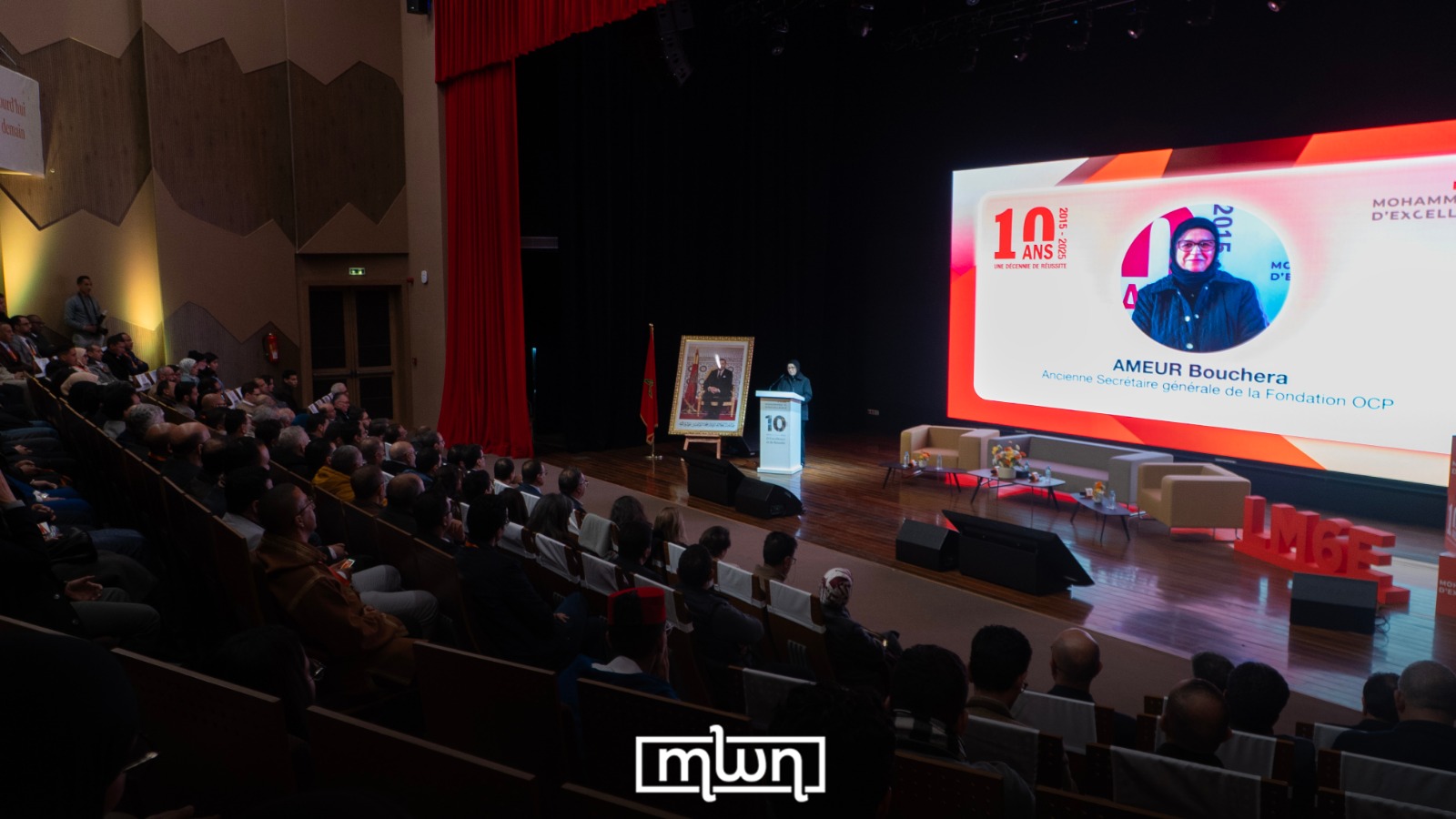
Benguerir – The Lycée Mohammed VI d’Excellence (LM6E) in Benguerir, widely known by its former abbreviation LYDEX, celebrated ten years of educational achievement on January 20.
Located in a small Moroccan city that many would struggle to place on a map, the institution, with support from the OCP Foundation, has nonetheless become a leading source for elite schools, ranking among the top five lycées in France for admissions to the prestigious École Polytechnique.
Since launching preparatory classes (CPGE) in 2015 and qualifying secondary education in 2017, the lycée has fundamentally altered Morocco’s approach to elite academic preparation.
Between 2017 and 2026, the lycée awarded 724 excellence scholarships based on financial need to former students pursuing studies at leading French engineering schools. This financial support targets students from diverse socioeconomic backgrounds, ensuring economic constraints do not limit access to competitive academic pathways.
The progression shows significant peaks starting from 2020, reflecting both expanded student recruitment and consolidated financial support systems.
View this post on Instagram
Enrollment has surged dramatically from the initial 80 students with several teachers in 2015 to 1,600 students currently spanning secondary qualifying and preparatory programs. Over the decade, 4,300 students have passed through the institution.
The institution’s national recruitment system draws students from virtually every province in Morocco. This geographic diversity reflects a deliberate effort to identify talent across all regions while maintaining rigorous academic standards.
Currently, 78% of students are female, indicating a growing interest in scientific fields among young women. Students receive nearly complete financial coverage, with 99.6% receiving support in 2025.
The Lycée now rivals major Parisian schools
Academic outcomes reflect outstanding levels of performance. Each year, approximately half of preparatory class graduates enter France’s most selective engineering schools, including École Polytechnique, CentraleSupélec, Mines de Paris, and Ponts et Chaussées.
The remaining graduates join Morocco’s top engineering institutions, such as EMINES, Centrale Casablanca, EMI, and EHTP. Since 2017, the lycée has sent 110 students to École Polytechnique alone, rivaling major Parisian institutions.
Beyond immediate academic placement, more than 15% of preparatory class alumni have pursued doctoral studies or high-level research careers. This trajectory toward advanced research represents an uncommon outcome among preparatory programs and signals the lycée’s success in developing scientific talent for both Morocco and international markets.
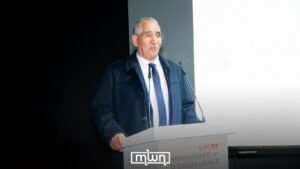 Ahmed Benzy, General Director of LM6E.
Speaking to Morocco World News (MWN), Ahmed Benzy, General Director of LM6E, captured the institution’s impact during the anniversary celebration. “Today, we have 110 students from the lycée who have been admitted to École Polytechnique since 2017, not to mention all the other schools, including Moroccan ones,” Benzy said.
“We are proud of what the students do first and foremost, of what the teachers do, and of what the supervisory staff do, who stand by the students day and night, so that they succeed in their studies.”
View this post on Instagram
The lycée operates under the Association for the Promotion of Excellence in Education (APEE) with substantial support from OCP Group. “OCP Group today invests in human beings who are tomorrow’s real treasure,” Benzy added, reflecting on the institution’s core mission of developing Morocco’s intellectual potential.
Speaking to MWN, Professor Fatima Azzahra Lajaibi detailed the comprehensive support framework. “The institution provides them with a comfortable environment, including housing, as well as opportunities to practice sports – all kinds of sports,” she explained.
View this post on Instagram
“There is also continuous academic follow-up, as well as high-quality teaching, because instruction in preparatory classes is based on methodology rather than content. Once students master the methodology, they are able to succeed anywhere.”
Student recruitment follows two distinct pathways, according to current student Omar Faraj. “There are actually two paths. I got admitted through the first path, which means that my grades at the baccalaureate allowed me to enter the school without any selection test, without any interview, without anything,” he explained to MWN.
“There is also voie de concours, which is the more common access path, which means that if you have a reasonable score at the baccalaureate and with considerations of the region you live in, you will have to take an exam and interview.”
Faraj described his experience as transformative. “The high school is very different from what you can hear about classes prépas in general. Of course, there is a lot of work that comes behind this, but it puts a lot of emphasis on community life, with sports and activities outside of the academic sphere being most notable. So it has been an experience that I don’t think I could have replicated anywhere else.”
4,300 students served over ten years
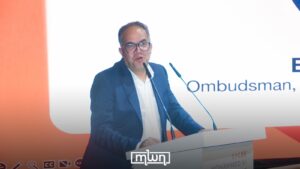 Larbi El Hilali, OCP Group’s ombudsman.
Larbi El Hilali, OCP Group’s ombudsman, provided comprehensive statistics during the panel discussion. The 4,300 students the lycée has served over ten years represent virtually all Moroccan communes, with even the smallest communities having representation.
Remarkably, proportionally, the Draa-Tafilalet region – officially considered Morocco’s poorest – maintains the highest representation among students per capita.
Financial accessibility remains central to the operational model, with 84% of students receiving scholarships covering tuition, accommodation, and meals. “We said we would create a lycée that excludes no one and distinguishes excellent students, whether they are rich or poor,” El Hilali stated. “At the qualifying secondary level, most students come from rural communes. They do not come from big cities.”
The lycée’s performance metrics tell a striking story. El Hilali calculated that last year alone, the institution sent twice as many students to École Polytechnique as all Moroccan preparatory programs combined in the decade before the lycée’s creation.
The UM6P-LM6E credibility and excellence axis
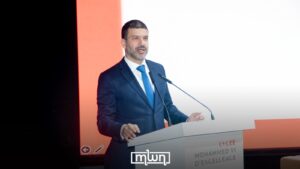 Hicham El Habti, President of Mohammed VI Polytechnic University (UM6P).
Hicham El Habti, President of Mohammed VI Polytechnic University (UM6P), traced the symbiotic institutional relationship. When UM6P launched in 2017-2018 with fewer than 220 students and under 20 faculty members, the lycée’s reputation provided crucial credibility.
“We benefited from the lycée’s reputation. When results came out in July, people thought it was UM6P, when in fact these are two legally separate institutions in the same ecosystem,” El Habti explained.
The partnership has proven mutually beneficial. UM6P has grown to approximately 8,700 students with 400-500 faculty members, while 66 lycée graduates annually enter UM6P programs across various disciplines.
“Today, we are really delighted to see this. What does this mean? There are many elements that come to mind when we look at history. Ten years is half a generation, approximately. So it’s possible. In less than a generation, we can develop international standards with local resources.”
“We have expanded the pipeline. We didn’t just take from France. But it’s a lycée that has a particularity,” he noted, referencing the institution’s ability to generate rather than simply redistribute academic success.
International recognition has followed domestic achievement. El Habti observed that the lycée model now serves as a reference point in French educational policy debates. “Today, as you know, we are the top 5 in France. But in fact, we are even taken as an example to criticize the French national education policy. We didn’t ask for this, but there are people who oppose the policy followed in France in terms of education with our model.”
El Habti drew inspiration from international examples while setting ambitious targets. After visiting Kyoto University, founded in 1897 when Japan was still transitioning from feudalism, he noted their first Nobel Prize came 52 years later.
“They did it in 52 years. Our objective at UM6P is not necessarily to produce a Nobel Prize, though if it comes, so much the better. But it’s to have sovereign technologies based on 20 years, not 50 years. Why 20 years? Because we’re not starting from zero.”
The partnership model relies on innovative public-private collaboration. Teachers come primarily from Morocco’s public education system while maintaining private management and funding structures.
A globally competitive model built with local resources
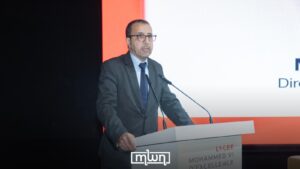 Moulay Youssef El Azhari, Director General of Pedagogical Action at the Ministry of Education.
Moulay Youssef El Azhari, Director General of Pedagogical Action at the Ministry of Education, traced the program’s origins to 2014 discussions about addressing teacher shortages in preparatory education.
“In 2013-2014, we no longer had preparation for the agrégation. Agrégation preparation had been stopped for 4 or 5 years, and we were going to start closing public preparatory classes due to lack of teachers,” El Azhari explained.
The partnership solution, launched in 2013 through a strategic agreement between OCP Group and El Azhari’s department, addressed multiple challenges simultaneously. This included renovating preparation centers in Casablanca and creating in Marrakech what he called “the largest agrégation preparation center in the world” by the number of disciplines and beneficiaries.
Five successive education ministers have supported the initiative, demonstrating institutional continuity across political transitions. “We had the chance to have ministers who understood the scope and horizons that such a partnership can open,” El Azhari noted, crediting this stability with enabling long-term planning and implementation.
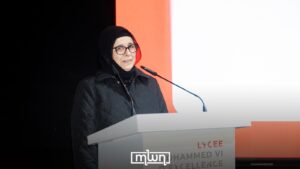 Bouchera Ameur, former OCP Foundation Secretary General and first LM6E board president.
Bouchera Ameur, former OCP Foundation Secretary General and first LM6E board president, reflected on the foundational period. “We had hope, really hope, a lot of hope, and we really wanted to see the lycée already functioning and shining, that is to say allowing students to find their path and excel,” she recalled. Current results “far exceed what we were dreaming of at the time,” validating the initial vision and investment.
The expansion strategy reflects growing confidence in the model’s applicability. Originally established solely in Benguerir, the program has extended to Rabat and Laayoune, with plans for broader regional deployment.
El Azhari outlined concepts for “regional lycées” inspired by the LM6E model, potentially covering multiple regions and offering excellence opportunities to students nationwide.
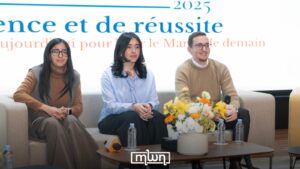 During the ceremony on January 20, alumni Chgoura Khadija, Wahb Majda, and Bahhad Mohammed shared testimonies about their post-graduation trajectories.
During the ceremony on January 20, alumni Chgoura Khadija, Wahb Majda, and Bahhad Mohammed shared testimonies about their post-graduation trajectories, illustrating the long-term impact of their lycée preparation on academic and professional success.
The ten-year milestone marks more than an institutional success. It is the ultimate evidence of Morocco’s capacity to design and sustain competitive educational models that reconcile academic rigor with social mobility, geographic inclusivity, and gender equity.
In doing so, the lycée has demonstrated that excellence and accessibility are not mutually exclusive. Instead, it offers a replicable framework for educational innovation that responds to local development imperatives while remaining legible and competitive within global academic standards.